

1 Introduction to Laser Micro-to-Nano Manufacturing
31
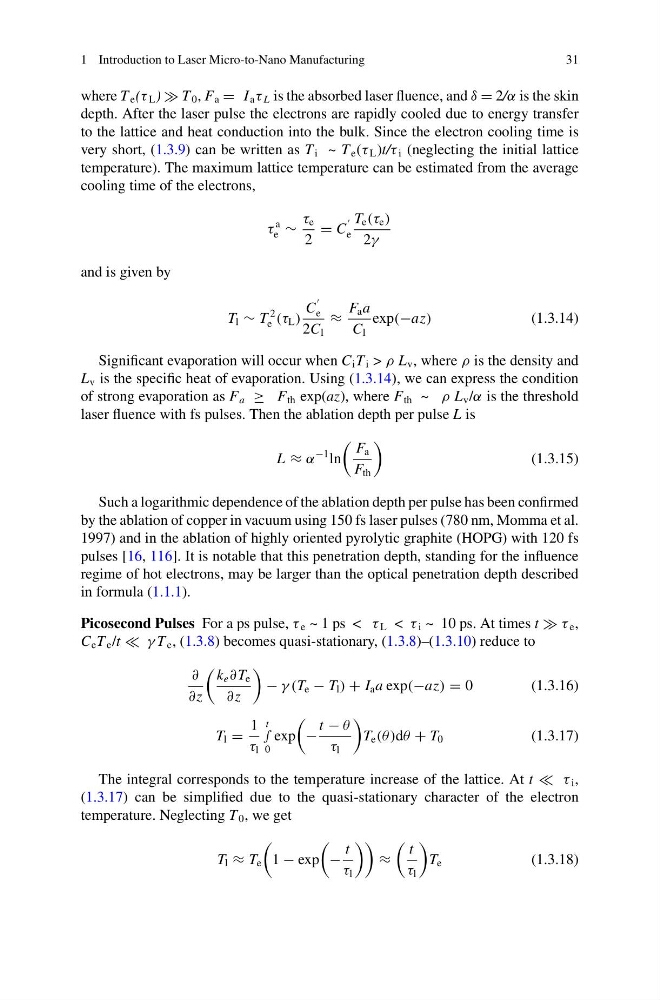
where T e (τ L ) T 0 , F a = I a τ L is the absorbed laser fluence, and δ = 2/α is the skin
depth. After the laser pulse the electrons are rapidly cooled due to energy transfer
to the lattice and heat conduction into the bulk. Since the electron cooling time is
very short, (1.3.9) can be written as T i ~ T e (τ L )t/τ i (neglecting the initial lattice
temperature). The maximum lattice temperature can be estimated from the average
cooling time of the electrons,
τ
a
e ∼
τ e
2
= C
e
T e (τ e )
2γ
and is given by
T l ∼ T
2
e (τ L )
C
e
2C l
≈
F a a
C l
exp(−az)
(1.3.14)
Significant evaporation will occur when C i T i > ρ L v , where ρ is the density and
L v is the specific heat of evaporation. Using (1.3.14), we can express the condition
of strong evaporation as F a ≥ F th exp(az), where F th ~ ρ L v /α is the threshold
laser fluence with fs pulses. Then the ablation depth per pulse L is
L ≈ α
−1 ln
F a
F th
(1.3.15)
Such a logarithmic dependence of the ablation depth per pulse has been confirmed
by the ablation of copper in vacuum using 150 fs laser pulses (780 nm, Momma et al.
1997) and in the ablation of highly oriented pyrolytic graphite (HOPG) with 120 fs
pulses [16, 116]. It is notable that this penetration depth, standing for the influence
regime of hot electrons, may be larger than the optical penetration depth described
in formula (1.1.1).
Picosecond Pulses For a ps pulse, τ e ~ 1 ps < τ L < τ i ~ 10 ps. At times t τ e ,
C e T e /t γ T e , (1.3.8) becomes quasi-stationary, (1.3.8)–(1.3.10) reduce to
∂
∂z
k e ∂ T e
∂z
− γ (T e − T l ) + I a a exp(−az) = 0
(1.3.16)
T l =
1
τ l
t
∫
0
exp
−
t − θ
τ l
T e (θ )dθ + T 0
(1.3.17)
The integral corresponds to the temperature increase of the lattice. At t τ i ,
(1.3.17) can be simplified due to the quasi-stationary character of the electron
temperature. Neglecting T 0 , we get
T l ≈ T e
1 − exp
−
t
τ l
≈
t
τ l
T e
(1.3.18)
31
where T e (τ L ) T 0 , F a = I a τ L is the absorbed laser fluence, and δ = 2/α is the skin
depth. After the laser pulse the electrons are rapidly cooled due to energy transfer
to the lattice and heat conduction into the bulk. Since the electron cooling time is
very short, (1.3.9) can be written as T i ~ T e (τ L )t/τ i (neglecting the initial lattice
temperature). The maximum lattice temperature can be estimated from the average
cooling time of the electrons,
τ
a
e ∼
τ e
2
= C
e
T e (τ e )
2γ
and is given by
T l ∼ T
2
e (τ L )
C
e
2C l
≈
F a a
C l
exp(−az)
(1.3.14)
Significant evaporation will occur when C i T i > ρ L v , where ρ is the density and
L v is the specific heat of evaporation. Using (1.3.14), we can express the condition
of strong evaporation as F a ≥ F th exp(az), where F th ~ ρ L v /α is the threshold
laser fluence with fs pulses. Then the ablation depth per pulse L is
L ≈ α
−1 ln
F a
F th
(1.3.15)
Such a logarithmic dependence of the ablation depth per pulse has been confirmed
by the ablation of copper in vacuum using 150 fs laser pulses (780 nm, Momma et al.
1997) and in the ablation of highly oriented pyrolytic graphite (HOPG) with 120 fs
pulses [16, 116]. It is notable that this penetration depth, standing for the influence
regime of hot electrons, may be larger than the optical penetration depth described
in formula (1.1.1).
Picosecond Pulses For a ps pulse, τ e ~ 1 ps < τ L < τ i ~ 10 ps. At times t τ e ,
C e T e /t γ T e , (1.3.8) becomes quasi-stationary, (1.3.8)–(1.3.10) reduce to
∂
∂z
k e ∂ T e
∂z
− γ (T e − T l ) + I a a exp(−az) = 0
(1.3.16)
T l =
1
τ l
t
∫
0
exp
−
t − θ
τ l
T e (θ )dθ + T 0
(1.3.17)
The integral corresponds to the temperature increase of the lattice. At t τ i ,
(1.3.17) can be simplified due to the quasi-stationary character of the electron
temperature. Neglecting T 0 , we get
T l ≈ T e
1 − exp
−
t
τ l
≈
t
τ l
T e
(1.3.18)