

1 Introduction to Laser Micro-to-Nano Manufacturing
23
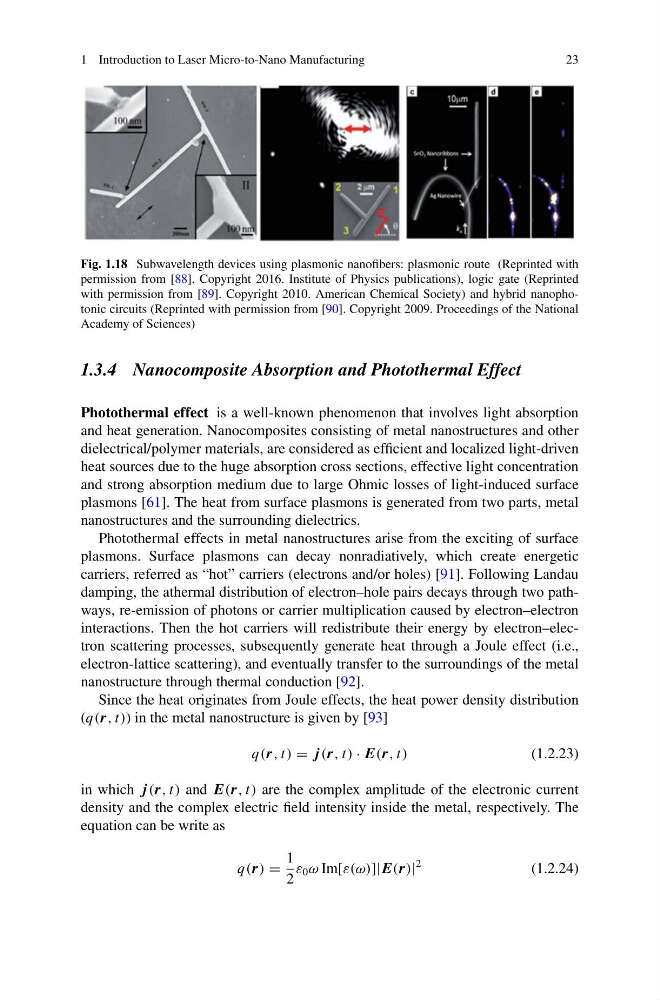
Fig. 1.18 Subwavelength devices using plasmonic nanofibers: plasmonic route (Reprinted with
permission from [88]. Copyright 2016. Institute of Physics publications), logic gate (Reprinted
with permission from [89]. Copyright 2010. American Chemical Society) and hybrid nanophotonic circuits (Reprinted with permission from [90]. Copyright 2009. Proceedings of the National
Academy of Sciences)
1.3.4 Nanocomposite Absorption and Photothermal Effect
Photothermal effect is a well-known phenomenon that involves light absorption
and heat generation. Nanocomposites consisting of metal nanostructures and other
dielectrical/polymer materials, are considered as efficient and localized light-driven
heat sources due to the huge absorption cross sections, effective light concentration
and strong absorption medium due to large Ohmic losses of light-induced surface
plasmons [61]. The heat from surface plasmons is generated from two parts, metal
nanostructures and the surrounding dielectrics.
Photothermal effects in metal nanostructures arise from the exciting of surface
plasmons. Surface plasmons can decay nonradiatively, which create energetic
carriers, referred as “hot” carriers (electrons and/or holes) [91]. Following Landau
damping, the athermal distribution of electron–hole pairs decays through two pathways, re-emission of photons or carrier multiplication caused by electron–electron
interactions. Then the hot carriers will redistribute their energy by electron–electron scattering processes, subsequently generate heat through a Joule effect (i.e.,
electron-lattice scattering), and eventually transfer to the surroundings of the metal
nanostructure through thermal conduction [92].
Since the heat originates from Joule effects, the heat power density distribution
(q(r, t)) in the metal nanostructure is given by [93]
q(r, t) = j (r, t) · E(r, t)
(1.2.23)
in which j (r, t) and E(r, t) are the complex amplitude of the electronic current
density and the complex electric field intensity inside the metal, respectively. The
equation can be write as
q(r) =
1
2
ε 0 ω Im[ε(ω)]|E(r)|
2
(1.2.24)
23
Fig. 1.18 Subwavelength devices using plasmonic nanofibers: plasmonic route (Reprinted with
permission from [88]. Copyright 2016. Institute of Physics publications), logic gate (Reprinted
with permission from [89]. Copyright 2010. American Chemical Society) and hybrid nanophotonic circuits (Reprinted with permission from [90]. Copyright 2009. Proceedings of the National
Academy of Sciences)
1.3.4 Nanocomposite Absorption and Photothermal Effect
Photothermal effect is a well-known phenomenon that involves light absorption
and heat generation. Nanocomposites consisting of metal nanostructures and other
dielectrical/polymer materials, are considered as efficient and localized light-driven
heat sources due to the huge absorption cross sections, effective light concentration
and strong absorption medium due to large Ohmic losses of light-induced surface
plasmons [61]. The heat from surface plasmons is generated from two parts, metal
nanostructures and the surrounding dielectrics.
Photothermal effects in metal nanostructures arise from the exciting of surface
plasmons. Surface plasmons can decay nonradiatively, which create energetic
carriers, referred as “hot” carriers (electrons and/or holes) [91]. Following Landau
damping, the athermal distribution of electron–hole pairs decays through two pathways, re-emission of photons or carrier multiplication caused by electron–electron
interactions. Then the hot carriers will redistribute their energy by electron–electron scattering processes, subsequently generate heat through a Joule effect (i.e.,
electron-lattice scattering), and eventually transfer to the surroundings of the metal
nanostructure through thermal conduction [92].
Since the heat originates from Joule effects, the heat power density distribution
(q(r, t)) in the metal nanostructure is given by [93]
q(r, t) = j (r, t) · E(r, t)
(1.2.23)
in which j (r, t) and E(r, t) are the complex amplitude of the electronic current
density and the complex electric field intensity inside the metal, respectively. The
equation can be write as
q(r) =
1
2
ε 0 ω Im[ε(ω)]|E(r)|
2
(1.2.24)