

332
W. Pfleging et al.
coating the laser structured LCO thin films were laser annealed to synthesize the hightemperature phase (HT-LCO). The passivated electrode (C 60 @3D-HT-LCO) could
finally counteract the above-mentioned problems for a widened voltage window of
about 3.0–4.5 V. The dissolution of Co could be prevented while maintaining the
interface kinetics which led to improved electrochemical performance of the special
designed cathode material.
11.4.1 Experimental Approach
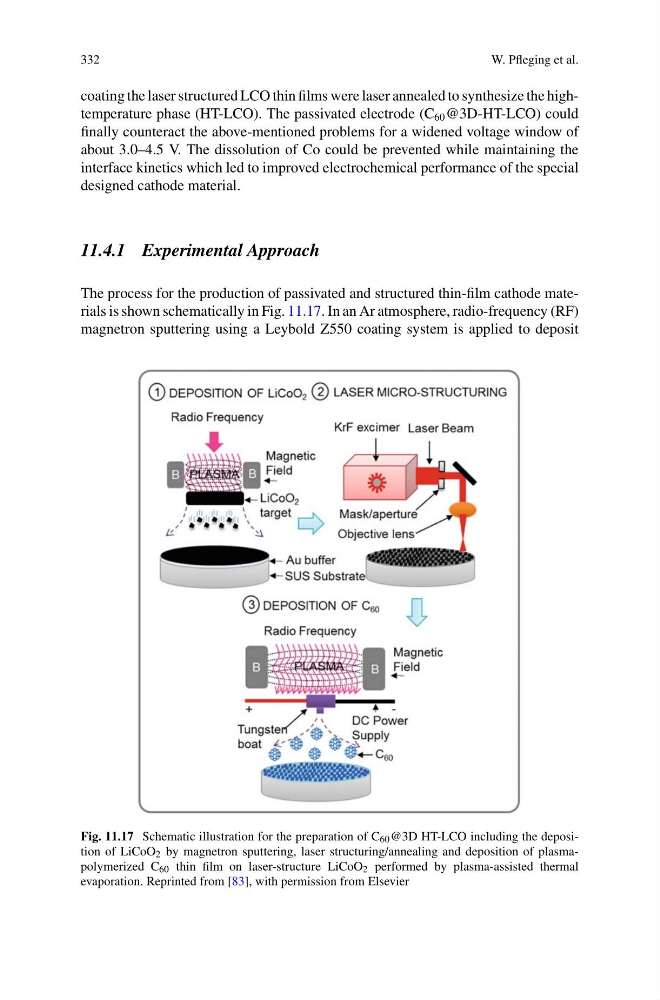
The process for the production of passivated and structured thin-film cathode materials is shown schematically in Fig. 11.17. In an Ar atmosphere, radio-frequency (RF)
magnetron sputtering using a Leybold Z550 coating system is applied to deposit
Fig. 11.17 Schematic illustration for the preparation of C 60 @3D HT-LCO including the deposition of LiCoO 2 by magnetron sputtering, laser structuring/annealing and deposition of plasmapolymerized C 60 thin film on laser-structure LiCoO 2 performed by plasma-assisted thermal
evaporation. Reprinted from [83], with permission from Elsevier
W. Pfleging et al.
coating the laser structured LCO thin films were laser annealed to synthesize the hightemperature phase (HT-LCO). The passivated electrode (C 60 @3D-HT-LCO) could
finally counteract the above-mentioned problems for a widened voltage window of
about 3.0–4.5 V. The dissolution of Co could be prevented while maintaining the
interface kinetics which led to improved electrochemical performance of the special
designed cathode material.
11.4.1 Experimental Approach
The process for the production of passivated and structured thin-film cathode materials is shown schematically in Fig. 11.17. In an Ar atmosphere, radio-frequency (RF)
magnetron sputtering using a Leybold Z550 coating system is applied to deposit
Fig. 11.17 Schematic illustration for the preparation of C 60 @3D HT-LCO including the deposition of LiCoO 2 by magnetron sputtering, laser structuring/annealing and deposition of plasmapolymerized C 60 thin film on laser-structure LiCoO 2 performed by plasma-assisted thermal
evaporation. Reprinted from [83], with permission from Elsevier