

14
A. Hu et al.
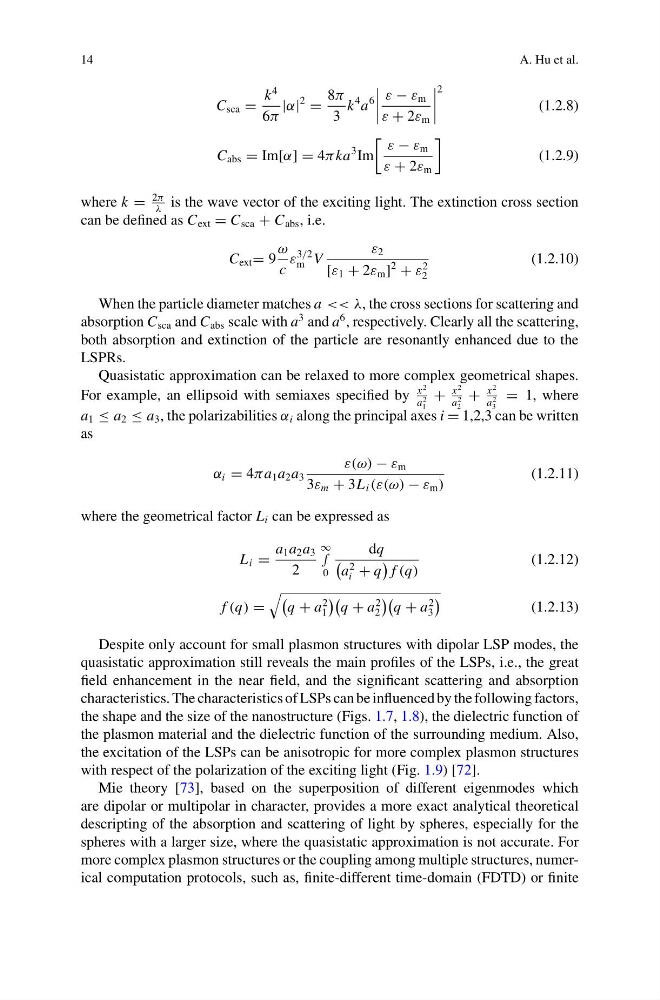
C sca =
k
4
6π
|α|
2
=
8π
3
k
4 a
6
ε − ε m
ε + 2ε m
2
(1.2.8)
C abs = Im[α] = 4π ka
3 Im
ε − ε m
ε + 2ε m
(1.2.9)
where k =
2π
λ
is the wave vector of the exciting light. The extinction cross section
can be defined as C ext = C sca + C abs , i.e.
C ext = 9
ω
c
ε
3/2
m V
ε 2
[ε 1 + 2ε m ]
2
+ ε
2
2
(1.2.10)
When the particle diameter matches a << λ, the cross sections for scattering and
absorption C sca and C abs scale with a
3 and a
6 , respectively. Clearly all the scattering,
both absorption and extinction of the particle are resonantly enhanced due to the
LSPRs.
Quasistatic approximation can be relaxed to more complex geometrical shapes.
For example, an ellipsoid with semiaxes specified by
x
2
a
2
1
+
x
2
a
2
2
+
x
2
a
2
3
= 1, where
a 1 ≤ a 2 ≤ a 3 , the polarizabilities α i along the principal axes i = 1,2,3 can be written
as
α i = 4πa 1 a 2 a 3
ε(ω) − ε m
3ε m + 3L i (ε(ω) − ε m )
(1.2.11)
where the geometrical factor L i can be expressed as
L i =
a 1 a 2 a 3
2
∞
∫
0
dq
a
2
i + q
f (q)
(1.2.12)
f (q) =
q + a
2
1
q + a
2
2
q + a
2
3
(1.2.13)
Despite only account for small plasmon structures with dipolar LSP modes, the
quasistatic approximation still reveals the main profiles of the LSPs, i.e., the great
field enhancement in the near field, and the significant scattering and absorption
characteristics. The characteristics of LSPs can be influenced by the following factors,
the shape and the size of the nanostructure (Figs. 1.7, 1.8), the dielectric function of
the plasmon material and the dielectric function of the surrounding medium. Also,
the excitation of the LSPs can be anisotropic for more complex plasmon structures
with respect of the polarization of the exciting light (Fig. 1.9) [72].
Mie theory [73], based on the superposition of different eigenmodes which
are dipolar or multipolar in character, provides a more exact analytical theoretical
descripting of the absorption and scattering of light by spheres, especially for the
spheres with a larger size, where the quasistatic approximation is not accurate. For
more complex plasmon structures or the coupling among multiple structures, numerical computation protocols, such as, finite-different time-domain (FDTD) or finite
A. Hu et al.
C sca =
k
4
6π
|α|
2
=
8π
3
k
4 a
6
ε − ε m
ε + 2ε m
2
(1.2.8)
C abs = Im[α] = 4π ka
3 Im
ε − ε m
ε + 2ε m
(1.2.9)
where k =
2π
λ
is the wave vector of the exciting light. The extinction cross section
can be defined as C ext = C sca + C abs , i.e.
C ext = 9
ω
c
ε
3/2
m V
ε 2
[ε 1 + 2ε m ]
2
+ ε
2
2
(1.2.10)
When the particle diameter matches a << λ, the cross sections for scattering and
absorption C sca and C abs scale with a
3 and a
6 , respectively. Clearly all the scattering,
both absorption and extinction of the particle are resonantly enhanced due to the
LSPRs.
Quasistatic approximation can be relaxed to more complex geometrical shapes.
For example, an ellipsoid with semiaxes specified by
x
2
a
2
1
+
x
2
a
2
2
+
x
2
a
2
3
= 1, where
a 1 ≤ a 2 ≤ a 3 , the polarizabilities α i along the principal axes i = 1,2,3 can be written
as
α i = 4πa 1 a 2 a 3
ε(ω) − ε m
3ε m + 3L i (ε(ω) − ε m )
(1.2.11)
where the geometrical factor L i can be expressed as
L i =
a 1 a 2 a 3
2
∞
∫
0
dq
a
2
i + q
f (q)
(1.2.12)
f (q) =
q + a
2
1
q + a
2
2
q + a
2
3
(1.2.13)
Despite only account for small plasmon structures with dipolar LSP modes, the
quasistatic approximation still reveals the main profiles of the LSPs, i.e., the great
field enhancement in the near field, and the significant scattering and absorption
characteristics. The characteristics of LSPs can be influenced by the following factors,
the shape and the size of the nanostructure (Figs. 1.7, 1.8), the dielectric function of
the plasmon material and the dielectric function of the surrounding medium. Also,
the excitation of the LSPs can be anisotropic for more complex plasmon structures
with respect of the polarization of the exciting light (Fig. 1.9) [72].
Mie theory [73], based on the superposition of different eigenmodes which
are dipolar or multipolar in character, provides a more exact analytical theoretical
descripting of the absorption and scattering of light by spheres, especially for the
spheres with a larger size, where the quasistatic approximation is not accurate. For
more complex plasmon structures or the coupling among multiple structures, numerical computation protocols, such as, finite-different time-domain (FDTD) or finite