

9 Laser-Induced Forward Transfer Towards Additive Manufacturing
297
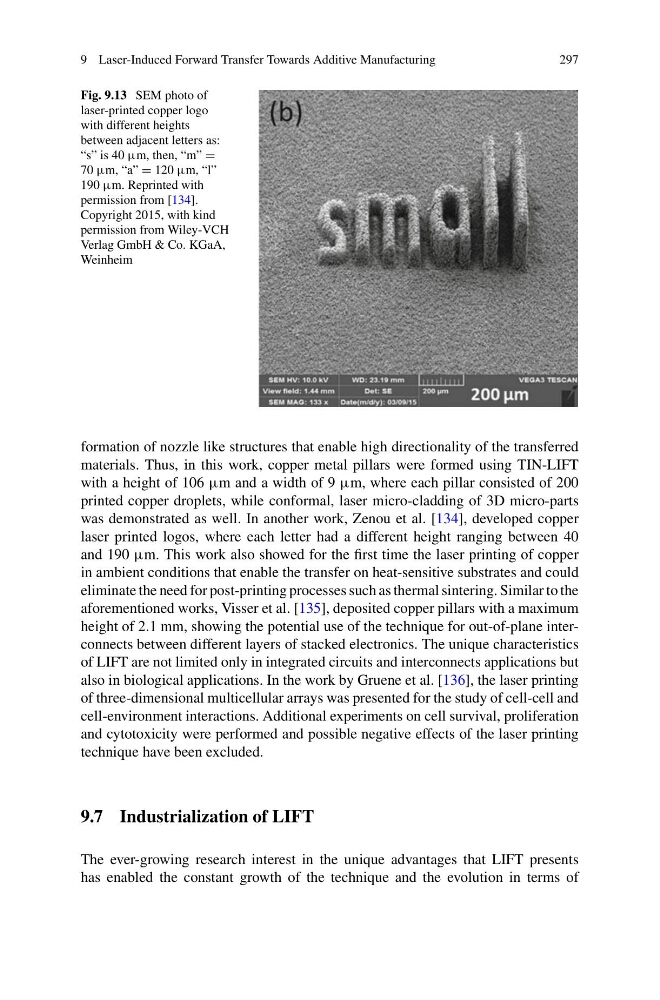
Fig. 9.13 SEM photo of
laser-printed copper logo
with different heights
between adjacent letters as:
“s” is 40 µm, then, “m” =
70 µm, “a” = 120 µm, “l”
190 µm. Reprinted with
permission from [134].
Copyright 2015, with kind
permission from Wiley-VCH
Verlag GmbH & Co. KGaA,
Weinheim
formation of nozzle like structures that enable high directionality of the transferred
materials. Thus, in this work, copper metal pillars were formed using TIN-LIFT
with a height of 106 µm and a width of 9 µm, where each pillar consisted of 200
printed copper droplets, while conformal, laser micro-cladding of 3D micro-parts
was demonstrated as well. In another work, Zenou et al. [134], developed copper
laser printed logos, where each letter had a different height ranging between 40
and 190 µm. This work also showed for the first time the laser printing of copper
in ambient conditions that enable the transfer on heat-sensitive substrates and could
eliminate the need for post-printing processes such as thermal sintering. Similar to the
aforementioned works, Visser et al. [135], deposited copper pillars with a maximum
height of 2.1 mm, showing the potential use of the technique for out-of-plane interconnects between different layers of stacked electronics. The unique characteristics
of LIFT are not limited only in integrated circuits and interconnects applications but
also in biological applications. In the work by Gruene et al. [136], the laser printing
of three-dimensional multicellular arrays was presented for the study of cell-cell and
cell-environment interactions. Additional experiments on cell survival, proliferation
and cytotoxicity were performed and possible negative effects of the laser printing
technique have been excluded.
9.7 Industrialization of LIFT
The ever-growing research interest in the unique advantages that LIFT presents
has enabled the constant growth of the technique and the evolution in terms of
297
Fig. 9.13 SEM photo of
laser-printed copper logo
with different heights
between adjacent letters as:
“s” is 40 µm, then, “m” =
70 µm, “a” = 120 µm, “l”
190 µm. Reprinted with
permission from [134].
Copyright 2015, with kind
permission from Wiley-VCH
Verlag GmbH & Co. KGaA,
Weinheim
formation of nozzle like structures that enable high directionality of the transferred
materials. Thus, in this work, copper metal pillars were formed using TIN-LIFT
with a height of 106 µm and a width of 9 µm, where each pillar consisted of 200
printed copper droplets, while conformal, laser micro-cladding of 3D micro-parts
was demonstrated as well. In another work, Zenou et al. [134], developed copper
laser printed logos, where each letter had a different height ranging between 40
and 190 µm. This work also showed for the first time the laser printing of copper
in ambient conditions that enable the transfer on heat-sensitive substrates and could
eliminate the need for post-printing processes such as thermal sintering. Similar to the
aforementioned works, Visser et al. [135], deposited copper pillars with a maximum
height of 2.1 mm, showing the potential use of the technique for out-of-plane interconnects between different layers of stacked electronics. The unique characteristics
of LIFT are not limited only in integrated circuits and interconnects applications but
also in biological applications. In the work by Gruene et al. [136], the laser printing
of three-dimensional multicellular arrays was presented for the study of cell-cell and
cell-environment interactions. Additional experiments on cell survival, proliferation
and cytotoxicity were performed and possible negative effects of the laser printing
technique have been excluded.
9.7 Industrialization of LIFT
The ever-growing research interest in the unique advantages that LIFT presents
has enabled the constant growth of the technique and the evolution in terms of