

9 Laser-Induced Forward Transfer Towards Additive Manufacturing
289
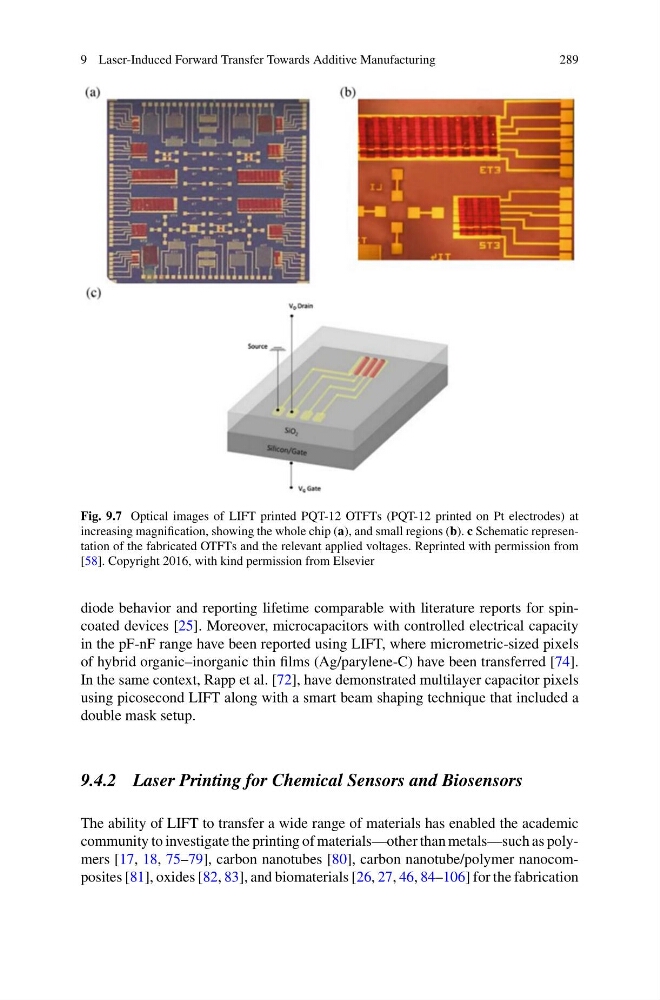
Fig. 9.7 Optical images of LIFT printed PQT-12 OTFTs (PQT-12 printed on Pt electrodes) at
increasing magnification, showing the whole chip (a), and small regions (b). c Schematic representation of the fabricated OTFTs and the relevant applied voltages. Reprinted with permission from
[58]. Copyright 2016, with kind permission from Elsevier
diode behavior and reporting lifetime comparable with literature reports for spincoated devices [25]. Moreover, microcapacitors with controlled electrical capacity
in the pF-nF range have been reported using LIFT, where micrometric-sized pixels
of hybrid organic–inorganic thin films (Ag/parylene-C) have been transferred [74].
In the same context, Rapp et al. [72], have demonstrated multilayer capacitor pixels
using picosecond LIFT along with a smart beam shaping technique that included a
double mask setup.
9.4.2 Laser Printing for Chemical Sensors and Biosensors
The ability of LIFT to transfer a wide range of materials has enabled the academic
community to investigate the printing of materials—other than metals—such as polymers [17, 18, 75–79], carbon nanotubes [80], carbon nanotube/polymer nanocomposites [81], oxides [82, 83], and biomaterials [26, 27, 46, 84–106] for the fabrication
289
Fig. 9.7 Optical images of LIFT printed PQT-12 OTFTs (PQT-12 printed on Pt electrodes) at
increasing magnification, showing the whole chip (a), and small regions (b). c Schematic representation of the fabricated OTFTs and the relevant applied voltages. Reprinted with permission from
[58]. Copyright 2016, with kind permission from Elsevier
diode behavior and reporting lifetime comparable with literature reports for spincoated devices [25]. Moreover, microcapacitors with controlled electrical capacity
in the pF-nF range have been reported using LIFT, where micrometric-sized pixels
of hybrid organic–inorganic thin films (Ag/parylene-C) have been transferred [74].
In the same context, Rapp et al. [72], have demonstrated multilayer capacitor pixels
using picosecond LIFT along with a smart beam shaping technique that included a
double mask setup.
9.4.2 Laser Printing for Chemical Sensors and Biosensors
The ability of LIFT to transfer a wide range of materials has enabled the academic
community to investigate the printing of materials—other than metals—such as polymers [17, 18, 75–79], carbon nanotubes [80], carbon nanotube/polymer nanocomposites [81], oxides [82, 83], and biomaterials [26, 27, 46, 84–106] for the fabrication