

8 Femtosecond Laser Direct Writing for 3D Microfluidic Biochip …
255
certain microoptical components, including optical microlenses and micromirrors in
the same microfluidic glass microchip.
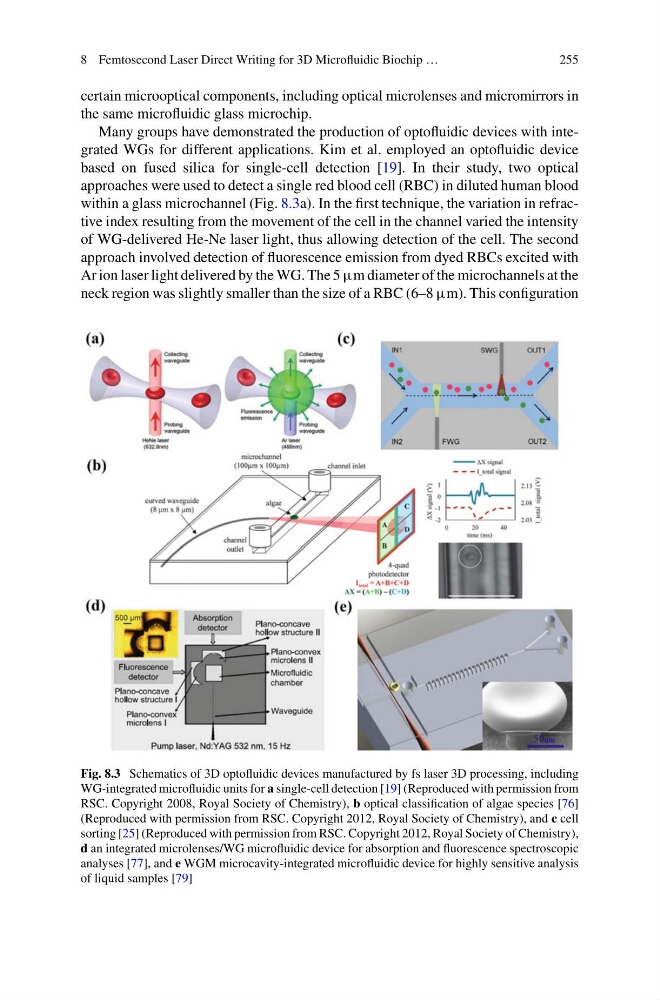
Many groups have demonstrated the production of optofluidic devices with integrated WGs for different applications. Kim et al. employed an optofluidic device
based on fused silica for single-cell detection [19]. In their study, two optical
approaches were used to detect a single red blood cell (RBC) in diluted human blood
within a glass microchannel (Fig. 8.3a). In the first technique, the variation in refractive index resulting from the movement of the cell in the channel varied the intensity
of WG-delivered He-Ne laser light, thus allowing detection of the cell. The second
approach involved detection of fluorescence emission from dyed RBCs excited with
Ar ion laser light delivered by the WG. The 5 µm diameter of the microchannels at the
neck region was slightly smaller than the size of a RBC (6–8 µm). This configuration
Fig. 8.3 Schematics of 3D optofluidic devices manufactured by fs laser 3D processing, including
WG-integrated microfluidic units for a single-cell detection [19] (Reproduced with permission from
RSC. Copyright 2008, Royal Society of Chemistry), b optical classification of algae species [76]
(Reproduced with permission from RSC. Copyright 2012, Royal Society of Chemistry), and c cell
sorting [25] (Reproduced with permission from RSC. Copyright 2012, Royal Society of Chemistry),
d an integrated microlenses/WG microfluidic device for absorption and fluorescence spectroscopic
analyses [77], and e WGM microcavity-integrated microfluidic device for highly sensitive analysis
of liquid samples [79]
255
certain microoptical components, including optical microlenses and micromirrors in
the same microfluidic glass microchip.
Many groups have demonstrated the production of optofluidic devices with integrated WGs for different applications. Kim et al. employed an optofluidic device
based on fused silica for single-cell detection [19]. In their study, two optical
approaches were used to detect a single red blood cell (RBC) in diluted human blood
within a glass microchannel (Fig. 8.3a). In the first technique, the variation in refractive index resulting from the movement of the cell in the channel varied the intensity
of WG-delivered He-Ne laser light, thus allowing detection of the cell. The second
approach involved detection of fluorescence emission from dyed RBCs excited with
Ar ion laser light delivered by the WG. The 5 µm diameter of the microchannels at the
neck region was slightly smaller than the size of a RBC (6–8 µm). This configuration
Fig. 8.3 Schematics of 3D optofluidic devices manufactured by fs laser 3D processing, including
WG-integrated microfluidic units for a single-cell detection [19] (Reproduced with permission from
RSC. Copyright 2008, Royal Society of Chemistry), b optical classification of algae species [76]
(Reproduced with permission from RSC. Copyright 2012, Royal Society of Chemistry), and c cell
sorting [25] (Reproduced with permission from RSC. Copyright 2012, Royal Society of Chemistry),
d an integrated microlenses/WG microfluidic device for absorption and fluorescence spectroscopic
analyses [77], and e WGM microcavity-integrated microfluidic device for highly sensitive analysis
of liquid samples [79]