

8
A. Hu et al.
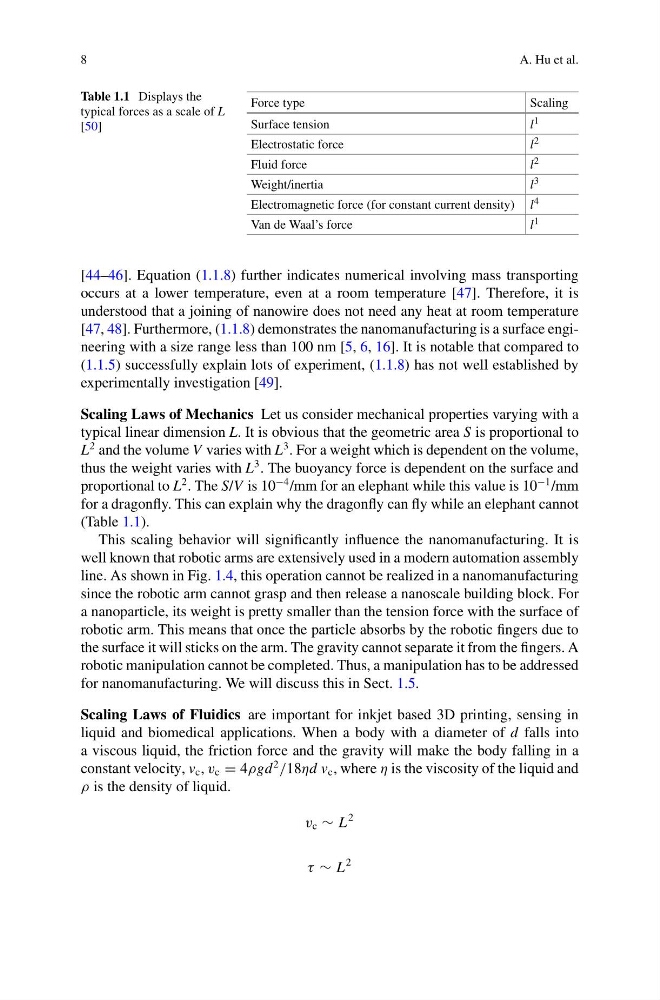
Table 1.1 Displays the
typical forces as a scale of L
[50]
Force type
Scaling
Surface tension
l 1
Electrostatic force
l 2
Fluid force
l 2
Weight/inertia
l 3
Electromagnetic force (for constant current density) l 4
Van de Waal’s force
l 1
[44–46]. Equation (1.1.8) further indicates numerical involving mass transporting
occurs at a lower temperature, even at a room temperature [47]. Therefore, it is
understood that a joining of nanowire does not need any heat at room temperature
[47, 48]. Furthermore, (1.1.8) demonstrates the nanomanufacturing is a surface engineering with a size range less than 100 nm [5, 6, 16]. It is notable that compared to
(1.1.5) successfully explain lots of experiment, (1.1.8) has not well established by
experimentally investigation [49].
Scaling Laws of Mechanics Let us consider mechanical properties varying with a
typical linear dimension L. It is obvious that the geometric area S is proportional to
L
2 and the volume V varies with L
3 . For a weight which is dependent on the volume,
thus the weight varies with L
3 . The buoyancy force is dependent on the surface and
proportional to L
2 . The S/V is 10
−4 /mm for an elephant while this value is 10
−1 /mm
for a dragonfly. This can explain why the dragonfly can fly while an elephant cannot
(Table 1.1).
This scaling behavior will significantly influence the nanomanufacturing. It is
well known that robotic arms are extensively used in a modern automation assembly
line. As shown in Fig. 1.4, this operation cannot be realized in a nanomanufacturing
since the robotic arm cannot grasp and then release a nanoscale building block. For
a nanoparticle, its weight is pretty smaller than the tension force with the surface of
robotic arm. This means that once the particle absorbs by the robotic fingers due to
the surface it will sticks on the arm. The gravity cannot separate it from the fingers. A
robotic manipulation cannot be completed. Thus, a manipulation has to be addressed
for nanomanufacturing. We will discuss this in Sect. 1.5.
Scaling Laws of Fluidics are important for inkjet based 3D printing, sensing in
liquid and biomedical applications. When a body with a diameter of d falls into
a viscous liquid, the friction force and the gravity will make the body falling in a
constant velocity, v c , v c = 4ρgd
2
/18ηd v c , where η is the viscosity of the liquid and
ρ is the density of liquid.
v c ∼ L
2
τ ∼ L
2
A. Hu et al.
Table 1.1 Displays the
typical forces as a scale of L
[50]
Force type
Scaling
Surface tension
l 1
Electrostatic force
l 2
Fluid force
l 2
Weight/inertia
l 3
Electromagnetic force (for constant current density) l 4
Van de Waal’s force
l 1
[44–46]. Equation (1.1.8) further indicates numerical involving mass transporting
occurs at a lower temperature, even at a room temperature [47]. Therefore, it is
understood that a joining of nanowire does not need any heat at room temperature
[47, 48]. Furthermore, (1.1.8) demonstrates the nanomanufacturing is a surface engineering with a size range less than 100 nm [5, 6, 16]. It is notable that compared to
(1.1.5) successfully explain lots of experiment, (1.1.8) has not well established by
experimentally investigation [49].
Scaling Laws of Mechanics Let us consider mechanical properties varying with a
typical linear dimension L. It is obvious that the geometric area S is proportional to
L
2 and the volume V varies with L
3 . For a weight which is dependent on the volume,
thus the weight varies with L
3 . The buoyancy force is dependent on the surface and
proportional to L
2 . The S/V is 10
−4 /mm for an elephant while this value is 10
−1 /mm
for a dragonfly. This can explain why the dragonfly can fly while an elephant cannot
(Table 1.1).
This scaling behavior will significantly influence the nanomanufacturing. It is
well known that robotic arms are extensively used in a modern automation assembly
line. As shown in Fig. 1.4, this operation cannot be realized in a nanomanufacturing
since the robotic arm cannot grasp and then release a nanoscale building block. For
a nanoparticle, its weight is pretty smaller than the tension force with the surface of
robotic arm. This means that once the particle absorbs by the robotic fingers due to
the surface it will sticks on the arm. The gravity cannot separate it from the fingers. A
robotic manipulation cannot be completed. Thus, a manipulation has to be addressed
for nanomanufacturing. We will discuss this in Sect. 1.5.
Scaling Laws of Fluidics are important for inkjet based 3D printing, sensing in
liquid and biomedical applications. When a body with a diameter of d falls into
a viscous liquid, the friction force and the gravity will make the body falling in a
constant velocity, v c , v c = 4ρgd
2
/18ηd v c , where η is the viscosity of the liquid and
ρ is the density of liquid.
v c ∼ L
2
τ ∼ L
2