

8 Femtosecond Laser Direct Writing for 3D Microfluidic Biochip …
249
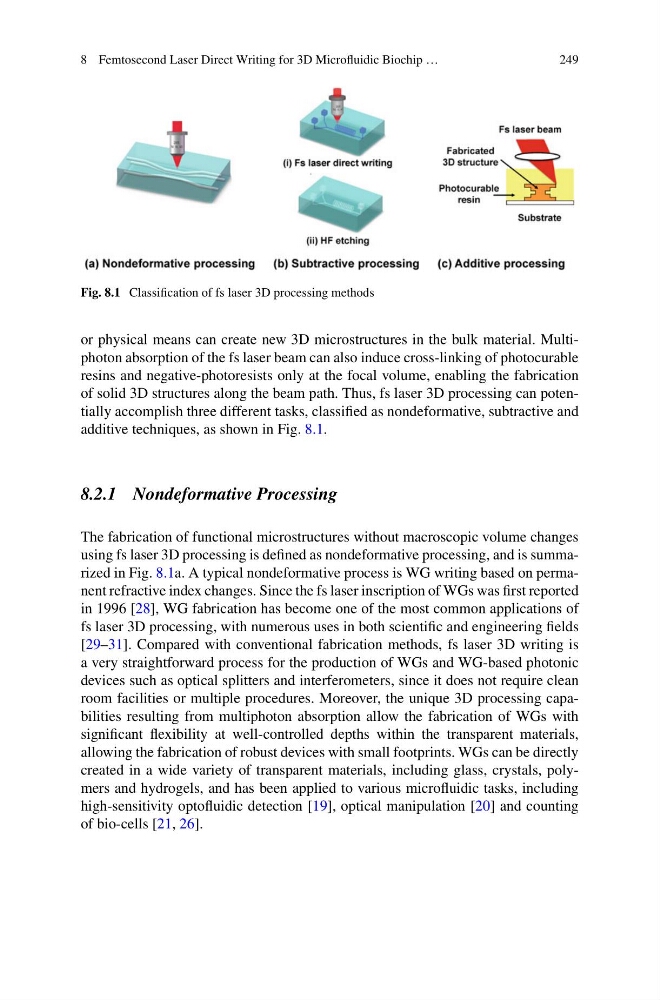
Fig. 8.1 Classification of fs laser 3D processing methods
or physical means can create new 3D microstructures in the bulk material. Multiphoton absorption of the fs laser beam can also induce cross-linking of photocurable
resins and negative-photoresists only at the focal volume, enabling the fabrication
of solid 3D structures along the beam path. Thus, fs laser 3D processing can potentially accomplish three different tasks, classified as nondeformative, subtractive and
additive techniques, as shown in Fig. 8.1.
8.2.1 Nondeformative Processing
The fabrication of functional microstructures without macroscopic volume changes
using fs laser 3D processing is defined as nondeformative processing, and is summarized in Fig. 8.1a. A typical nondeformative process is WG writing based on permanent refractive index changes. Since the fs laser inscription of WGs was first reported
in 1996 [28], WG fabrication has become one of the most common applications of
fs laser 3D processing, with numerous uses in both scientific and engineering fields
[29–31]. Compared with conventional fabrication methods, fs laser 3D writing is
a very straightforward process for the production of WGs and WG-based photonic
devices such as optical splitters and interferometers, since it does not require clean
room facilities or multiple procedures. Moreover, the unique 3D processing capabilities resulting from multiphoton absorption allow the fabrication of WGs with
significant flexibility at well-controlled depths within the transparent materials,
allowing the fabrication of robust devices with small footprints. WGs can be directly
created in a wide variety of transparent materials, including glass, crystals, polymers and hydrogels, and has been applied to various microfluidic tasks, including
high-sensitivity optofluidic detection [19], optical manipulation [20] and counting
of bio-cells [21, 26].
249
Fig. 8.1 Classification of fs laser 3D processing methods
or physical means can create new 3D microstructures in the bulk material. Multiphoton absorption of the fs laser beam can also induce cross-linking of photocurable
resins and negative-photoresists only at the focal volume, enabling the fabrication
of solid 3D structures along the beam path. Thus, fs laser 3D processing can potentially accomplish three different tasks, classified as nondeformative, subtractive and
additive techniques, as shown in Fig. 8.1.
8.2.1 Nondeformative Processing
The fabrication of functional microstructures without macroscopic volume changes
using fs laser 3D processing is defined as nondeformative processing, and is summarized in Fig. 8.1a. A typical nondeformative process is WG writing based on permanent refractive index changes. Since the fs laser inscription of WGs was first reported
in 1996 [28], WG fabrication has become one of the most common applications of
fs laser 3D processing, with numerous uses in both scientific and engineering fields
[29–31]. Compared with conventional fabrication methods, fs laser 3D writing is
a very straightforward process for the production of WGs and WG-based photonic
devices such as optical splitters and interferometers, since it does not require clean
room facilities or multiple procedures. Moreover, the unique 3D processing capabilities resulting from multiphoton absorption allow the fabrication of WGs with
significant flexibility at well-controlled depths within the transparent materials,
allowing the fabrication of robust devices with small footprints. WGs can be directly
created in a wide variety of transparent materials, including glass, crystals, polymers and hydrogels, and has been applied to various microfluidic tasks, including
high-sensitivity optofluidic detection [19], optical manipulation [20] and counting
of bio-cells [21, 26].