

7 Micro-hole Arrays and Net-like Structure Fabrication …
233
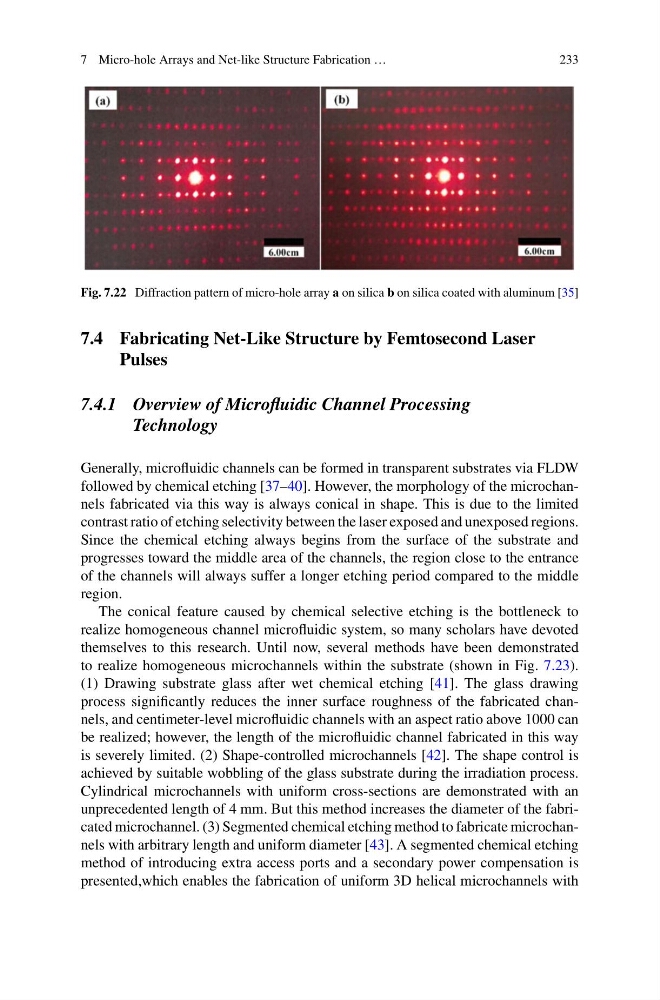
Fig. 7.22 Diffraction pattern of micro-hole array a on silica b on silica coated with aluminum [35]
7.4 Fabricating Net-Like Structure by Femtosecond Laser
Pulses
7.4.1 Overview of Microfluidic Channel Processing
Technology
Generally, microfluidic channels can be formed in transparent substrates via FLDW
followed by chemical etching [37–40]. However, the morphology of the microchannels fabricated via this way is always conical in shape. This is due to the limited
contrast ratio of etching selectivity between the laser exposed and unexposed regions.
Since the chemical etching always begins from the surface of the substrate and
progresses toward the middle area of the channels, the region close to the entrance
of the channels will always suffer a longer etching period compared to the middle
region.
The conical feature caused by chemical selective etching is the bottleneck to
realize homogeneous channel microfluidic system, so many scholars have devoted
themselves to this research. Until now, several methods have been demonstrated
to realize homogeneous microchannels within the substrate (shown in Fig. 7.23).
(1) Drawing substrate glass after wet chemical etching [41]. The glass drawing
process significantly reduces the inner surface roughness of the fabricated channels, and centimeter-level microfluidic channels with an aspect ratio above 1000 can
be realized; however, the length of the microfluidic channel fabricated in this way
is severely limited. (2) Shape-controlled microchannels [42]. The shape control is
achieved by suitable wobbling of the glass substrate during the irradiation process.
Cylindrical microchannels with uniform cross-sections are demonstrated with an
unprecedented length of 4 mm. But this method increases the diameter of the fabricated microchannel. (3) Segmented chemical etching method to fabricate microchannels with arbitrary length and uniform diameter [43]. A segmented chemical etching
method of introducing extra access ports and a secondary power compensation is
presented,which enables the fabrication of uniform 3D helical microchannels with
233
Fig. 7.22 Diffraction pattern of micro-hole array a on silica b on silica coated with aluminum [35]
7.4 Fabricating Net-Like Structure by Femtosecond Laser
Pulses
7.4.1 Overview of Microfluidic Channel Processing
Technology
Generally, microfluidic channels can be formed in transparent substrates via FLDW
followed by chemical etching [37–40]. However, the morphology of the microchannels fabricated via this way is always conical in shape. This is due to the limited
contrast ratio of etching selectivity between the laser exposed and unexposed regions.
Since the chemical etching always begins from the surface of the substrate and
progresses toward the middle area of the channels, the region close to the entrance
of the channels will always suffer a longer etching period compared to the middle
region.
The conical feature caused by chemical selective etching is the bottleneck to
realize homogeneous channel microfluidic system, so many scholars have devoted
themselves to this research. Until now, several methods have been demonstrated
to realize homogeneous microchannels within the substrate (shown in Fig. 7.23).
(1) Drawing substrate glass after wet chemical etching [41]. The glass drawing
process significantly reduces the inner surface roughness of the fabricated channels, and centimeter-level microfluidic channels with an aspect ratio above 1000 can
be realized; however, the length of the microfluidic channel fabricated in this way
is severely limited. (2) Shape-controlled microchannels [42]. The shape control is
achieved by suitable wobbling of the glass substrate during the irradiation process.
Cylindrical microchannels with uniform cross-sections are demonstrated with an
unprecedented length of 4 mm. But this method increases the diameter of the fabricated microchannel. (3) Segmented chemical etching method to fabricate microchannels with arbitrary length and uniform diameter [43]. A segmented chemical etching
method of introducing extra access ports and a secondary power compensation is
presented,which enables the fabrication of uniform 3D helical microchannels with