

222
G. Feng et al.
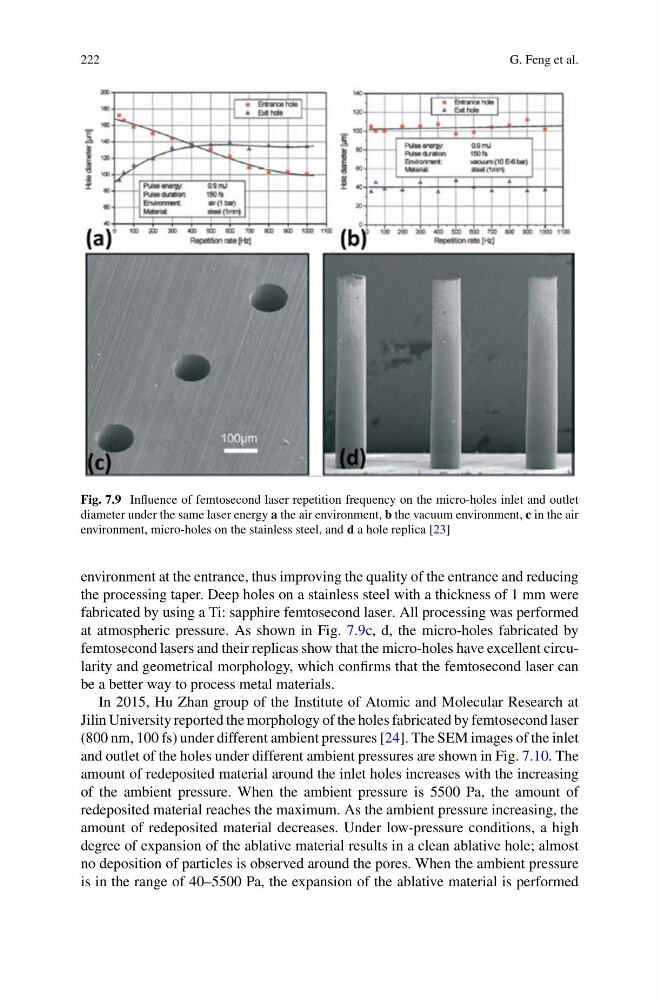
Fig. 7.9 Influence of femtosecond laser repetition frequency on the micro-holes inlet and outlet
diameter under the same laser energy a the air environment, b the vacuum environment, c in the air
environment, micro-holes on the stainless steel, and d a hole replica [23]
environment at the entrance, thus improving the quality of the entrance and reducing
the processing taper. Deep holes on a stainless steel with a thickness of 1 mm were
fabricated by using a Ti: sapphire femtosecond laser. All processing was performed
at atmospheric pressure. As shown in Fig. 7.9c, d, the micro-holes fabricated by
femtosecond lasers and their replicas show that the micro-holes have excellent circularity and geometrical morphology, which confirms that the femtosecond laser can
be a better way to process metal materials.
In 2015, Hu Zhan group of the Institute of Atomic and Molecular Research at
Jilin University reported the morphology of the holes fabricated by femtosecond laser
(800 nm, 100 fs) under different ambient pressures [24]. The SEM images of the inlet
and outlet of the holes under different ambient pressures are shown in Fig. 7.10. The
amount of redeposited material around the inlet holes increases with the increasing
of the ambient pressure. When the ambient pressure is 5500 Pa, the amount of
redeposited material reaches the maximum. As the ambient pressure increasing, the
amount of redeposited material decreases. Under low-pressure conditions, a high
degree of expansion of the ablative material results in a clean ablative hole; almost
no deposition of particles is observed around the pores. When the ambient pressure
is in the range of 40–5500 Pa, the expansion of the ablative material is performed
G. Feng et al.
Fig. 7.9 Influence of femtosecond laser repetition frequency on the micro-holes inlet and outlet
diameter under the same laser energy a the air environment, b the vacuum environment, c in the air
environment, micro-holes on the stainless steel, and d a hole replica [23]
environment at the entrance, thus improving the quality of the entrance and reducing
the processing taper. Deep holes on a stainless steel with a thickness of 1 mm were
fabricated by using a Ti: sapphire femtosecond laser. All processing was performed
at atmospheric pressure. As shown in Fig. 7.9c, d, the micro-holes fabricated by
femtosecond lasers and their replicas show that the micro-holes have excellent circularity and geometrical morphology, which confirms that the femtosecond laser can
be a better way to process metal materials.
In 2015, Hu Zhan group of the Institute of Atomic and Molecular Research at
Jilin University reported the morphology of the holes fabricated by femtosecond laser
(800 nm, 100 fs) under different ambient pressures [24]. The SEM images of the inlet
and outlet of the holes under different ambient pressures are shown in Fig. 7.10. The
amount of redeposited material around the inlet holes increases with the increasing
of the ambient pressure. When the ambient pressure is 5500 Pa, the amount of
redeposited material reaches the maximum. As the ambient pressure increasing, the
amount of redeposited material decreases. Under low-pressure conditions, a high
degree of expansion of the ablative material results in a clean ablative hole; almost
no deposition of particles is observed around the pores. When the ambient pressure
is in the range of 40–5500 Pa, the expansion of the ablative material is performed