

200
F. Chen and J. R. V. de Aldana
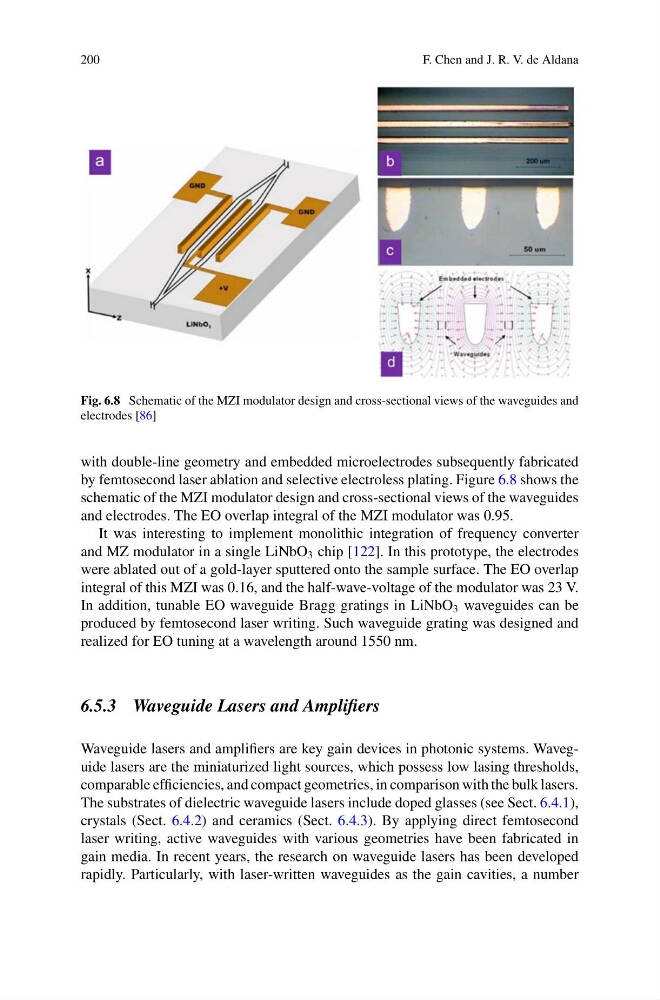
Fig. 6.8 Schematic of the MZI modulator design and cross-sectional views of the waveguides and
electrodes [86]
with double-line geometry and embedded microelectrodes subsequently fabricated
by femtosecond laser ablation and selective electroless plating. Figure 6.8 shows the
schematic of the MZI modulator design and cross-sectional views of the waveguides
and electrodes. The EO overlap integral of the MZI modulator was 0.95.
It was interesting to implement monolithic integration of frequency converter
and MZ modulator in a single LiNbO 3 chip [122]. In this prototype, the electrodes
were ablated out of a gold-layer sputtered onto the sample surface. The EO overlap
integral of this MZI was 0.16, and the half-wave-voltage of the modulator was 23 V.
In addition, tunable EO waveguide Bragg gratings in LiNbO 3 waveguides can be
produced by femtosecond laser writing. Such waveguide grating was designed and
realized for EO tuning at a wavelength around 1550 nm.
6.5.3 Waveguide Lasers and Amplifiers
Waveguide lasers and amplifiers are key gain devices in photonic systems. Waveguide lasers are the miniaturized light sources, which possess low lasing thresholds,
comparable efficiencies, and compact geometries, in comparison with the bulk lasers.
The substrates of dielectric waveguide lasers include doped glasses (see Sect. 6.4.1),
crystals (Sect. 6.4.2) and ceramics (Sect. 6.4.3). By applying direct femtosecond
laser writing, active waveguides with various geometries have been fabricated in
gain media. In recent years, the research on waveguide lasers has been developed
rapidly. Particularly, with laser-written waveguides as the gain cavities, a number
F. Chen and J. R. V. de Aldana
Fig. 6.8 Schematic of the MZI modulator design and cross-sectional views of the waveguides and
electrodes [86]
with double-line geometry and embedded microelectrodes subsequently fabricated
by femtosecond laser ablation and selective electroless plating. Figure 6.8 shows the
schematic of the MZI modulator design and cross-sectional views of the waveguides
and electrodes. The EO overlap integral of the MZI modulator was 0.95.
It was interesting to implement monolithic integration of frequency converter
and MZ modulator in a single LiNbO 3 chip [122]. In this prototype, the electrodes
were ablated out of a gold-layer sputtered onto the sample surface. The EO overlap
integral of this MZI was 0.16, and the half-wave-voltage of the modulator was 23 V.
In addition, tunable EO waveguide Bragg gratings in LiNbO 3 waveguides can be
produced by femtosecond laser writing. Such waveguide grating was designed and
realized for EO tuning at a wavelength around 1550 nm.
6.5.3 Waveguide Lasers and Amplifiers
Waveguide lasers and amplifiers are key gain devices in photonic systems. Waveguide lasers are the miniaturized light sources, which possess low lasing thresholds,
comparable efficiencies, and compact geometries, in comparison with the bulk lasers.
The substrates of dielectric waveguide lasers include doped glasses (see Sect. 6.4.1),
crystals (Sect. 6.4.2) and ceramics (Sect. 6.4.3). By applying direct femtosecond
laser writing, active waveguides with various geometries have been fabricated in
gain media. In recent years, the research on waveguide lasers has been developed
rapidly. Particularly, with laser-written waveguides as the gain cavities, a number