

180
T. Sano
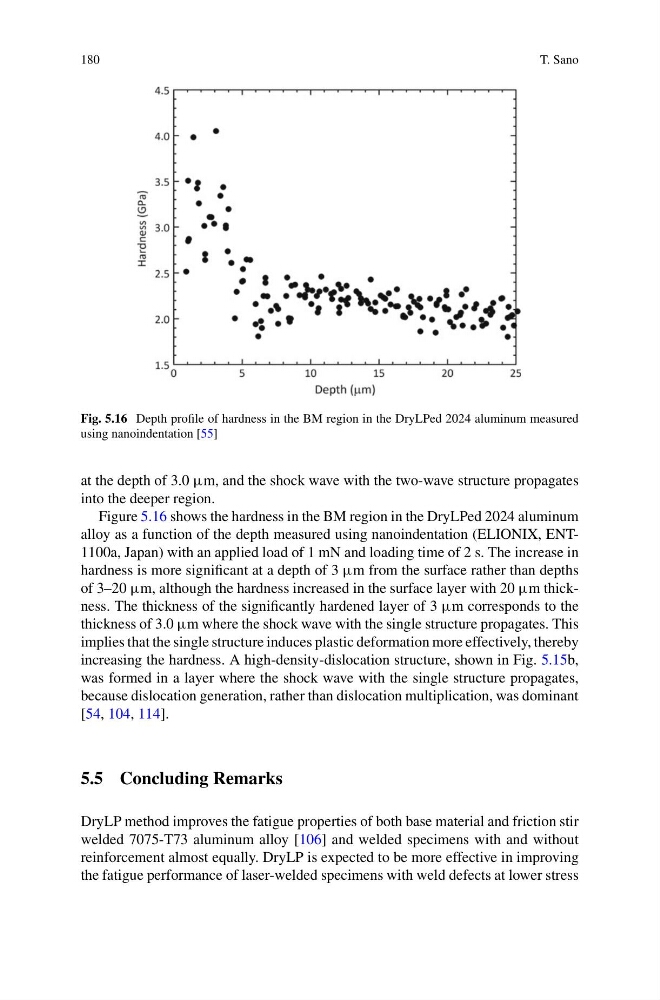
Fig. 5.16 Depth profile of hardness in the BM region in the DryLPed 2024 aluminum measured
using nanoindentation [55]
at the depth of 3.0 μm, and the shock wave with the two-wave structure propagates
into the deeper region.
Figure 5.16 shows the hardness in the BM region in the DryLPed 2024 aluminum
alloy as a function of the depth measured using nanoindentation (ELIONIX, ENT1100a, Japan) with an applied load of 1 mN and loading time of 2 s. The increase in
hardness is more significant at a depth of 3 μm from the surface rather than depths
of 3–20 μm, although the hardness increased in the surface layer with 20 μm thickness. The thickness of the significantly hardened layer of 3 μm corresponds to the
thickness of 3.0 μm where the shock wave with the single structure propagates. This
implies that the single structure induces plastic deformation more effectively, thereby
increasing the hardness. A high-density-dislocation structure, shown in Fig. 5.15b,
was formed in a layer where the shock wave with the single structure propagates,
because dislocation generation, rather than dislocation multiplication, was dominant
[54, 104, 114].
5.5 Concluding Remarks
DryLP method improves the fatigue properties of both base material and friction stir
welded 7075-T73 aluminum alloy [106] and welded specimens with and without
reinforcement almost equally. DryLP is expected to be more effective in improving
the fatigue performance of laser-welded specimens with weld defects at lower stress
T. Sano
Fig. 5.16 Depth profile of hardness in the BM region in the DryLPed 2024 aluminum measured
using nanoindentation [55]
at the depth of 3.0 μm, and the shock wave with the two-wave structure propagates
into the deeper region.
Figure 5.16 shows the hardness in the BM region in the DryLPed 2024 aluminum
alloy as a function of the depth measured using nanoindentation (ELIONIX, ENT1100a, Japan) with an applied load of 1 mN and loading time of 2 s. The increase in
hardness is more significant at a depth of 3 μm from the surface rather than depths
of 3–20 μm, although the hardness increased in the surface layer with 20 μm thickness. The thickness of the significantly hardened layer of 3 μm corresponds to the
thickness of 3.0 μm where the shock wave with the single structure propagates. This
implies that the single structure induces plastic deformation more effectively, thereby
increasing the hardness. A high-density-dislocation structure, shown in Fig. 5.15b,
was formed in a layer where the shock wave with the single structure propagates,
because dislocation generation, rather than dislocation multiplication, was dominant
[54, 104, 114].
5.5 Concluding Remarks
DryLP method improves the fatigue properties of both base material and friction stir
welded 7075-T73 aluminum alloy [106] and welded specimens with and without
reinforcement almost equally. DryLP is expected to be more effective in improving
the fatigue performance of laser-welded specimens with weld defects at lower stress