

4 Laser-Induced Synthesis and Processing of Nanoparticles …
141
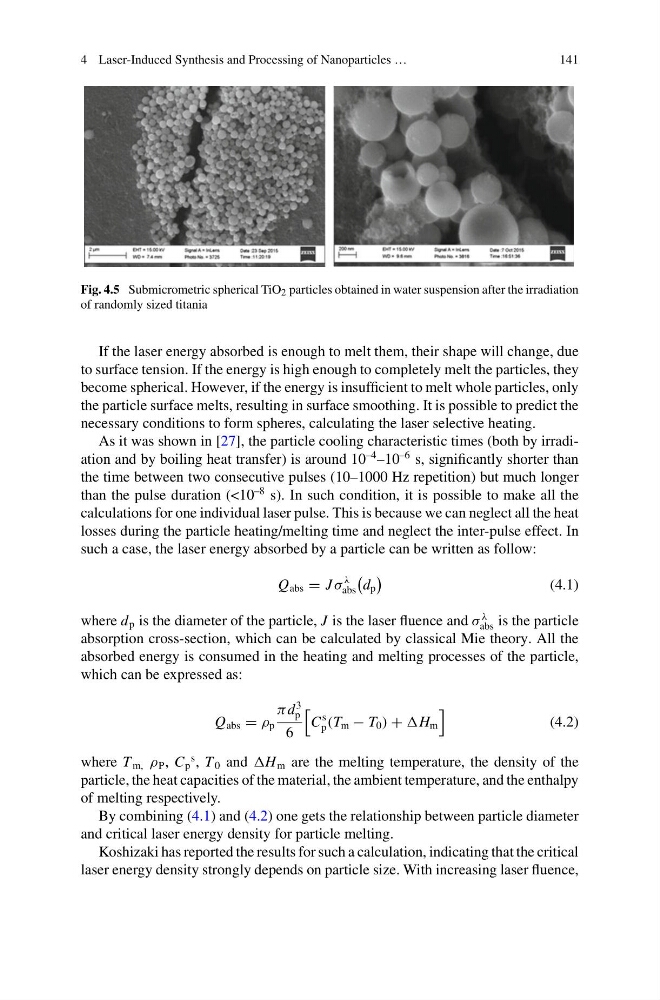
Fig. 4.5 Submicrometric spherical TiO 2 particles obtained in water suspension after the irradiation
of randomly sized titania
If the laser energy absorbed is enough to melt them, their shape will change, due
to surface tension. If the energy is high enough to completely melt the particles, they
become spherical. However, if the energy is insufficient to melt whole particles, only
the particle surface melts, resulting in surface smoothing. It is possible to predict the
necessary conditions to form spheres, calculating the laser selective heating.
As it was shown in [27], the particle cooling characteristic times (both by irradiation and by boiling heat transfer) is around 10
–4 –10
–6 s, significantly shorter than
the time between two consecutive pulses (10–1000 Hz repetition) but much longer
than the pulse duration (<10
–8 s). In such condition, it is possible to make all the
calculations for one individual laser pulse. This is because we can neglect all the heat
losses during the particle heating/melting time and neglect the inter-pulse effect. In
such a case, the laser energy absorbed by a particle can be written as follow:
Q abs = J σ
λ
abs
d p
(4.1)
where d p is the diameter of the particle, J is the laser fluence and σ
λ
abs is the particle
absorption cross-section, which can be calculated by classical Mie theory. All the
absorbed energy is consumed in the heating and melting processes of the particle,
which can be expressed as:
Q abs = ρ p
π d
3
p
6
C
s
p (T m − T 0 ) + H m
(4.2)
where T m, ρ P , C p
s , T 0 and H m are the melting temperature, the density of the
particle, the heat capacities of the material, the ambient temperature, and the enthalpy
of melting respectively.
By combining (4.1) and (4.2) one gets the relationship between particle diameter
and critical laser energy density for particle melting.
Koshizaki has reported the results for such a calculation, indicating that the critical
laser energy density strongly depends on particle size. With increasing laser fluence,
141
Fig. 4.5 Submicrometric spherical TiO 2 particles obtained in water suspension after the irradiation
of randomly sized titania
If the laser energy absorbed is enough to melt them, their shape will change, due
to surface tension. If the energy is high enough to completely melt the particles, they
become spherical. However, if the energy is insufficient to melt whole particles, only
the particle surface melts, resulting in surface smoothing. It is possible to predict the
necessary conditions to form spheres, calculating the laser selective heating.
As it was shown in [27], the particle cooling characteristic times (both by irradiation and by boiling heat transfer) is around 10
–4 –10
–6 s, significantly shorter than
the time between two consecutive pulses (10–1000 Hz repetition) but much longer
than the pulse duration (<10
–8 s). In such condition, it is possible to make all the
calculations for one individual laser pulse. This is because we can neglect all the heat
losses during the particle heating/melting time and neglect the inter-pulse effect. In
such a case, the laser energy absorbed by a particle can be written as follow:
Q abs = J σ
λ
abs
d p
(4.1)
where d p is the diameter of the particle, J is the laser fluence and σ
λ
abs is the particle
absorption cross-section, which can be calculated by classical Mie theory. All the
absorbed energy is consumed in the heating and melting processes of the particle,
which can be expressed as:
Q abs = ρ p
π d
3
p
6
C
s
p (T m − T 0 ) + H m
(4.2)
where T m, ρ P , C p
s , T 0 and H m are the melting temperature, the density of the
particle, the heat capacities of the material, the ambient temperature, and the enthalpy
of melting respectively.
By combining (4.1) and (4.2) one gets the relationship between particle diameter
and critical laser energy density for particle melting.
Koshizaki has reported the results for such a calculation, indicating that the critical
laser energy density strongly depends on particle size. With increasing laser fluence,