

7.1 Overview of Existing Architectures
85
M PU
m
f
d
M PU
m 1
d 1
d 2
m 2
f 1
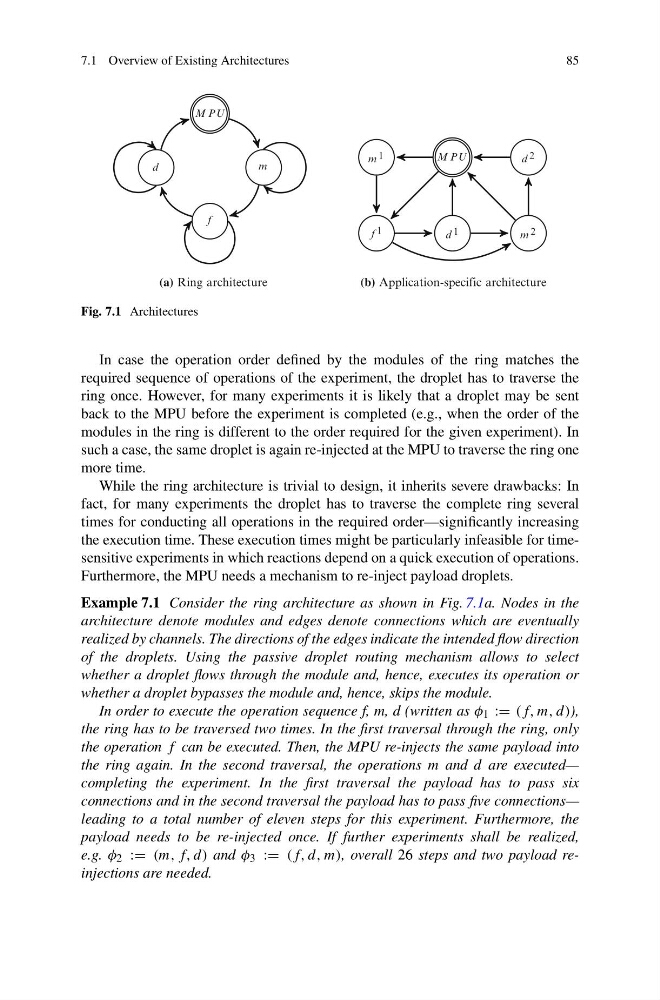
(a) Ring architecture
(b) Application-specific architecture
Fig. 7.1 Architectures
In case the operation order defined by the modules of the ring matches the
required sequence of operations of the experiment, the droplet has to traverse the
ring once. However, for many experiments it is likely that a droplet may be sent
back to the MPU before the experiment is completed (e.g., when the order of the
modules in the ring is different to the order required for the given experiment). In
such a case, the same droplet is again re-injected at the MPU to traverse the ring one
more time.
While the ring architecture is trivial to design, it inherits severe drawbacks: In
fact, for many experiments the droplet has to traverse the complete ring several
times for conducting all operations in the required order—significantly increasing
the execution time. These execution times might be particularly infeasible for timesensitive experiments in which reactions depend on a quick execution of operations.
Furthermore, the MPU needs a mechanism to re-inject payload droplets.
Example 7.1 Consider the ring architecture as shown in Fig. 7.1a. Nodes in the
architecture denote modules and edges denote connections which are eventually
realized by channels. The directions of the edges indicate the intended flow direction
of the droplets. Using the passive droplet routing mechanism allows to select
whether a droplet flows through the module and, hence, executes its operation or
whether a droplet bypasses the module and, hence, skips the module.
In order to execute the operation sequence f, m, d (written as φ 1 := (f, m, d)),
the ring has to be traversed two times. In the first traversal through the ring, only
the operation f can be executed. Then, the MPU re-injects the same payload into
the ring again. In the second traversal, the operations m and d are executed—
completing the experiment. In the first traversal the payload has to pass six
connections and in the second traversal the payload has to pass five connections—
leading to a total number of eleven steps for this experiment. Furthermore, the
payload needs to be re-injected once. If further experiments shall be realized,
e.g. φ 2 := (m, f, d) and φ 3 := (f, d, m), overall 26 steps and two payload reinjections are needed.
85
M PU
m
f
d
M PU
m 1
d 1
d 2
m 2
f 1
(a) Ring architecture
(b) Application-specific architecture
Fig. 7.1 Architectures
In case the operation order defined by the modules of the ring matches the
required sequence of operations of the experiment, the droplet has to traverse the
ring once. However, for many experiments it is likely that a droplet may be sent
back to the MPU before the experiment is completed (e.g., when the order of the
modules in the ring is different to the order required for the given experiment). In
such a case, the same droplet is again re-injected at the MPU to traverse the ring one
more time.
While the ring architecture is trivial to design, it inherits severe drawbacks: In
fact, for many experiments the droplet has to traverse the complete ring several
times for conducting all operations in the required order—significantly increasing
the execution time. These execution times might be particularly infeasible for timesensitive experiments in which reactions depend on a quick execution of operations.
Furthermore, the MPU needs a mechanism to re-inject payload droplets.
Example 7.1 Consider the ring architecture as shown in Fig. 7.1a. Nodes in the
architecture denote modules and edges denote connections which are eventually
realized by channels. The directions of the edges indicate the intended flow direction
of the droplets. Using the passive droplet routing mechanism allows to select
whether a droplet flows through the module and, hence, executes its operation or
whether a droplet bypasses the module and, hence, skips the module.
In order to execute the operation sequence f, m, d (written as φ 1 := (f, m, d)),
the ring has to be traversed two times. In the first traversal through the ring, only
the operation f can be executed. Then, the MPU re-injects the same payload into
the ring again. In the second traversal, the operations m and d are executed—
completing the experiment. In the first traversal the payload has to pass six
connections and in the second traversal the payload has to pass five connections—
leading to a total number of eleven steps for this experiment. Furthermore, the
payload needs to be re-injected once. If further experiments shall be realized,
e.g. φ 2 := (m, f, d) and φ 3 := (f, d, m), overall 26 steps and two payload reinjections are needed.