

82
6 Passive Droplet Routing
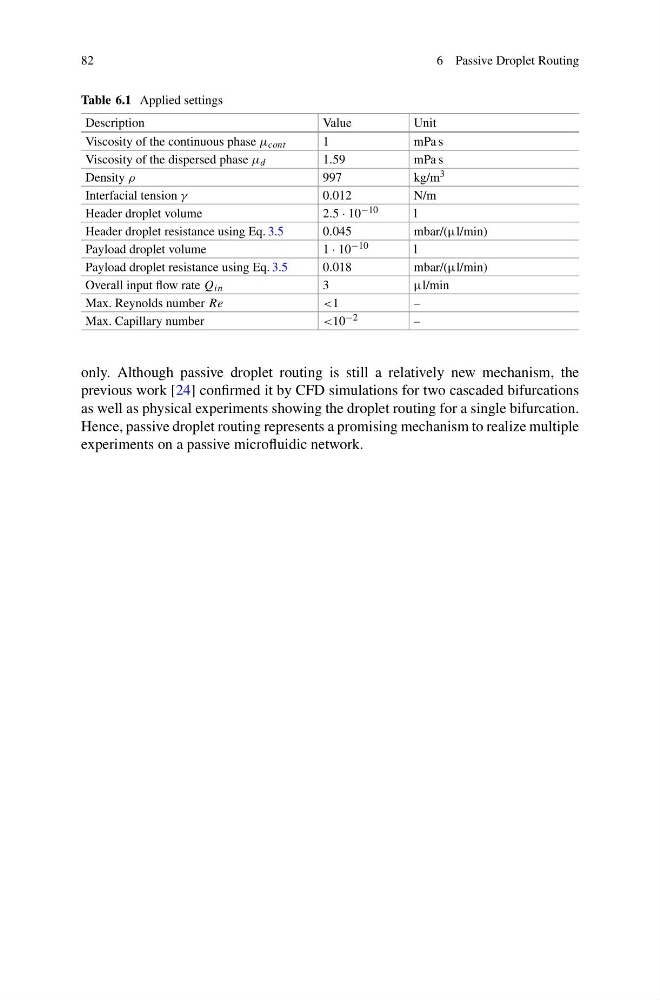
Table 6.1 Applied settings
Description
Value
Unit
Viscosity of the continuous phase μ cont
1
mPa s
Viscosity of the dispersed phase μ d
1.59
mPa s
Density ρ
997
kg/m 3
Interfacial tension γ
0.012
N/m
Header droplet volume
2.5 · 10 −10
l
Header droplet resistance using Eq. 3.5
0.045
mbar/(μl/min)
Payload droplet volume
1 · 10 −10
l
Payload droplet resistance using Eq. 3.5
0.018
mbar/(μl/min)
Overall input flow rate Q in
3
μl/min
Max. Reynolds number Re
<1
–
Max. Capillary number
<10 −2
–
only. Although passive droplet routing is still a relatively new mechanism, the
previous work [24] confirmed it by CFD simulations for two cascaded bifurcations
as well as physical experiments showing the droplet routing for a single bifurcation.
Hence, passive droplet routing represents a promising mechanism to realize multiple
experiments on a passive microfluidic network.
6 Passive Droplet Routing
Table 6.1 Applied settings
Description
Value
Unit
Viscosity of the continuous phase μ cont
1
mPa s
Viscosity of the dispersed phase μ d
1.59
mPa s
Density ρ
997
kg/m 3
Interfacial tension γ
0.012
N/m
Header droplet volume
2.5 · 10 −10
l
Header droplet resistance using Eq. 3.5
0.045
mbar/(μl/min)
Payload droplet volume
1 · 10 −10
l
Payload droplet resistance using Eq. 3.5
0.018
mbar/(μl/min)
Overall input flow rate Q in
3
μl/min
Max. Reynolds number Re
<1
–
Max. Capillary number
<10 −2
–
only. Although passive droplet routing is still a relatively new mechanism, the
previous work [24] confirmed it by CFD simulations for two cascaded bifurcations
as well as physical experiments showing the droplet routing for a single bifurcation.
Hence, passive droplet routing represents a promising mechanism to realize multiple
experiments on a passive microfluidic network.