

22
3 Simulating Droplet Microfluidic Networks
framework directly works on the specification of the design, supports essential
physical phenomena, is publicly available, and easy to extend.
In order to describe the advanced simulation framework, this chapter first reviews
the abstraction levels in Sect. 3.1 and the in detail considered 1D analysis model
in Sect. 3.2. Based on that, the advanced simulation framework is proposed in
Sect. 3.3. Finally, this chapter presents a case study (based on [46]), where the
proposed simulation framework is applied for the design of a practically relevant
microfluidic network. More precisely, the case study demonstrates that using the
proposed simulation framework allows to reduce the manual design time and costs,
e.g., of the drug screening device proposed in [13] from one person month and
USD 1200, respectively, to just a fraction of that.
3.1 Abstraction Levels
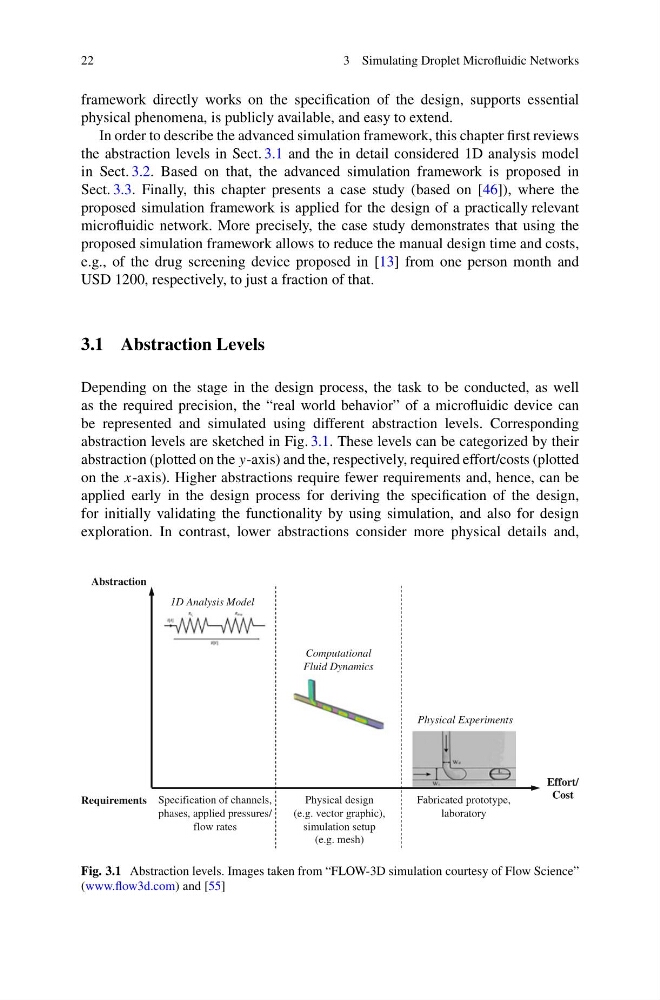
Depending on the stage in the design process, the task to be conducted, as well
as the required precision, the “real world behavior” of a microfluidic device can
be represented and simulated using different abstraction levels. Corresponding
abstraction levels are sketched in Fig. 3.1. These levels can be categorized by their
abstraction (plotted on the y-axis) and the, respectively, required effort/costs (plotted
on the x-axis). Higher abstractions require fewer requirements and, hence, can be
applied early in the design process for deriving the specification of the design,
for initially validating the functionality by using simulation, and also for design
exploration. In contrast, lower abstractions consider more physical details and,
Physical Experiments
Abstraction
Effort/
Cost
Computational
Fluid Dynamics
1D Analysis Model
Requirements Specification of channels,
phases, applied pressures/
flow rates
Physical design
(e.g. vector graphic),
simulation setup
(e.g. mesh)
Fabricated prototype,
laboratory
Fig. 3.1 Abstraction levels. Images taken from “FLOW-3D simulation courtesy of Flow Science”
(www.flow3d.com) and [55]
3 Simulating Droplet Microfluidic Networks
framework directly works on the specification of the design, supports essential
physical phenomena, is publicly available, and easy to extend.
In order to describe the advanced simulation framework, this chapter first reviews
the abstraction levels in Sect. 3.1 and the in detail considered 1D analysis model
in Sect. 3.2. Based on that, the advanced simulation framework is proposed in
Sect. 3.3. Finally, this chapter presents a case study (based on [46]), where the
proposed simulation framework is applied for the design of a practically relevant
microfluidic network. More precisely, the case study demonstrates that using the
proposed simulation framework allows to reduce the manual design time and costs,
e.g., of the drug screening device proposed in [13] from one person month and
USD 1200, respectively, to just a fraction of that.
3.1 Abstraction Levels
Depending on the stage in the design process, the task to be conducted, as well
as the required precision, the “real world behavior” of a microfluidic device can
be represented and simulated using different abstraction levels. Corresponding
abstraction levels are sketched in Fig. 3.1. These levels can be categorized by their
abstraction (plotted on the y-axis) and the, respectively, required effort/costs (plotted
on the x-axis). Higher abstractions require fewer requirements and, hence, can be
applied early in the design process for deriving the specification of the design,
for initially validating the functionality by using simulation, and also for design
exploration. In contrast, lower abstractions consider more physical details and,
Physical Experiments
Abstraction
Effort/
Cost
Computational
Fluid Dynamics
1D Analysis Model
Requirements Specification of channels,
phases, applied pressures/
flow rates
Physical design
(e.g. vector graphic),
simulation setup
(e.g. mesh)
Fabricated prototype,
laboratory
Fig. 3.1 Abstraction levels. Images taken from “FLOW-3D simulation courtesy of Flow Science”
(www.flow3d.com) and [55]