

8.2 Droplet Sequence Generation
111
t
t t − 28
h 0 injected
t t
p injected
t t + 42
Earliest
entry time
step of
h 0 in c 11
t t + 43
Used entry
time step of
h 0 in c 11
t t + 44
Latest entry
time step of
h 0 in c 11
t t + 45
p flows
into c 12
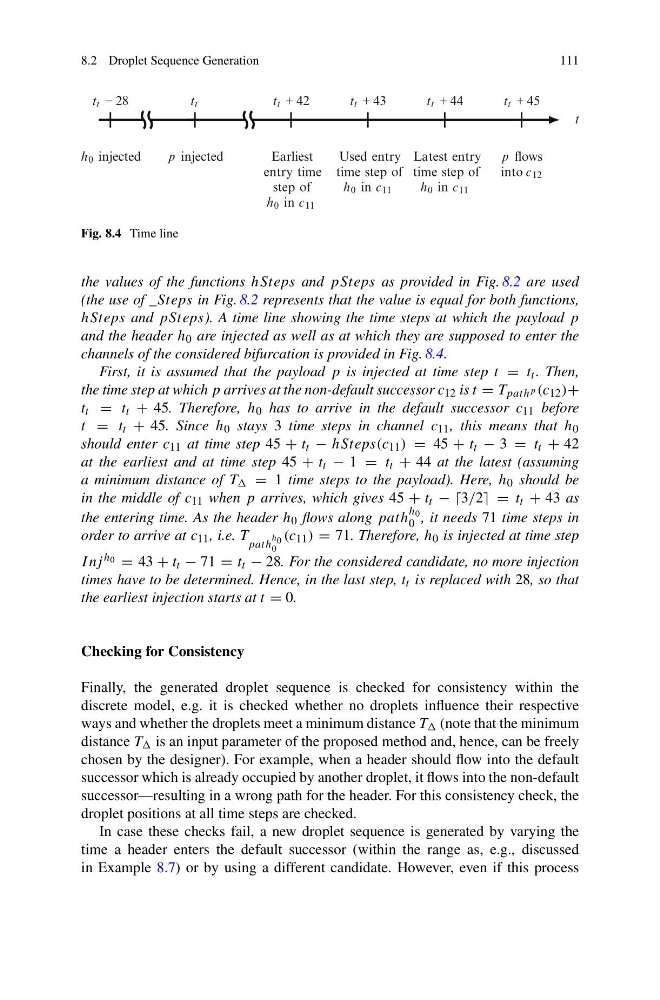
Fig. 8.4 Time line
the values of the functions hSteps and pSteps as provided in Fig. 8.2 are used
(the use of _Steps in Fig. 8.2 represents that the value is equal for both functions,
hSteps and pSteps). A time line showing the time steps at which the payload p
and the header h 0 are injected as well as at which they are supposed to enter the
channels of the considered bifurcation is provided in Fig. 8.4.
First, it is assumed that the payload p is injected at time step t = t t . Then,
the time step at which p arrives at the non-default successor c 12 is t = T path p (c 12 )+
t t = t t + 45. Therefore, h 0 has to arrive in the default successor c 11 before
t = t t + 45. Since h 0 stays 3 time steps in channel c 11 , this means that h 0
should enter c 11 at time step 45 + t t − hSteps(c 11 ) = 45 + t t − 3 = t t + 42
at the earliest and at time step 45 + t t − 1 = t t + 44 at the latest (assuming
a minimum distance of T = 1 time steps to the payload). Here, h 0 should be
in the middle of c 11 when p arrives, which gives 45 + t t − −3/2 = t t + 43 as
the entering time. As the header h 0 flows along path
h 0
0 , it needs 71 time steps in
order to arrive at c 11 , i.e. T path
h 0
0
(c 11 ) = 71. Therefore, h 0 is injected at time step
I nj h 0 = 43 + t t − 71 = t t − 28. For the considered candidate, no more injection
times have to be determined. Hence, in the last step, t t is replaced with 28, so that
the earliest injection starts at t = 0.
Checking for Consistency
Finally, the generated droplet sequence is checked for consistency within the
discrete model, e.g. it is checked whether no droplets influence their respective
ways and whether the droplets meet a minimum distance T (note that the minimum
distance T is an input parameter of the proposed method and, hence, can be freely
chosen by the designer). For example, when a header should flow into the default
successor which is already occupied by another droplet, it flows into the non-default
successor—resulting in a wrong path for the header. For this consistency check, the
droplet positions at all time steps are checked.
In case these checks fail, a new droplet sequence is generated by varying the
time a header enters the default successor (within the range as, e.g., discussed
in Example 8.7) or by using a different candidate. However, even if this process
111
t
t t − 28
h 0 injected
t t
p injected
t t + 42
Earliest
entry time
step of
h 0 in c 11
t t + 43
Used entry
time step of
h 0 in c 11
t t + 44
Latest entry
time step of
h 0 in c 11
t t + 45
p flows
into c 12
Fig. 8.4 Time line
the values of the functions hSteps and pSteps as provided in Fig. 8.2 are used
(the use of _Steps in Fig. 8.2 represents that the value is equal for both functions,
hSteps and pSteps). A time line showing the time steps at which the payload p
and the header h 0 are injected as well as at which they are supposed to enter the
channels of the considered bifurcation is provided in Fig. 8.4.
First, it is assumed that the payload p is injected at time step t = t t . Then,
the time step at which p arrives at the non-default successor c 12 is t = T path p (c 12 )+
t t = t t + 45. Therefore, h 0 has to arrive in the default successor c 11 before
t = t t + 45. Since h 0 stays 3 time steps in channel c 11 , this means that h 0
should enter c 11 at time step 45 + t t − hSteps(c 11 ) = 45 + t t − 3 = t t + 42
at the earliest and at time step 45 + t t − 1 = t t + 44 at the latest (assuming
a minimum distance of T = 1 time steps to the payload). Here, h 0 should be
in the middle of c 11 when p arrives, which gives 45 + t t − −3/2 = t t + 43 as
the entering time. As the header h 0 flows along path
h 0
0 , it needs 71 time steps in
order to arrive at c 11 , i.e. T path
h 0
0
(c 11 ) = 71. Therefore, h 0 is injected at time step
I nj h 0 = 43 + t t − 71 = t t − 28. For the considered candidate, no more injection
times have to be determined. Hence, in the last step, t t is replaced with 28, so that
the earliest injection starts at t = 0.
Checking for Consistency
Finally, the generated droplet sequence is checked for consistency within the
discrete model, e.g. it is checked whether no droplets influence their respective
ways and whether the droplets meet a minimum distance T (note that the minimum
distance T is an input parameter of the proposed method and, hence, can be freely
chosen by the designer). For example, when a header should flow into the default
successor which is already occupied by another droplet, it flows into the non-default
successor—resulting in a wrong path for the header. For this consistency check, the
droplet positions at all time steps are checked.
In case these checks fail, a new droplet sequence is generated by varying the
time a header enters the default successor (within the range as, e.g., discussed
in Example 8.7) or by using a different candidate. However, even if this process