

92
10 Measuring-Rods and Clocks in Motion
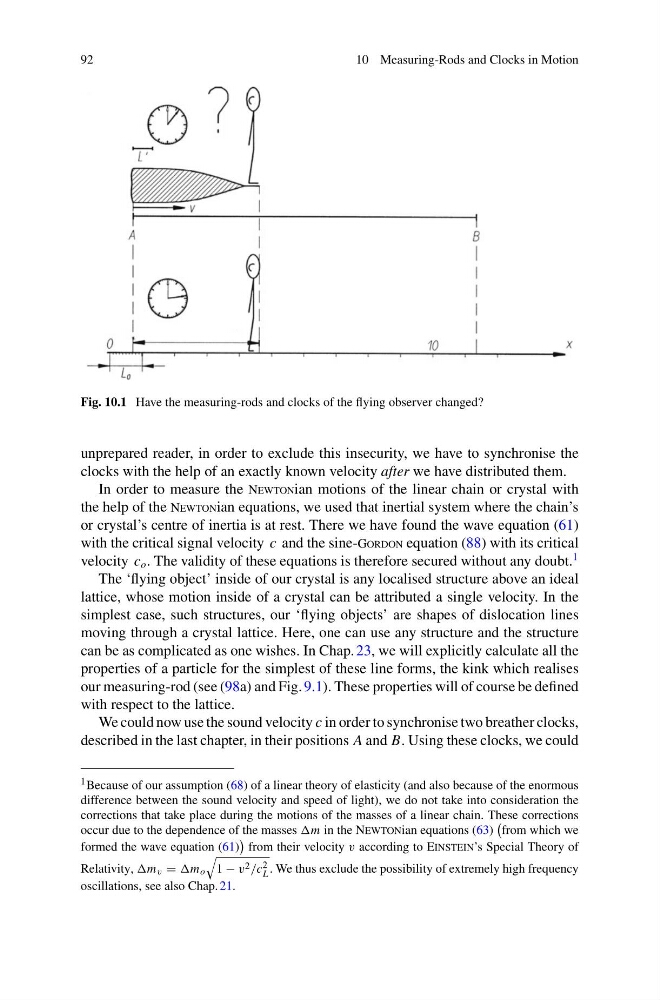
Fig. 10.1 Have the measuring-rods and clocks of the flying observer changed?
unprepared reader, in order to exclude this insecurity, we have to synchronise the
clocks with the help of an exactly known velocity after we have distributed them.
In order to measure the Newtonian motions of the linear chain or crystal with
the help of the Newtonian equations, we used that inertial system where the chain’s
or crystal’s centre of inertia is at rest. There we have found the wave equation (61)
with the critical signal velocity c and the sine-Gordon equation (88) with its critical
velocity c o . The validity of these equations is therefore secured without any doubt.
1
The ‘flying object’ inside of our crystal is any localised structure above an ideal
lattice, whose motion inside of a crystal can be attributed a single velocity. In the
simplest case, such structures, our ‘flying objects’ are shapes of dislocation lines
moving through a crystal lattice. Here, one can use any structure and the structure
can be as complicated as one wishes. In Chap. 23, we will explicitly calculate all the
properties of a particle for the simplest of these line forms, the kink which realises
our measuring-rod (see (98a) and Fig. 9.1). These properties will of course be defined
with respect to the lattice.
We could now use the sound velocity c in order to synchronise two breather clocks,
described in the last chapter, in their positions A and B. Using these clocks, we could
1 Because of our assumption (68) of a linear theory of elasticity (and also because of the enormous
difference between the sound velocity and speed of light), we do not take into consideration the
corrections that take place during the motions of the masses of a linear chain. These corrections
occur due to the dependence of the masses m in the Newtonian equations (63)
from which we
formed the wave equation (61)
from their velocity v according to Einstein’s Special Theory of
Relativity, m v = m o
1 − v 2 /c 2
L . We thus exclude the possibility of extremely high frequency
oscillations, see also Chap. 21.
10 Measuring-Rods and Clocks in Motion
Fig. 10.1 Have the measuring-rods and clocks of the flying observer changed?
unprepared reader, in order to exclude this insecurity, we have to synchronise the
clocks with the help of an exactly known velocity after we have distributed them.
In order to measure the Newtonian motions of the linear chain or crystal with
the help of the Newtonian equations, we used that inertial system where the chain’s
or crystal’s centre of inertia is at rest. There we have found the wave equation (61)
with the critical signal velocity c and the sine-Gordon equation (88) with its critical
velocity c o . The validity of these equations is therefore secured without any doubt.
1
The ‘flying object’ inside of our crystal is any localised structure above an ideal
lattice, whose motion inside of a crystal can be attributed a single velocity. In the
simplest case, such structures, our ‘flying objects’ are shapes of dislocation lines
moving through a crystal lattice. Here, one can use any structure and the structure
can be as complicated as one wishes. In Chap. 23, we will explicitly calculate all the
properties of a particle for the simplest of these line forms, the kink which realises
our measuring-rod (see (98a) and Fig. 9.1). These properties will of course be defined
with respect to the lattice.
We could now use the sound velocity c in order to synchronise two breather clocks,
described in the last chapter, in their positions A and B. Using these clocks, we could
1 Because of our assumption (68) of a linear theory of elasticity (and also because of the enormous
difference between the sound velocity and speed of light), we do not take into consideration the
corrections that take place during the motions of the masses of a linear chain. These corrections
occur due to the dependence of the masses m in the Newtonian equations (63)
from which we
formed the wave equation (61)
from their velocity v according to Einstein’s Special Theory of
Relativity, m v = m o
1 − v 2 /c 2
L . We thus exclude the possibility of extremely high frequency
oscillations, see also Chap. 21.