

9 Natural Measuring-Rods and Clocks
87
o =
c o
λ o
√
2
=
1
τ o
√
2
,
(101)
that according to T o = 2π// o defines a period of oscillation. Thus we have, out of
the internal spacetime geometry of the breather solution q
III
o (x, t) introduced a unit
of measure for time, the period of oscillation T o ,
T o = 2π
√
2 τ o = 2π
√
2
λ o
c o
,
(102)
in which τ o was substituted according to Eq. (91); see Fig. 9.4.
This oscillation reaches the maximum amplitude at x = 0 . We use these oscillations to define a natural clock, the ‘breather clock’, see Günther [34]—in the same
way as the oscillations of atoms are used to define a caesium atomic clock. This is
the way that clocks have been built. The time designation t on the clock counts the
number of oscillations. It is the coefficient of measure. The oscillation period of the
clock is the unit of measure. Let us recapitulate: The time T for any mechanical process in our crystal can be determined using our breather clock by counting how often
an oscillation T o took place, here for example T = 13T o . This number 13 can be read
from the clock as t = 13. Once again the coefficient of measure for the same process
increases if the period of the oscillation, used as our unit of measure, decreases.
Together with (99) and (102), we have not only found a natural measuring-rod, but
now also a natural standard of time. These standards of course could be calculated
mathematically using the lattice parameters according to (91),
L o =
πaσ
2D
,
T o =
4πaρ o
D
.
⎫
⎪ ⎪ ⎪ ⎪ ⎪ ⎬
⎪ ⎪ ⎪ ⎪ ⎪ ⎭
(103)
Once again, this is not necessary. The point is that we can now just forget the lattice
and its many parameters and also forget the ‘Gittermeter’ and ‘Gittersecond’ we
calculated according the (91). We can immediately use our measuring-rods and clocks
determined alone out of the internal geometry of those line forms available,
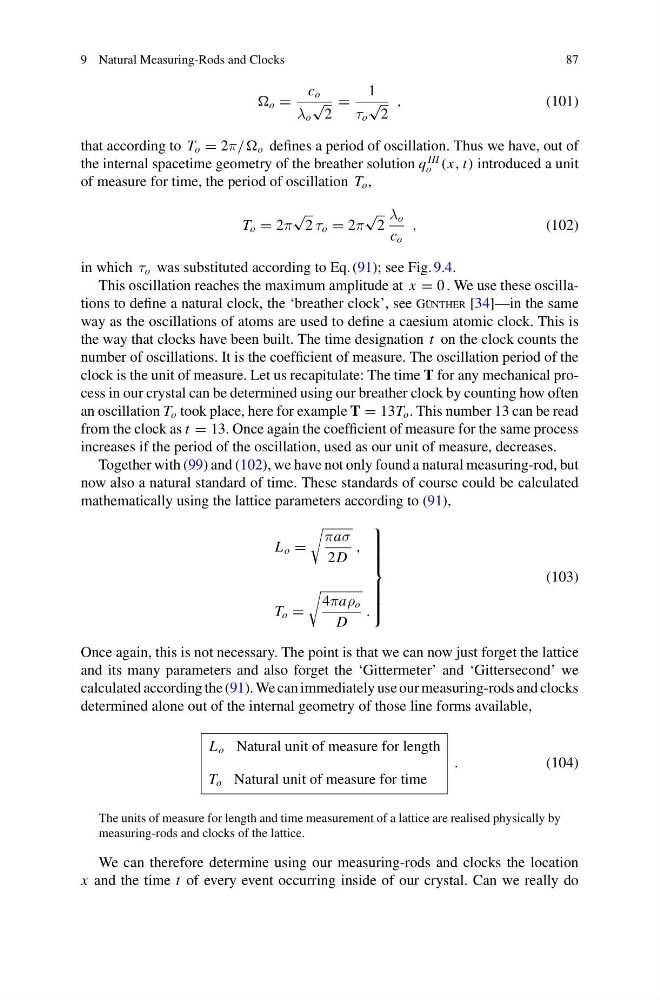
L o Natural unit of measure for length
T o Natural unit of measure for time
.
(104)
The units of measure for length and time measurement of a lattice are realised physically by
measuring-rods and clocks of the lattice.
We can therefore determine using our measuring-rods and clocks the location
x and the time t of every event occurring inside of our crystal. Can we really do
87
o =
c o
λ o
√
2
=
1
τ o
√
2
,
(101)
that according to T o = 2π// o defines a period of oscillation. Thus we have, out of
the internal spacetime geometry of the breather solution q
III
o (x, t) introduced a unit
of measure for time, the period of oscillation T o ,
T o = 2π
√
2 τ o = 2π
√
2
λ o
c o
,
(102)
in which τ o was substituted according to Eq. (91); see Fig. 9.4.
This oscillation reaches the maximum amplitude at x = 0 . We use these oscillations to define a natural clock, the ‘breather clock’, see Günther [34]—in the same
way as the oscillations of atoms are used to define a caesium atomic clock. This is
the way that clocks have been built. The time designation t on the clock counts the
number of oscillations. It is the coefficient of measure. The oscillation period of the
clock is the unit of measure. Let us recapitulate: The time T for any mechanical process in our crystal can be determined using our breather clock by counting how often
an oscillation T o took place, here for example T = 13T o . This number 13 can be read
from the clock as t = 13. Once again the coefficient of measure for the same process
increases if the period of the oscillation, used as our unit of measure, decreases.
Together with (99) and (102), we have not only found a natural measuring-rod, but
now also a natural standard of time. These standards of course could be calculated
mathematically using the lattice parameters according to (91),
L o =
πaσ
2D
,
T o =
4πaρ o
D
.
⎫
⎪ ⎪ ⎪ ⎪ ⎪ ⎬
⎪ ⎪ ⎪ ⎪ ⎪ ⎭
(103)
Once again, this is not necessary. The point is that we can now just forget the lattice
and its many parameters and also forget the ‘Gittermeter’ and ‘Gittersecond’ we
calculated according the (91). We can immediately use our measuring-rods and clocks
determined alone out of the internal geometry of those line forms available,
L o Natural unit of measure for length
T o Natural unit of measure for time
.
(104)
The units of measure for length and time measurement of a lattice are realised physically by
measuring-rods and clocks of the lattice.
We can therefore determine using our measuring-rods and clocks the location
x and the time t of every event occurring inside of our crystal. Can we really do