

84
9 Natural Measuring-Rods and Clocks
-
6
x
-λ o
q
a
q
I
o (x)
λ o
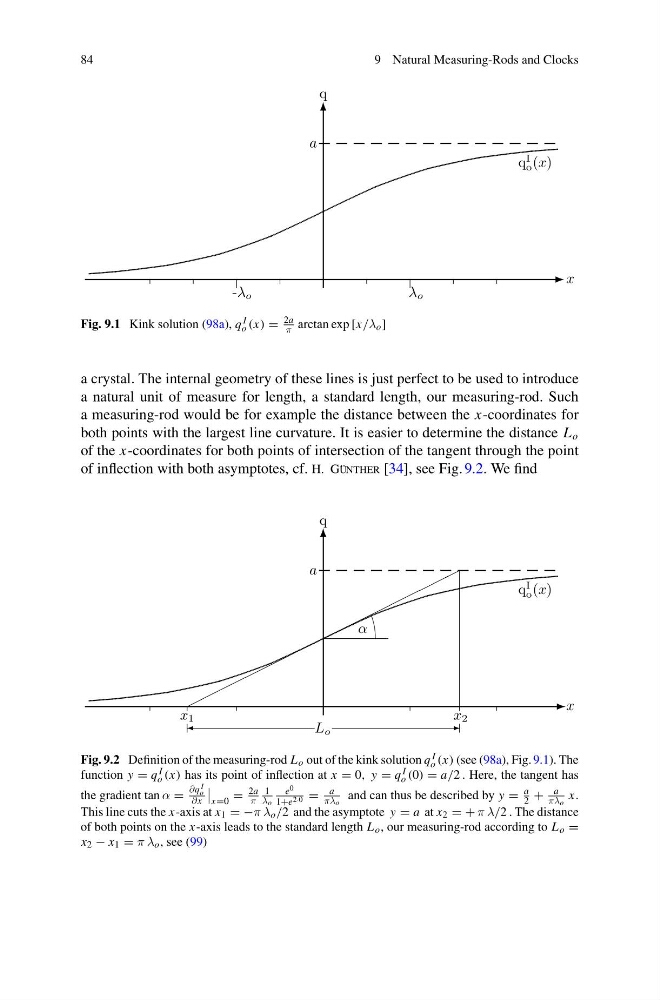
Fig. 9.1 Kink solution (98a), q I
o (x) =
2a
π arctan exp [x/λ o ]
a crystal. The internal geometry of these lines is just perfect to be used to introduce
a natural unit of measure for length, a standard length, our measuring-rod. Such
a measuring-rod would be for example the distance between the x-coordinates for
both points with the largest line curvature. It is easier to determine the distance L o
of the x-coordinates for both points of intersection of the tangent through the point
of inflection with both asymptotes, cf. H. Günther [34], see Fig. 9.2. We find
E
'
¨ ¨ ¨ ¨
¨ ¨
¨ ¨ ¨
¨
¨ ¨
¨ ¨ ¨
¨ ¨ ¨ ¨
-
6
x
x 1
x 2
q
a
α
L o
q
I
o (x)
Fig. 9.2 Definition of the measuring-rod L o out of the kink solution q I
o (x) (see (98a), Fig. 9.1). The
function y = q I
o (x) has its point of inflection at x = 0, y = q I
o (0) = a/2 . Here, the tangent has
the gradient tan α =
∂q I
o
∂x
x=0
=
2a
π
1
λo
e 0
1+e 2·0 =
a
πλo and can thus be described by y =
a
2 +
a
πλo x.
This line cuts the x-axis at x 1 = −π λ o /2 and the asymptote y = a at x 2 = + π λ/2 . The distance
of both points on the x-axis leads to the standard length L o , our measuring-rod according to L o =
x 2 − x 1 = π λ o , see (99)
9 Natural Measuring-Rods and Clocks
-
6
x
-λ o
q
a
q
I
o (x)
λ o
Fig. 9.1 Kink solution (98a), q I
o (x) =
2a
π arctan exp [x/λ o ]
a crystal. The internal geometry of these lines is just perfect to be used to introduce
a natural unit of measure for length, a standard length, our measuring-rod. Such
a measuring-rod would be for example the distance between the x-coordinates for
both points with the largest line curvature. It is easier to determine the distance L o
of the x-coordinates for both points of intersection of the tangent through the point
of inflection with both asymptotes, cf. H. Günther [34], see Fig. 9.2. We find
E
'
¨ ¨ ¨ ¨
¨ ¨
¨ ¨ ¨
¨
¨ ¨
¨ ¨ ¨
¨ ¨ ¨ ¨
-
6
x
x 1
x 2
q
a
α
L o
q
I
o (x)
Fig. 9.2 Definition of the measuring-rod L o out of the kink solution q I
o (x) (see (98a), Fig. 9.1). The
function y = q I
o (x) has its point of inflection at x = 0, y = q I
o (0) = a/2 . Here, the tangent has
the gradient tan α =
∂q I
o
∂x
x=0
=
2a
π
1
λo
e 0
1+e 2·0 =
a
πλo and can thus be described by y =
a
2 +
a
πλo x.
This line cuts the x-axis at x 1 = −π λ o /2 and the asymptote y = a at x 2 = + π λ/2 . The distance
of both points on the x-axis leads to the standard length L o , our measuring-rod according to L o =
x 2 − x 1 = π λ o , see (99)