

82
9 Natural Measuring-Rods and Clocks
order to be able to examine the physical quantity under consideration. The different
qualities of the units of measure are defined as dimensions. If the temperature of an
object is determined to be 277 K, this means the defined unit of one Kelvin had to be
taken 277 times in order to reach this temperature. Thus, the temperature here has
dimension K (Kelvin). In the same manner, the statement that an object has the mass
of 43, 5 kg means that I have to place my unit of one kg 43, 5 times on to a scale
to achieve the equivalent mass. Here, the mass has the dimension kg (kilogram).
Physical measurement is thus a process of comparing and counting. We will now
turn to the measurement of length and time in our crystal. Here, we search for those
solutions of the sine-Gordon equation that serves our purposes as suitable units of
measurement. We will start with the unit of length.
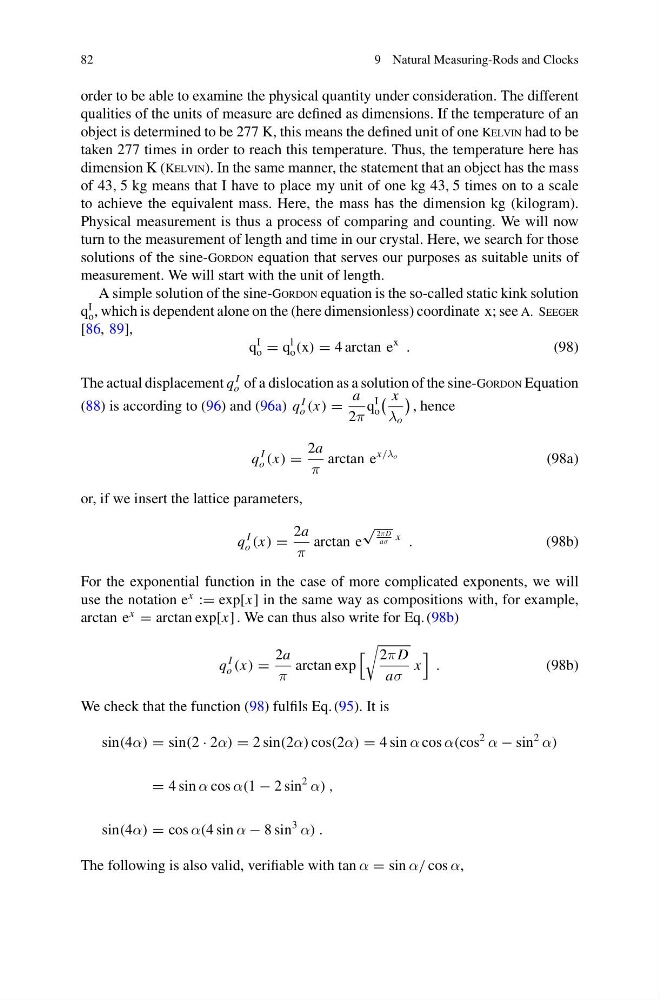
A simple solution of the sine-Gordon equation is the so-called static kink solution
q
I
o , which is dependent alone on the (here dimensionless) coordinate x; see A. Seeger
[86, 89],
q
I
o = q
l
o (x) = 4 arctan e
x
.
(98)
The actual displacement q
I
o of a dislocation as a solution of the sine-Gordon Equation
(88) is according to (96) and (96a) q
I
o (x) =
a
2π
q
I
o
x
λ o
, hence
q
I
o (x) =
2a
π
arctan e
x/λ o
(98a)
or, if we insert the lattice parameters,
q
I
o (x) =
2a
π
arctan e
√
2π D
aσ x
.
(98b)
For the exponential function in the case of more complicated exponents, we will
use the notation e
x
:= exp[x] in the same way as compositions with, for example,
arctan e
x
= arctan exp[x] . We can thus also write for Eq. (98b)
q
I
o (x) =
2a
π
arctan exp
2π D
aσ
x
.
(98b)
We check that the function (98) fulfils Eq. (95). It is
sin(4α) = sin(2 · 2α) = 2 sin(2α) cos(2α) = 4 sin α cos α(cos
2
α − sin
2
α)
= 4 sin α cos α(1 − 2 sin
2
α) ,
sin(4α) = cos α(4 sin α − 8 sin
3
α) .
The following is also valid, verifiable with tan α = sin α/ cos α,
9 Natural Measuring-Rods and Clocks
order to be able to examine the physical quantity under consideration. The different
qualities of the units of measure are defined as dimensions. If the temperature of an
object is determined to be 277 K, this means the defined unit of one Kelvin had to be
taken 277 times in order to reach this temperature. Thus, the temperature here has
dimension K (Kelvin). In the same manner, the statement that an object has the mass
of 43, 5 kg means that I have to place my unit of one kg 43, 5 times on to a scale
to achieve the equivalent mass. Here, the mass has the dimension kg (kilogram).
Physical measurement is thus a process of comparing and counting. We will now
turn to the measurement of length and time in our crystal. Here, we search for those
solutions of the sine-Gordon equation that serves our purposes as suitable units of
measurement. We will start with the unit of length.
A simple solution of the sine-Gordon equation is the so-called static kink solution
q
I
o , which is dependent alone on the (here dimensionless) coordinate x; see A. Seeger
[86, 89],
q
I
o = q
l
o (x) = 4 arctan e
x
.
(98)
The actual displacement q
I
o of a dislocation as a solution of the sine-Gordon Equation
(88) is according to (96) and (96a) q
I
o (x) =
a
2π
q
I
o
x
λ o
, hence
q
I
o (x) =
2a
π
arctan e
x/λ o
(98a)
or, if we insert the lattice parameters,
q
I
o (x) =
2a
π
arctan e
√
2π D
aσ x
.
(98b)
For the exponential function in the case of more complicated exponents, we will
use the notation e
x
:= exp[x] in the same way as compositions with, for example,
arctan e
x
= arctan exp[x] . We can thus also write for Eq. (98b)
q
I
o (x) =
2a
π
arctan exp
2π D
aσ
x
.
(98b)
We check that the function (98) fulfils Eq. (95). It is
sin(4α) = sin(2 · 2α) = 2 sin(2α) cos(2α) = 4 sin α cos α(cos
2
α − sin
2
α)
= 4 sin α cos α(1 − 2 sin
2
α) ,
sin(4α) = cos α(4 sin α − 8 sin
3
α) .
The following is also valid, verifiable with tan α = sin α/ cos α,