

8 The sine-Gordon Equation of a Dislocation
79
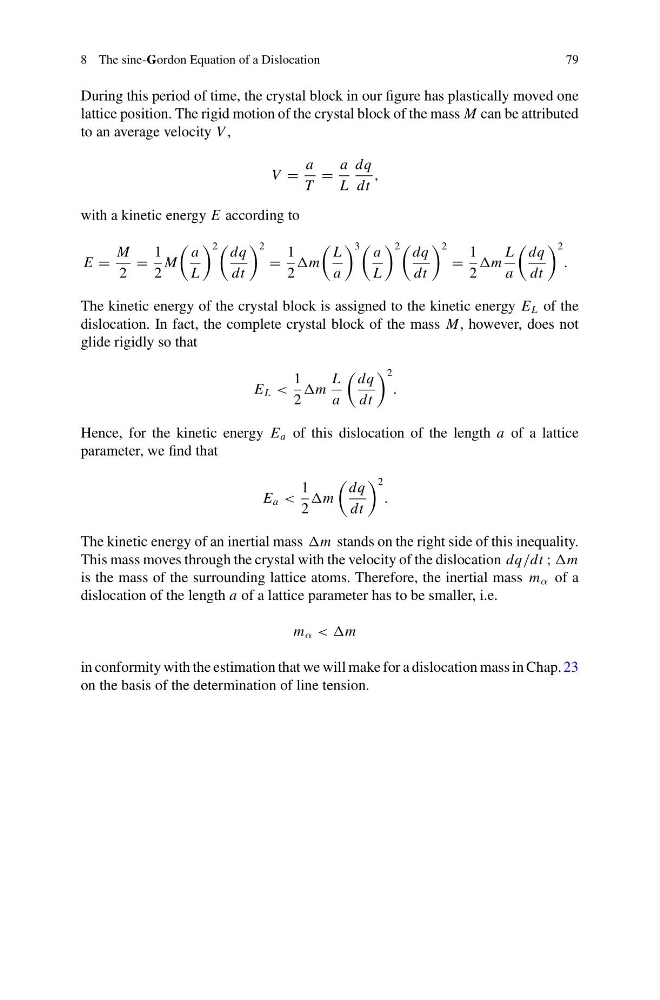
During this period of time, the crystal block in our figure has plastically moved one
lattice position. The rigid motion of the crystal block of the mass M can be attributed
to an average velocity V ,
V =
a
T
=
a
L
dq
dt
,
with a kinetic energy E according to
E =
M
2
=
1
2
M
a
L
2
dq
dt
2
=
1
2
m
L
a
3
a
L
2
dq
dt
2
=
1
2
m
L
a
dq
dt
2
.
The kinetic energy of the crystal block is assigned to the kinetic energy E L of the
dislocation. In fact, the complete crystal block of the mass M, however, does not
glide rigidly so that
E L <
1
2
m
L
a
dq
dt
2
.
Hence, for the kinetic energy E a of this dislocation of the length a of a lattice
parameter, we find that
E a <
1
2
m
dq
dt
2
.
The kinetic energy of an inertial mass m stands on the right side of this inequality.
This mass moves through the crystal with the velocity of the dislocation dq/dt ; m
is the mass of the surrounding lattice atoms. Therefore, the inertial mass m α of a
dislocation of the length a of a lattice parameter has to be smaller, i.e.
m α <
on the basis of the determination of line tension.
79
During this period of time, the crystal block in our figure has plastically moved one
lattice position. The rigid motion of the crystal block of the mass M can be attributed
to an average velocity V ,
V =
a
T
=
a
L
dq
dt
,
with a kinetic energy E according to
E =
M
2
=
1
2
M
a
L
2
dq
dt
2
=
1
2
m
L
a
3
a
L
2
dq
dt
2
=
1
2
m
L
a
dq
dt
2
.
The kinetic energy of the crystal block is assigned to the kinetic energy E L of the
dislocation. In fact, the complete crystal block of the mass M, however, does not
glide rigidly so that
E L <
1
2
m
L
a
dq
dt
2
.
Hence, for the kinetic energy E a of this dislocation of the length a of a lattice
parameter, we find that
E a <
1
2
m
dq
dt
2
.
The kinetic energy of an inertial mass m stands on the right side of this inequality.
This mass moves through the crystal with the velocity of the dislocation dq/dt ; m
is the mass of the surrounding lattice atoms. Therefore, the inertial mass m α of a
dislocation of the length a of a lattice parameter has to be smaller, i.e.
m α <
on the basis of the determination of line tension.