

8 The sine-Gordon Equation of a Dislocation
75
soon as we take a look at the energy mass equivalence. The energy of a dislocation,
that is closely tied to the line tension, can be determined, for example, (at least in
an ideal experiment) by the mutual destruction of two dislocations with opposite
signs. The released energy can be found in the oscillations of the lattice and after its
dissipation in heat motion of the lattice and can therefore principally be determined
through calorimetric measurement. Such a process of mutual destruction of two
opposite dislocations is comparable to the conversion of the energy 2m o c
2
L of an
electron–positron pair during its annihilation into radiation energy of electromagnetic
waves. However, the released energy from the mutual destruction of two dislocations
is not allowed to be calculated using the speed of light in a vacuum c L ; it has to be
calculated out of the relativistic energy mass equivalence using the signal velocity
c o many times smaller then c L . We will deal with this in more detail in Chap. 23. An
estimation of the determination of the magnitude of the mass of a dislocation will be
shown at the end of this chapter.
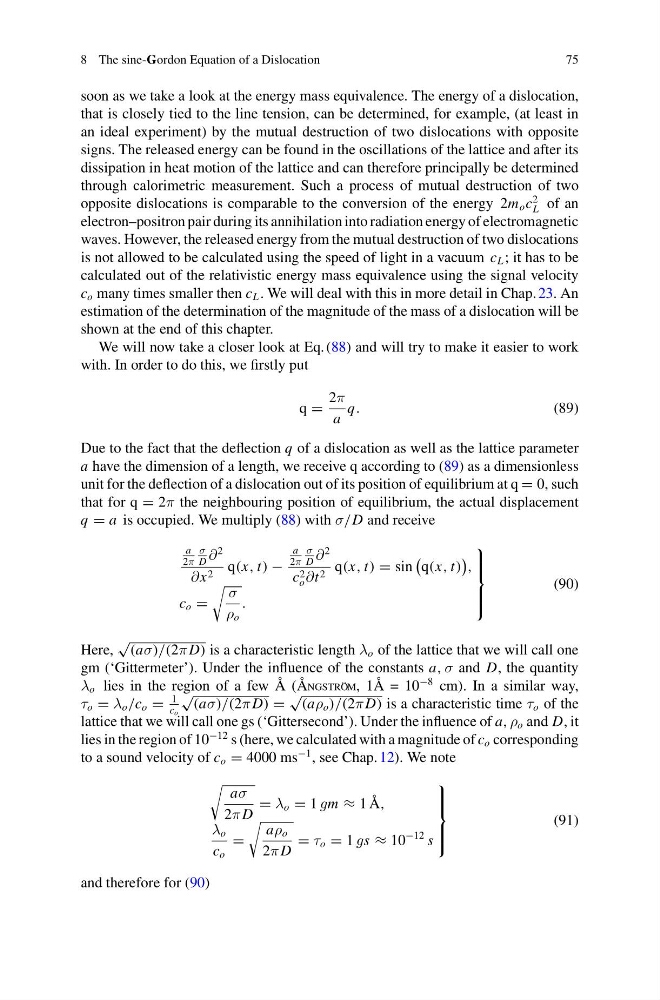
We will now take a closer look at Eq. (88) and will try to make it easier to work
with. In order to do this, we firstly put
q =
2π
a
q.
(89)
Due to the fact that the deflection q of a dislocation as well as the lattice parameter
a have the dimension of a length, we receive q according to (89) as a dimensionless
unit for the deflection of a dislocation out of its position of equilibrium at q = 0, such
that for q = 2π the neighbouring position of equilibrium, the actual displacement
q = a is occupied. We multiply (88) with σ/D and receive
a
2π
σ
D
∂
2
∂x 2 q(x, t) −
a
2π
σ
D
∂
2
c 2
o ∂t 2 q(x, t) = sin
q(x, t)
,
c o =
σ
ρ o
.
⎫
⎪ ⎪ ⎬
⎪ ⎪ ⎭
(90)
Here,
√ (aσ)/(2π D) is a characteristic length λ o of the lattice that we will call one
gm (‘Gittermeter’). Under the influence of the constants a, σ and D, the quantity
λ o lies in the region of a few Å (Ångström, 1Å = 10
−8 cm). In a similar way,
τ o = λ o /c o =
1
c o
√
(aσ)/(2π D) =
√
(aρ o )/(2π D) is a characteristic time τ o of the
lattice that we will call one gs (‘Gittersecond’). Under the influence of a, ρ o and D, it
lies in the region of 10
−12 s (here, we calculated with a magnitude of c o corresponding
to a sound velocity of c o = 4000 ms
−1 , see Chap. 12). We note
aσ
2π D
= λ o = 1 gm ≈ 1 Å,
λ o
c o
=
aρ o
2π D
= τ o = 1 gs ≈ 10
−12 s
⎫
⎪ ⎪ ⎬
⎪ ⎪ ⎭
(91)
and therefore for (90)
75
soon as we take a look at the energy mass equivalence. The energy of a dislocation,
that is closely tied to the line tension, can be determined, for example, (at least in
an ideal experiment) by the mutual destruction of two dislocations with opposite
signs. The released energy can be found in the oscillations of the lattice and after its
dissipation in heat motion of the lattice and can therefore principally be determined
through calorimetric measurement. Such a process of mutual destruction of two
opposite dislocations is comparable to the conversion of the energy 2m o c
2
L of an
electron–positron pair during its annihilation into radiation energy of electromagnetic
waves. However, the released energy from the mutual destruction of two dislocations
is not allowed to be calculated using the speed of light in a vacuum c L ; it has to be
calculated out of the relativistic energy mass equivalence using the signal velocity
c o many times smaller then c L . We will deal with this in more detail in Chap. 23. An
estimation of the determination of the magnitude of the mass of a dislocation will be
shown at the end of this chapter.
We will now take a closer look at Eq. (88) and will try to make it easier to work
with. In order to do this, we firstly put
q =
2π
a
q.
(89)
Due to the fact that the deflection q of a dislocation as well as the lattice parameter
a have the dimension of a length, we receive q according to (89) as a dimensionless
unit for the deflection of a dislocation out of its position of equilibrium at q = 0, such
that for q = 2π the neighbouring position of equilibrium, the actual displacement
q = a is occupied. We multiply (88) with σ/D and receive
a
2π
σ
D
∂
2
∂x 2 q(x, t) −
a
2π
σ
D
∂
2
c 2
o ∂t 2 q(x, t) = sin
q(x, t)
,
c o =
σ
ρ o
.
⎫
⎪ ⎪ ⎬
⎪ ⎪ ⎭
(90)
Here,
√ (aσ)/(2π D) is a characteristic length λ o of the lattice that we will call one
gm (‘Gittermeter’). Under the influence of the constants a, σ and D, the quantity
λ o lies in the region of a few Å (Ångström, 1Å = 10
−8 cm). In a similar way,
τ o = λ o /c o =
1
c o
√
(aσ)/(2π D) =
√
(aρ o )/(2π D) is a characteristic time τ o of the
lattice that we will call one gs (‘Gittersecond’). Under the influence of a, ρ o and D, it
lies in the region of 10
−12 s (here, we calculated with a magnitude of c o corresponding
to a sound velocity of c o = 4000 ms
−1 , see Chap. 12). We note
aσ
2π D
= λ o = 1 gm ≈ 1 Å,
λ o
c o
=
aρ o
2π D
= τ o = 1 gs ≈ 10
−12 s
⎫
⎪ ⎪ ⎬
⎪ ⎪ ⎭
(91)
and therefore for (90)