

70
8 The sine-Gordon Equation of a Dislocation
move through the whole lattice. The lattice atoms with their masses m i remain
with slight displacements at their lattice positions.
We will show in the appendix, Chap. 25, that there are principally two different
forms of dislocation motion: Gliding and climbing. Both of these motions lead to
plastic deformation of the lattice. However, only gliding, the so-called conservative
dislocation motion, is a pure translation of the lattice distorsion made by the dislocation. This allows us to identify the inertia term in (76) with the momentum of the
dislocation. In comparison to this, we have climbing, the so-called non-conservative
dislocation motion, which plays a more important role with increasing temperatures,
generally only occurring in connection with point defects. Here, in this case, the inertia term in (76) describes the coupled properties of dislocations and point defects.
For our considerations, we will assume that the dislocations do not climb, which can
be physically realised if we stay at sufficiently low temperatures.
Here, we note: Conservative motion means ‘conservation of crystal volume’ and
does not mean the conservation of energy as in point mechanics. Implicitly Kröner’s
idea of a relative, inertial mass of dislocations in the so-called line tension model
of dislocations (or string model) was anticipated. This model is explained in great
detail in A. Seeger [88] and P. Schiller’s paper dated from 1966. Here, the dislocation
line is examined as if it were a tense string. This is nothing else than a continuum
approximation of a linear chain of elastic coupled inertial masses under the influence
of a base tension as seen and dealt with in Chap. 6. The model of line tension is
based on the assumption that the above-introduced dislocation coordinates q α and
the inertia’s m α move relative to the lattice. In order to register the influence of the
surrounding lattice on the ‘tense string’ the authors determined a periodical potential
U , namely
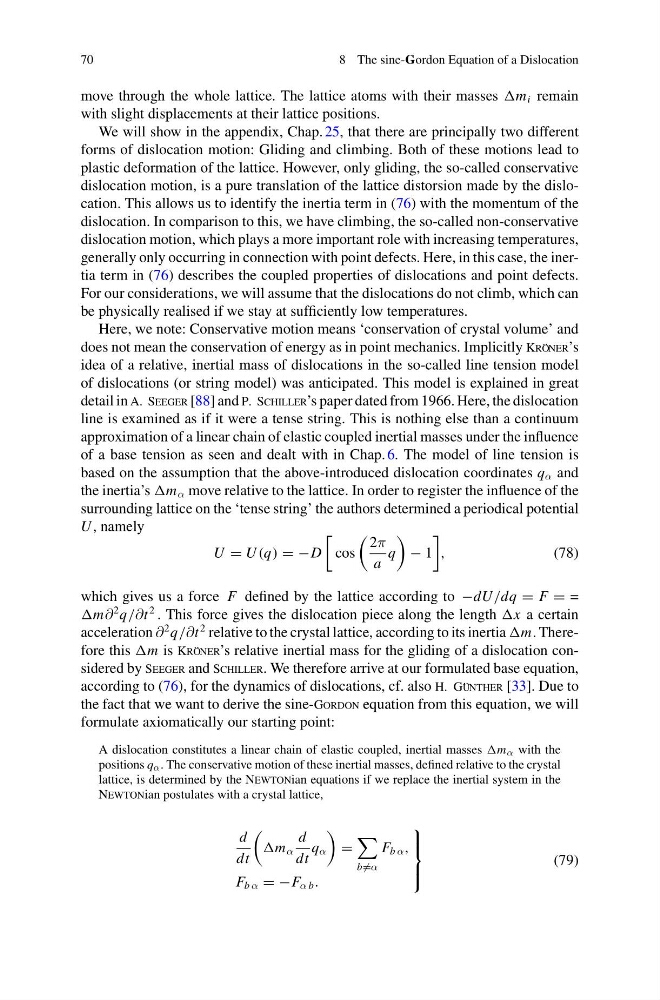
U = U (q) = −D
cos
2π
a
q
− 1
,
(78)
which gives us a force F defined by the lattice according to −dU/dq = F = =
m∂
2 q/∂t
2 . This force gives the dislocation piece along the length x a certain
acceleration ∂
2 q/∂t
2 relative to the crystal lattice, according to its inertia m. Therefore this m is Kröner’s relative inertial mass for the gliding of a dislocation considered by Seeger and Schiller. We therefore arrive at our formulated base equation,
according to (76), for the dynamics of dislocations, cf. also H. Günther [33]. Due to
the fact that we want to derive the sine-Gordon equation from this equation, we will
formulate axiomatically our starting point:
A dislocation constitutes a linear chain of elastic coupled, inertial masses m α with the
positions q α . The conservative motion of these inertial masses, defined relative to the crystal
lattice, is determined by the Newtonian equations if we replace the inertial system in the
Newtonian postulates with a crystal lattice,
d
dt
m α
d
dt
q α
=
b =α
F b α ,
F b α = −F α b .
⎫
⎪ ⎬
⎪ ⎭
(79)
8 The sine-Gordon Equation of a Dislocation
move through the whole lattice. The lattice atoms with their masses m i remain
with slight displacements at their lattice positions.
We will show in the appendix, Chap. 25, that there are principally two different
forms of dislocation motion: Gliding and climbing. Both of these motions lead to
plastic deformation of the lattice. However, only gliding, the so-called conservative
dislocation motion, is a pure translation of the lattice distorsion made by the dislocation. This allows us to identify the inertia term in (76) with the momentum of the
dislocation. In comparison to this, we have climbing, the so-called non-conservative
dislocation motion, which plays a more important role with increasing temperatures,
generally only occurring in connection with point defects. Here, in this case, the inertia term in (76) describes the coupled properties of dislocations and point defects.
For our considerations, we will assume that the dislocations do not climb, which can
be physically realised if we stay at sufficiently low temperatures.
Here, we note: Conservative motion means ‘conservation of crystal volume’ and
does not mean the conservation of energy as in point mechanics. Implicitly Kröner’s
idea of a relative, inertial mass of dislocations in the so-called line tension model
of dislocations (or string model) was anticipated. This model is explained in great
detail in A. Seeger [88] and P. Schiller’s paper dated from 1966. Here, the dislocation
line is examined as if it were a tense string. This is nothing else than a continuum
approximation of a linear chain of elastic coupled inertial masses under the influence
of a base tension as seen and dealt with in Chap. 6. The model of line tension is
based on the assumption that the above-introduced dislocation coordinates q α and
the inertia’s m α move relative to the lattice. In order to register the influence of the
surrounding lattice on the ‘tense string’ the authors determined a periodical potential
U , namely
U = U (q) = −D
cos
2π
a
q
− 1
,
(78)
which gives us a force F defined by the lattice according to −dU/dq = F = =
m∂
2 q/∂t
2 . This force gives the dislocation piece along the length x a certain
acceleration ∂
2 q/∂t
2 relative to the crystal lattice, according to its inertia m. Therefore this m is Kröner’s relative inertial mass for the gliding of a dislocation considered by Seeger and Schiller. We therefore arrive at our formulated base equation,
according to (76), for the dynamics of dislocations, cf. also H. Günther [33]. Due to
the fact that we want to derive the sine-Gordon equation from this equation, we will
formulate axiomatically our starting point:
A dislocation constitutes a linear chain of elastic coupled, inertial masses m α with the
positions q α . The conservative motion of these inertial masses, defined relative to the crystal
lattice, is determined by the Newtonian equations if we replace the inertial system in the
Newtonian postulates with a crystal lattice,
d
dt
m α
d
dt
q α
=
b =α
F b α ,
F b α = −F α b .
⎫
⎪ ⎬
⎪ ⎭
(79)