

44
5 The Wave Equation and the Third Axiom
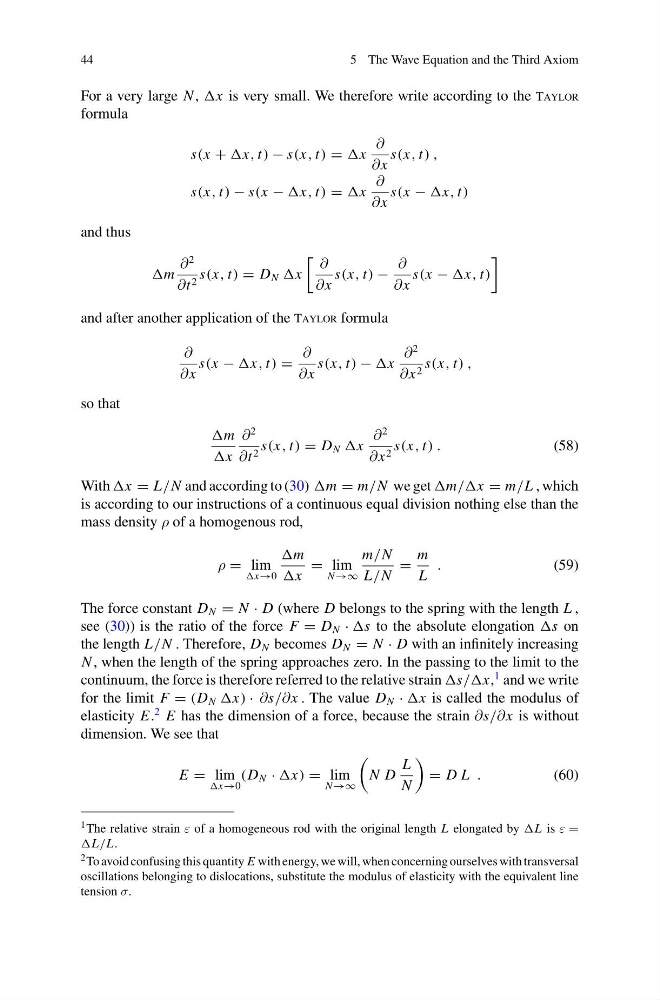
For a very large N , x is very small. We therefore write according to the Taylor
formula
s(x + x, t) − s(x, t) = x
∂
∂x
s(x, t) ,
s(x, t) − s(x − x, t) = x
∂
∂x
s(x − x, t)
and thus
m
∂
2
∂t 2 s(x, t) = D N x
∂
∂x
s(x, t) −
∂
∂x
s(x − x, t)
and after another application of the Taylor formula
∂
∂x
s(x − x, t) =
∂
∂x
s(x, t) − x
∂
2
∂x 2 s(x, t) ,
so that
m
x
∂
2
∂t 2 s(x, t) = D N x
∂
2
∂x 2 s(x, t) .
(58)
With x = L/N and according to (30) m = m/N we get m//x = m/L , which
is according to our instructions of a continuous equal division nothing else than the
mass density ρ of a homogenous rod,
ρ = lim
x→0
m
x
= lim
N →∞
m/N
L/N
=
m
L
.
(59)
The force constant D N = N · D (where D belongs to the spring with the length L ,
see (30)) is the ratio of the force F = D N · s to the absolute elongation s on
the length L/N . Therefore, D N becomes D N = N · D with an infinitely increasing
N , when the length of the spring approaches zero. In the passing to the limit to the
continuum, the force is therefore referred to the relative strain s//x,
1 and we write
for the limit F = (D N x) · ∂s/∂x . The value D N · x is called the modulus of
elasticity E.
2 E has the dimension of a force, because the strain ∂s/∂x is without
dimension. We see that
E = lim
x→0
(D N · x) = lim
N →∞
N D
L
N
= D L .
(60)
1 The relative strain ε of a homogeneous rod with the original length L elongated by L is ε =
L/L.
2 To avoid confusing this quantity E with energy, we will, when concerning ourselves with transversal
oscillations belonging to dislocations, substitute the modulus of elasticity with the equivalent line
tension σ.
5 The Wave Equation and the Third Axiom
For a very large N , x is very small. We therefore write according to the Taylor
formula
s(x + x, t) − s(x, t) = x
∂
∂x
s(x, t) ,
s(x, t) − s(x − x, t) = x
∂
∂x
s(x − x, t)
and thus
m
∂
2
∂t 2 s(x, t) = D N x
∂
∂x
s(x, t) −
∂
∂x
s(x − x, t)
and after another application of the Taylor formula
∂
∂x
s(x − x, t) =
∂
∂x
s(x, t) − x
∂
2
∂x 2 s(x, t) ,
so that
m
x
∂
2
∂t 2 s(x, t) = D N x
∂
2
∂x 2 s(x, t) .
(58)
With x = L/N and according to (30) m = m/N we get m//x = m/L , which
is according to our instructions of a continuous equal division nothing else than the
mass density ρ of a homogenous rod,
ρ = lim
x→0
m
x
= lim
N →∞
m/N
L/N
=
m
L
.
(59)
The force constant D N = N · D (where D belongs to the spring with the length L ,
see (30)) is the ratio of the force F = D N · s to the absolute elongation s on
the length L/N . Therefore, D N becomes D N = N · D with an infinitely increasing
N , when the length of the spring approaches zero. In the passing to the limit to the
continuum, the force is therefore referred to the relative strain s//x,
1 and we write
for the limit F = (D N x) · ∂s/∂x . The value D N · x is called the modulus of
elasticity E.
2 E has the dimension of a force, because the strain ∂s/∂x is without
dimension. We see that
E = lim
x→0
(D N · x) = lim
N →∞
N D
L
N
= D L .
(60)
1 The relative strain ε of a homogeneous rod with the original length L elongated by L is ε =
L/L.
2 To avoid confusing this quantity E with energy, we will, when concerning ourselves with transversal
oscillations belonging to dislocations, substitute the modulus of elasticity with the equivalent line
tension σ.