

4 Where Does the Wave Equation Come From?
35
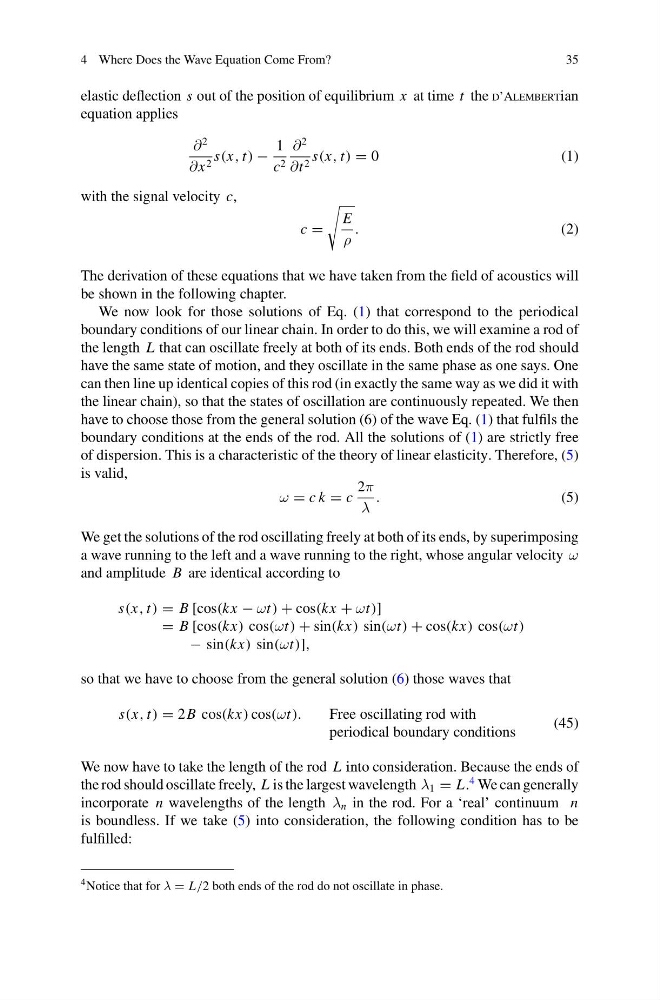
elastic deflection s out of the position of equilibrium x at time t the d’Alembertian
equation applies
∂
2
∂x 2 s(x, t) −
1
c 2
∂
2
∂t 2 s(x, t) = 0
( 1 )
with the signal velocity c,
c =
E
ρ
.
(2)
The derivation of these equations that we have taken from the field of acoustics will
be shown in the following chapter.
We now look for those solutions of Eq. (1) that correspond to the periodical
boundary conditions of our linear chain. In order to do this, we will examine a rod of
the length L that can oscillate freely at both of its ends. Both ends of the rod should
have the same state of motion, and they oscillate in the same phase as one says. One
can then line up identical copies of this rod (in exactly the same way as we did it with
the linear chain), so that the states of oscillation are continuously repeated. We then
have to choose those from the general solution (6) of the wave Eq. (1) that fulfils the
boundary conditions at the ends of the rod. All the solutions of (1) are strictly free
of dispersion. This is a characteristic of the theory of linear elasticity. Therefore, (5)
is valid,
ω = c k = c
2π
λ
.
(5)
We get the solutions of the rod oscillating freely at both of its ends, by superimposing
a wave running to the left and a wave running to the right, whose angular velocity ω
and amplitude B are identical according to
s(x, t) = B [cos(kx − ωt) + cos(kx + ωt)]
= B [cos(kx) cos(ωt) + sin(kx) sin(ωt) + cos(kx) cos(ωt)
− sin(kx) sin(ωt)],
so that we have to choose from the general solution (6) those waves that
s(x, t) = 2B cos(kx) cos(ωt).
Free oscillating rod with
periodical boundary conditions
(45)
We now have to take the length of the rod L into consideration. Because the ends of
the rod should oscillate freely, L is the largest wavelength λ 1 = L.
4 We can generally
incorporate n wavelengths of the length λ n in the rod. For a ‘real’ continuum n
is boundless. If we take (5) into consideration, the following condition has to be
fulfilled:
4 Notice that for λ = L/2 both ends of the rod do not oscillate in phase.
35
elastic deflection s out of the position of equilibrium x at time t the d’Alembertian
equation applies
∂
2
∂x 2 s(x, t) −
1
c 2
∂
2
∂t 2 s(x, t) = 0
( 1 )
with the signal velocity c,
c =
E
ρ
.
(2)
The derivation of these equations that we have taken from the field of acoustics will
be shown in the following chapter.
We now look for those solutions of Eq. (1) that correspond to the periodical
boundary conditions of our linear chain. In order to do this, we will examine a rod of
the length L that can oscillate freely at both of its ends. Both ends of the rod should
have the same state of motion, and they oscillate in the same phase as one says. One
can then line up identical copies of this rod (in exactly the same way as we did it with
the linear chain), so that the states of oscillation are continuously repeated. We then
have to choose those from the general solution (6) of the wave Eq. (1) that fulfils the
boundary conditions at the ends of the rod. All the solutions of (1) are strictly free
of dispersion. This is a characteristic of the theory of linear elasticity. Therefore, (5)
is valid,
ω = c k = c
2π
λ
.
(5)
We get the solutions of the rod oscillating freely at both of its ends, by superimposing
a wave running to the left and a wave running to the right, whose angular velocity ω
and amplitude B are identical according to
s(x, t) = B [cos(kx − ωt) + cos(kx + ωt)]
= B [cos(kx) cos(ωt) + sin(kx) sin(ωt) + cos(kx) cos(ωt)
− sin(kx) sin(ωt)],
so that we have to choose from the general solution (6) those waves that
s(x, t) = 2B cos(kx) cos(ωt).
Free oscillating rod with
periodical boundary conditions
(45)
We now have to take the length of the rod L into consideration. Because the ends of
the rod should oscillate freely, L is the largest wavelength λ 1 = L.
4 We can generally
incorporate n wavelengths of the length λ n in the rod. For a ‘real’ continuum n
is boundless. If we take (5) into consideration, the following condition has to be
fulfilled:
4 Notice that for λ = L/2 both ends of the rod do not oscillate in phase.