

30
4 Where Does the Wave Equation Come From?
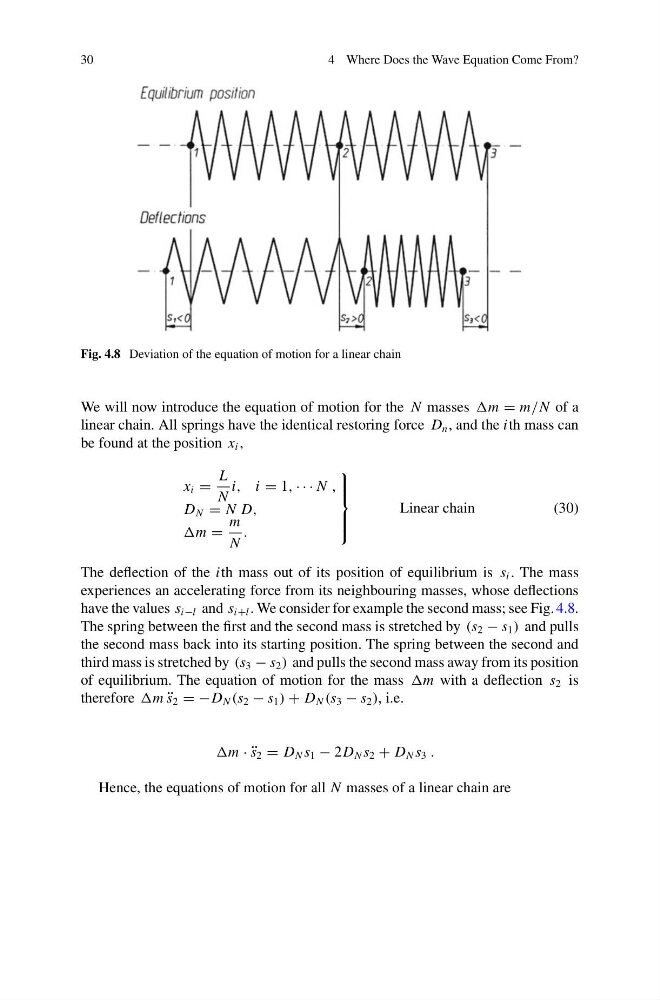
Fig. 4.8 Deviation of the equation of motion for a linear chain
We will now introduce the equation of motion for the N masses m = m/N of a
linear chain. All springs have the identical restoring force D n , and the ith mass can
be found at the position x i ,
x i =
L
N
i, i = 1, · · · N ,
D N = N D,
m =
m
N
.
⎫
⎪ ⎪ ⎬
⎪ ⎪ ⎭
Linear chain
(30)
The deflection of the ith mass out of its position of equilibrium is s i . The mass
experiences an accelerating force from its neighbouring masses, whose deflections
have the values s i−l and s i+l . We consider for example the second mass; see Fig. 4.8.
The spring between the first and the second mass is stretched by (s 2 − s 1 ) and pulls
the second mass back into its starting position. The spring between the second and
third mass is stretched by (s 3 − s 2 ) and pulls the second mass away from its position
of equilibrium. The equation of motion for the mass m with a deflection s 2 is
therefore m ¨
s 2 = −D N (s 2 − s 1 ) + D N (s 3 − s 2 ), i.e.
m · ¨
s 2 = D N s 1 − 2D N s 2 + D N s 3 .
Hence, the equations of motion for all N masses of a linear chain are
4 Where Does the Wave Equation Come From?
Fig. 4.8 Deviation of the equation of motion for a linear chain
We will now introduce the equation of motion for the N masses m = m/N of a
linear chain. All springs have the identical restoring force D n , and the ith mass can
be found at the position x i ,
x i =
L
N
i, i = 1, · · · N ,
D N = N D,
m =
m
N
.
⎫
⎪ ⎪ ⎬
⎪ ⎪ ⎭
Linear chain
(30)
The deflection of the ith mass out of its position of equilibrium is s i . The mass
experiences an accelerating force from its neighbouring masses, whose deflections
have the values s i−l and s i+l . We consider for example the second mass; see Fig. 4.8.
The spring between the first and the second mass is stretched by (s 2 − s 1 ) and pulls
the second mass back into its starting position. The spring between the second and
third mass is stretched by (s 3 − s 2 ) and pulls the second mass away from its position
of equilibrium. The equation of motion for the mass m with a deflection s 2 is
therefore m ¨
s 2 = −D N (s 2 − s 1 ) + D N (s 3 − s 2 ), i.e.
m · ¨
s 2 = D N s 1 − 2D N s 2 + D N s 3 .
Hence, the equations of motion for all N masses of a linear chain are