

26
4 Where Does the Wave Equation Come From?
here in our example with the same frequency ω, as observed in the oscillation for
single masses (13),
ω =
D
m
.
(15)
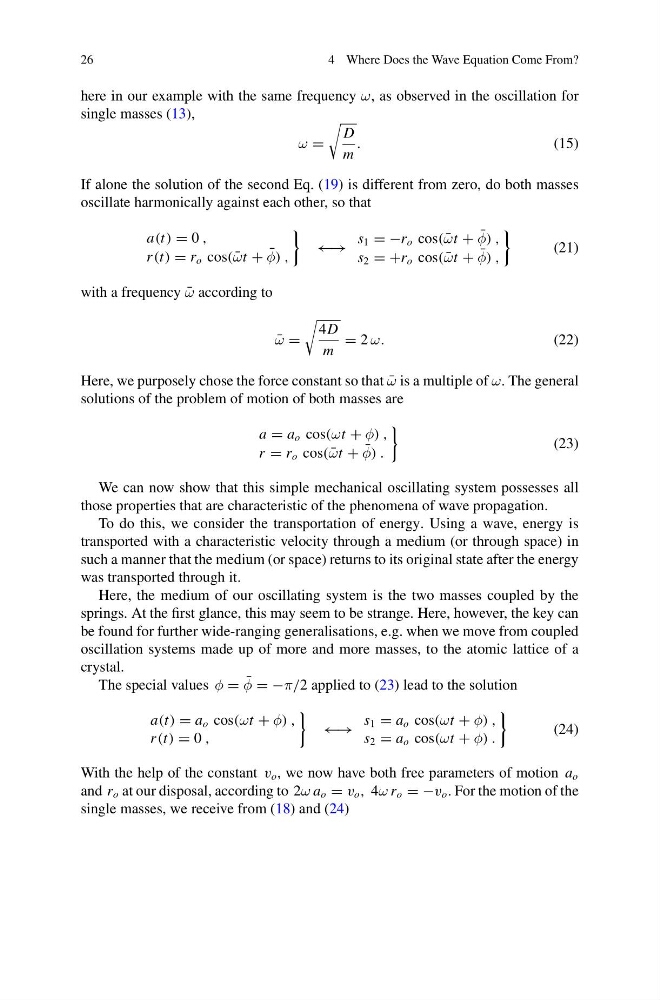
If alone the solution of the second Eq. (19) is different from zero, do both masses
oscillate harmonically against each other, so that
a(t) = 0 ,
r (t) = r o cos( ¯
ωt + ¯
φ) ,
←→
s 1 = −r o cos( ¯
ωt + ¯
φ) ,
s 2 = +r o cos( ¯
ωt + ¯
φ) ,
(21)
with a frequency ¯
ω according to
¯
ω =
4D
m
= 2 ω.
(22)
Here, we purposely chose the force constant so that ¯
ω is a multiple of ω. The general
solutions of the problem of motion of both masses are
a = a o cos(ωt + φ) ,
r = r o cos( ¯
ωt + ¯
φ) .
(23)
We can now show that this simple mechanical oscillating system possesses all
those properties that are characteristic of the phenomena of wave propagation.
To do this, we consider the transportation of energy. Using a wave, energy is
transported with a characteristic velocity through a medium (or through space) in
such a manner that the medium (or space) returns to its original state after the energy
was transported through it.
Here, the medium of our oscillating system is the two masses coupled by the
springs. At the first glance, this may seem to be strange. Here, however, the key can
be found for further wide-ranging generalisations, e.g. when we move from coupled
oscillation systems made up of more and more masses, to the atomic lattice of a
crystal.
The special values φ = ¯
φ = −π/2 applied to (23) lead to the solution
a(t) = a o cos(ωt + φ) ,
r (t) = 0 ,
←→
s 1 = a o cos(ωt + φ) ,
s 2 = a o cos(ωt + φ) .
(24)
With the help of the constant v o , we now have both free parameters of motion a o
and r o at our disposal, according to 2ω a o = v o , 4ω r o = −v o . For the motion of the
single masses, we receive from (18) and (24)
4 Where Does the Wave Equation Come From?
here in our example with the same frequency ω, as observed in the oscillation for
single masses (13),
ω =
D
m
.
(15)
If alone the solution of the second Eq. (19) is different from zero, do both masses
oscillate harmonically against each other, so that
a(t) = 0 ,
r (t) = r o cos( ¯
ωt + ¯
φ) ,
←→
s 1 = −r o cos( ¯
ωt + ¯
φ) ,
s 2 = +r o cos( ¯
ωt + ¯
φ) ,
(21)
with a frequency ¯
ω according to
¯
ω =
4D
m
= 2 ω.
(22)
Here, we purposely chose the force constant so that ¯
ω is a multiple of ω. The general
solutions of the problem of motion of both masses are
a = a o cos(ωt + φ) ,
r = r o cos( ¯
ωt + ¯
φ) .
(23)
We can now show that this simple mechanical oscillating system possesses all
those properties that are characteristic of the phenomena of wave propagation.
To do this, we consider the transportation of energy. Using a wave, energy is
transported with a characteristic velocity through a medium (or through space) in
such a manner that the medium (or space) returns to its original state after the energy
was transported through it.
Here, the medium of our oscillating system is the two masses coupled by the
springs. At the first glance, this may seem to be strange. Here, however, the key can
be found for further wide-ranging generalisations, e.g. when we move from coupled
oscillation systems made up of more and more masses, to the atomic lattice of a
crystal.
The special values φ = ¯
φ = −π/2 applied to (23) lead to the solution
a(t) = a o cos(ωt + φ) ,
r (t) = 0 ,
←→
s 1 = a o cos(ωt + φ) ,
s 2 = a o cos(ωt + φ) .
(24)
With the help of the constant v o , we now have both free parameters of motion a o
and r o at our disposal, according to 2ω a o = v o , 4ω r o = −v o . For the motion of the
single masses, we receive from (18) and (24)