

336
30 On the Causality Problem: Particle–Tachyon Collisions
If the constructed case above were true, what would be the effects on causality?
Would not we have proven the following above: If Dr Fast had caused the death of
Mr Stus with the help of his tachyon device then Mr Holmes, sitting in the Mercury
Express, would have observed the effect (the death of Stus) occurred before the cause
(shooting the tachyon). Causality broken?
In this case, the answer must in fact be no. A further piece of information is to
be added to the facts concerning Dr Fast’s action, namely that his assistant, Mr
Wacker, who was positioned at a distance of 2L away from Fast, simultaneously
emitted a tachyon, simultaneously in o . The cause of death must therefore include
that Mr Wacker indeed knew the exact time point when to fire the tachyon. We always
assumed that this was somehow known to both Fast and Wacker. This assumption
however is not exact enough when investigating the question of causality. Dr Fast
would have to have sent Wacker a message containing the information about the time
point, here t o = 0 in the reference system o , when Wacker should fire the tachyon.
This information cannot be sent faster than the velocity c o . The respective signal to
Wacker must have been sent no later than t
∗
= −2L/c o in order for Wacker to be
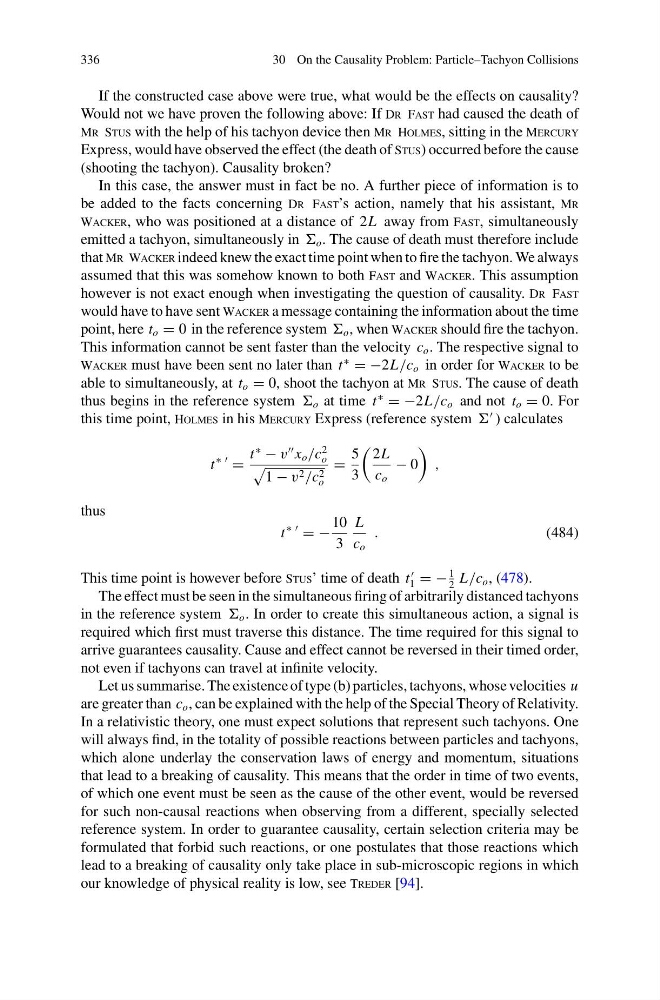
able to simultaneously, at t o = 0, shoot the tachyon at Mr Stus. The cause of death
thus begins in the reference system o at time t
∗
= −2L/c o and not t o = 0. For
this time point, Holmes in his Mercury Express (reference system
) calculates
t
∗ ∗
=
t
∗
− v
x o /c
2
o
1 − v 2 /c 2
o
=
5
3
2L
c o
− 0
,
thus
t
∗ ∗
= −
10
3
L
c o
.
(484)
This time point is however before Stus’ time of death t
1 = −
1
2
L/c o , (478).
The effect must be seen in the simultaneous firing of arbitrarily distanced tachyons
in the reference system o . In order to create this simultaneous action, a signal is
required which first must traverse this distance. The time required for this signal to
arrive guarantees causality. Cause and effect cannot be reversed in their timed order,
not even if tachyons can travel at infinite velocity.
Let us summarise. The existence of type (b) particles, tachyons, whose velocities u
are greater than c o , can be explained with the help of the Special Theory of Relativity.
In a relativistic theory, one must expect solutions that represent such tachyons. One
will always find, in the totality of possible reactions between particles and tachyons,
which alone underlay the conservation laws of energy and momentum, situations
that lead to a breaking of causality. This means that the order in time of two events,
of which one event must be seen as the cause of the other event, would be reversed
for such non-causal reactions when observing from a different, specially selected
reference system. In order to guarantee causality, certain selection criteria may be
formulated that forbid such reactions, or one postulates that those reactions which
lead to a breaking of causality only take place in sub-microscopic regions in which
our knowledge of physical reality is low, see Treder [94].
30 On the Causality Problem: Particle–Tachyon Collisions
If the constructed case above were true, what would be the effects on causality?
Would not we have proven the following above: If Dr Fast had caused the death of
Mr Stus with the help of his tachyon device then Mr Holmes, sitting in the Mercury
Express, would have observed the effect (the death of Stus) occurred before the cause
(shooting the tachyon). Causality broken?
In this case, the answer must in fact be no. A further piece of information is to
be added to the facts concerning Dr Fast’s action, namely that his assistant, Mr
Wacker, who was positioned at a distance of 2L away from Fast, simultaneously
emitted a tachyon, simultaneously in o . The cause of death must therefore include
that Mr Wacker indeed knew the exact time point when to fire the tachyon. We always
assumed that this was somehow known to both Fast and Wacker. This assumption
however is not exact enough when investigating the question of causality. Dr Fast
would have to have sent Wacker a message containing the information about the time
point, here t o = 0 in the reference system o , when Wacker should fire the tachyon.
This information cannot be sent faster than the velocity c o . The respective signal to
Wacker must have been sent no later than t
∗
= −2L/c o in order for Wacker to be
able to simultaneously, at t o = 0, shoot the tachyon at Mr Stus. The cause of death
thus begins in the reference system o at time t
∗
= −2L/c o and not t o = 0. For
this time point, Holmes in his Mercury Express (reference system
) calculates
t
∗ ∗
=
t
∗
− v
x o /c
2
o
1 − v 2 /c 2
o
=
5
3
2L
c o
− 0
,
thus
t
∗ ∗
= −
10
3
L
c o
.
(484)
This time point is however before Stus’ time of death t
1 = −
1
2
L/c o , (478).
The effect must be seen in the simultaneous firing of arbitrarily distanced tachyons
in the reference system o . In order to create this simultaneous action, a signal is
required which first must traverse this distance. The time required for this signal to
arrive guarantees causality. Cause and effect cannot be reversed in their timed order,
not even if tachyons can travel at infinite velocity.
Let us summarise. The existence of type (b) particles, tachyons, whose velocities u
are greater than c o , can be explained with the help of the Special Theory of Relativity.
In a relativistic theory, one must expect solutions that represent such tachyons. One
will always find, in the totality of possible reactions between particles and tachyons,
which alone underlay the conservation laws of energy and momentum, situations
that lead to a breaking of causality. This means that the order in time of two events,
of which one event must be seen as the cause of the other event, would be reversed
for such non-causal reactions when observing from a different, specially selected
reference system. In order to guarantee causality, certain selection criteria may be
formulated that forbid such reactions, or one postulates that those reactions which
lead to a breaking of causality only take place in sub-microscopic regions in which
our knowledge of physical reality is low, see Treder [94].