

30 On the Causality Problem: Particle–Tachyon Collisions
331
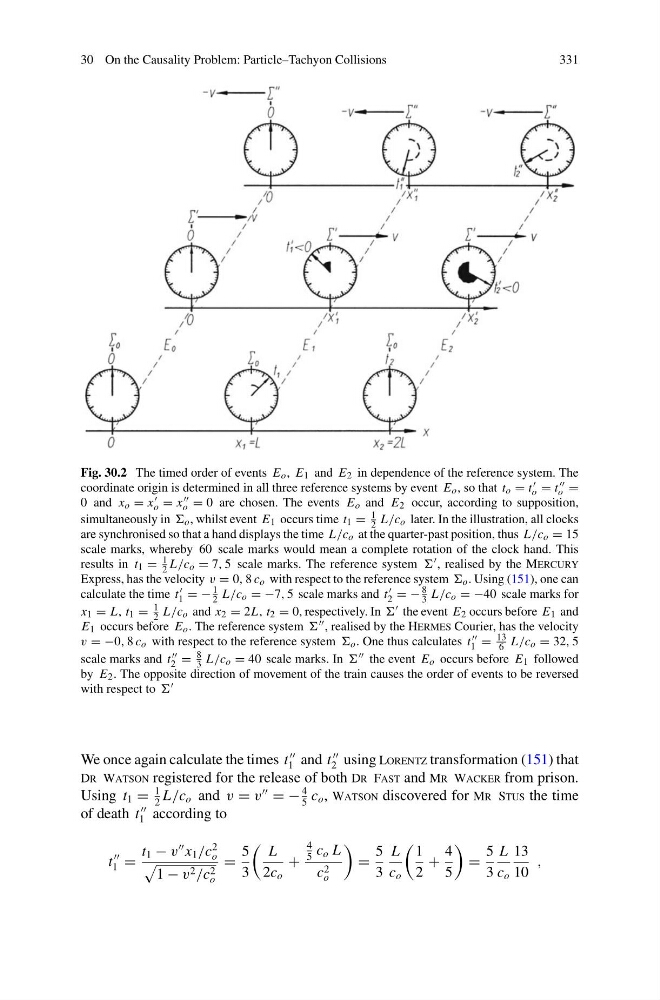
Fig. 30.2 The timed order of events E o , E 1 and E 2 in dependence of the reference system. The
coordinate origin is determined in all three reference systems by event E o , so that t o = t
o = t
o =
0 and x o = x
o = x
o = 0 are chosen. The events E o and E 2 occur, according to supposition,
simultaneously in o , whilst event E 1 occurs time t 1 =
1
2 L/c o later. In the illustration, all clocks
are synchronised so that a hand displays the time L/c o at the quarter-past position, thus L/c o = 15
scale marks, whereby 60 scale marks would mean a complete rotation of the clock hand. This
results in t 1 =
1
2 L/c o = 7, 5 scale marks. The reference system , realised by the Mercury
Express, has the velocity v = 0, 8 c o with respect to the reference system o . Using (151), one can
calculate the time t
1 = −
1
2 L/c o = −7, 5 scale marks and t
2 = −
8
3 L/c o = −40 scale marks for
x 1 = L, t 1 =
1
2 L/c o and x 2 = 2L, t 2 = 0, respectively. In the event E 2 occurs before E 1 and
E 1 occurs before E o . The reference system , realised by the Hermes Courier, has the velocity
v = −0, 8 c o with respect to the reference system o . One thus calculates t
1 =
13
6 L/c o = 32, 5
scale marks and t
2 =
8
3 L/c o = 40 scale marks. In the event E o occurs before E 1 followed
by E 2 . The opposite direction of movement of the train causes the order of events to be reversed
with respect to
We once again calculate the times t
1 and t
2 using Lorentz transformation (151) that
Dr Watson registered for the release of both Dr Fast and Mr Wacker from prison.
Using t 1 =
1
2
L/c o and v = v
= −
4
5
c o , Watson discovered for Mr Stus the time
of death t
1 according to
t
1 =
t 1 − v
x 1 /c
2
o
1 − v 2 /c 2
o
=
5
3
L
2c o
+
4
5
c o L
c 2
o
=
5
3
L
c o
1
2
+
4
5
=
5
3
L
c o
13
10
,
331
Fig. 30.2 The timed order of events E o , E 1 and E 2 in dependence of the reference system. The
coordinate origin is determined in all three reference systems by event E o , so that t o = t
o = t
o =
0 and x o = x
o = x
o = 0 are chosen. The events E o and E 2 occur, according to supposition,
simultaneously in o , whilst event E 1 occurs time t 1 =
1
2 L/c o later. In the illustration, all clocks
are synchronised so that a hand displays the time L/c o at the quarter-past position, thus L/c o = 15
scale marks, whereby 60 scale marks would mean a complete rotation of the clock hand. This
results in t 1 =
1
2 L/c o = 7, 5 scale marks. The reference system , realised by the Mercury
Express, has the velocity v = 0, 8 c o with respect to the reference system o . Using (151), one can
calculate the time t
1 = −
1
2 L/c o = −7, 5 scale marks and t
2 = −
8
3 L/c o = −40 scale marks for
x 1 = L, t 1 =
1
2 L/c o and x 2 = 2L, t 2 = 0, respectively. In the event E 2 occurs before E 1 and
E 1 occurs before E o . The reference system , realised by the Hermes Courier, has the velocity
v = −0, 8 c o with respect to the reference system o . One thus calculates t
1 =
13
6 L/c o = 32, 5
scale marks and t
2 =
8
3 L/c o = 40 scale marks. In the event E o occurs before E 1 followed
by E 2 . The opposite direction of movement of the train causes the order of events to be reversed
with respect to
We once again calculate the times t
1 and t
2 using Lorentz transformation (151) that
Dr Watson registered for the release of both Dr Fast and Mr Wacker from prison.
Using t 1 =
1
2
L/c o and v = v
= −
4
5
c o , Watson discovered for Mr Stus the time
of death t
1 according to
t
1 =
t 1 − v
x 1 /c
2
o
1 − v 2 /c 2
o
=
5
3
L
2c o
+
4
5
c o L
c 2
o
=
5
3
L
c o
1
2
+
4
5
=
5
3
L
c o
13
10
,