

328
30 On the Causality Problem: Particle–Tachyon Collisions
tachyon parts, and that from the very beginning. In a non-linear field theory, one
would generally have to re-consider which initial condition basically approximates
that of an incoming tachyon colliding with a particle. The question with respect to the
transmission of an amount of energy E by the tachyon to the particle can be seen as
a solution in a non-linear field theory of an initial value problem of a corresponding
partial differential equation. If exact calculations are not supplied, we drift into the
realm of speculation with respect to the comprehensive question about causality. As
we have seen above with respect to the plastic tachyons of the sine-Gordon equation,
they represent states which exist at any time along the complete x-axis, thus also
at the position of an arbitrary, isolated ‘normal’ particle. The requirements for the
collision of two particles, used by us for the above calculations, cannot be fulfilled.
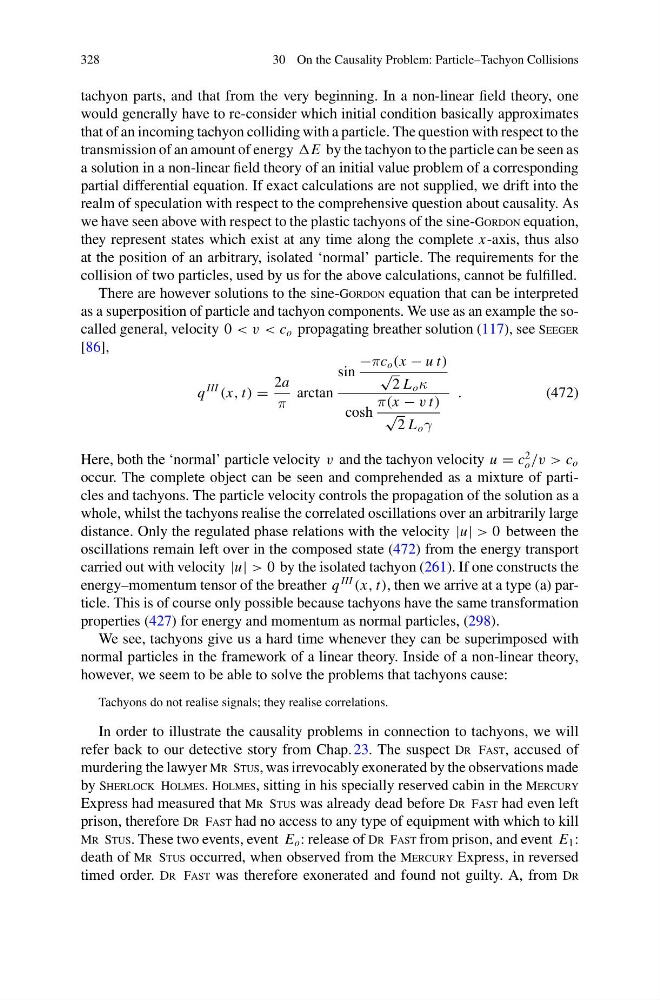
There are however solutions to the sine-Gordon equation that can be interpreted
as a superposition of particle and tachyon components. We use as an example the socalled general, velocity 0 < v < c o propagating breather solution (117), see Seeger
[86],
q
III
(x, t) =
2a
π
arctan
sin
−πc o (x − u t)
√
2 L o κ
cosh
π(x − v t)
√
2 L o γ
.
(472)
Here, both the ‘normal’ particle velocity v and the tachyon velocity u = c
2
o /v > c o
occur. The complete object can be seen and comprehended as a mixture of particles and tachyons. The particle velocity controls the propagation of the solution as a
whole, whilst the tachyons realise the correlated oscillations over an arbitrarily large
distance. Only the regulated phase relations with the velocity |u| > 0 between the
oscillations remain left over in the composed state (472) from the energy transport
carried out with velocity |u| > 0 by the isolated tachyon (261). If one constructs the
energy–momentum tensor of the breather q
III
(x, t), then we arrive at a type (a) particle. This is of course only possible because tachyons have the same transformation
properties (427) for energy and momentum as normal particles, (298).
We see, tachyons give us a hard time whenever they can be superimposed with
normal particles in the framework of a linear theory. Inside of a non-linear theory,
however, we seem to be able to solve the problems that tachyons cause:
Tachyons do not realise signals; they realise correlations.
In order to illustrate the causality problems in connection to tachyons, we will
refer back to our detective story from Chap. 23. The suspect Dr Fast, accused of
murdering the lawyer Mr Stus, was irrevocably exonerated by the observations made
by Sherlock Holmes. Holmes, sitting in his specially reserved cabin in the Mercury
Express had measured that Mr Stus was already dead before Dr Fast had even left
prison, therefore Dr Fast had no access to any type of equipment with which to kill
Mr Stus. These two events, event E o : release of Dr Fast from prison, and event E 1 :
death of Mr Stus occurred, when observed from the Mercury Express, in reversed
timed order. Dr Fast was therefore exonerated and found not guilty. A, from Dr
30 On the Causality Problem: Particle–Tachyon Collisions
tachyon parts, and that from the very beginning. In a non-linear field theory, one
would generally have to re-consider which initial condition basically approximates
that of an incoming tachyon colliding with a particle. The question with respect to the
transmission of an amount of energy E by the tachyon to the particle can be seen as
a solution in a non-linear field theory of an initial value problem of a corresponding
partial differential equation. If exact calculations are not supplied, we drift into the
realm of speculation with respect to the comprehensive question about causality. As
we have seen above with respect to the plastic tachyons of the sine-Gordon equation,
they represent states which exist at any time along the complete x-axis, thus also
at the position of an arbitrary, isolated ‘normal’ particle. The requirements for the
collision of two particles, used by us for the above calculations, cannot be fulfilled.
There are however solutions to the sine-Gordon equation that can be interpreted
as a superposition of particle and tachyon components. We use as an example the socalled general, velocity 0 < v < c o propagating breather solution (117), see Seeger
[86],
q
III
(x, t) =
2a
π
arctan
sin
−πc o (x − u t)
√
2 L o κ
cosh
π(x − v t)
√
2 L o γ
.
(472)
Here, both the ‘normal’ particle velocity v and the tachyon velocity u = c
2
o /v > c o
occur. The complete object can be seen and comprehended as a mixture of particles and tachyons. The particle velocity controls the propagation of the solution as a
whole, whilst the tachyons realise the correlated oscillations over an arbitrarily large
distance. Only the regulated phase relations with the velocity |u| > 0 between the
oscillations remain left over in the composed state (472) from the energy transport
carried out with velocity |u| > 0 by the isolated tachyon (261). If one constructs the
energy–momentum tensor of the breather q
III
(x, t), then we arrive at a type (a) particle. This is of course only possible because tachyons have the same transformation
properties (427) for energy and momentum as normal particles, (298).
We see, tachyons give us a hard time whenever they can be superimposed with
normal particles in the framework of a linear theory. Inside of a non-linear theory,
however, we seem to be able to solve the problems that tachyons cause:
Tachyons do not realise signals; they realise correlations.
In order to illustrate the causality problems in connection to tachyons, we will
refer back to our detective story from Chap. 23. The suspect Dr Fast, accused of
murdering the lawyer Mr Stus, was irrevocably exonerated by the observations made
by Sherlock Holmes. Holmes, sitting in his specially reserved cabin in the Mercury
Express had measured that Mr Stus was already dead before Dr Fast had even left
prison, therefore Dr Fast had no access to any type of equipment with which to kill
Mr Stus. These two events, event E o : release of Dr Fast from prison, and event E 1 :
death of Mr Stus occurred, when observed from the Mercury Express, in reversed
timed order. Dr Fast was therefore exonerated and found not guilty. A, from Dr