

29 Tachyons of Plastic Deformation
319
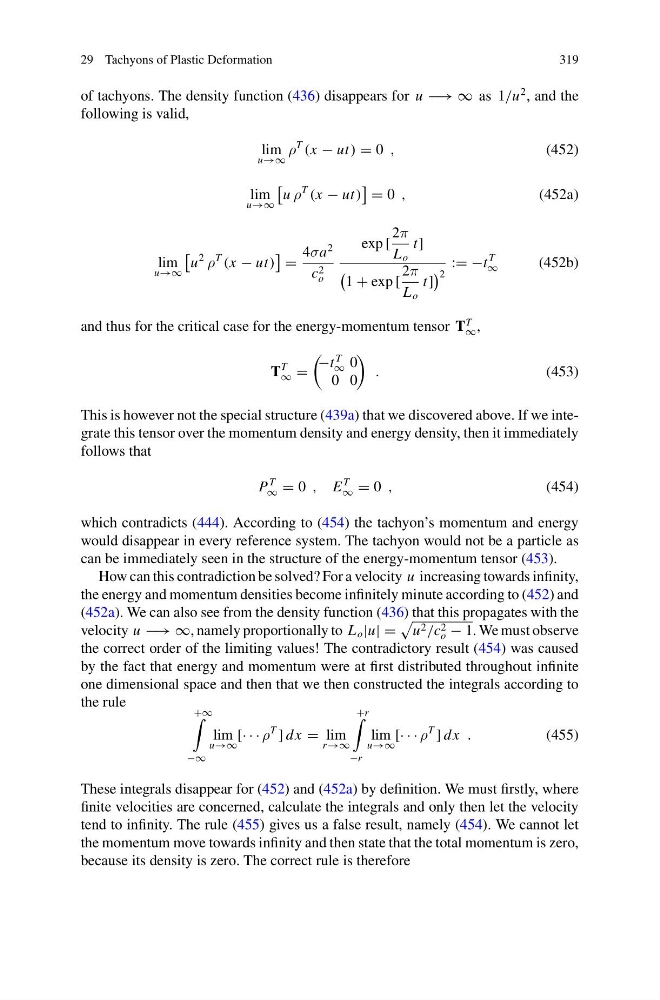
of tachyons. The density function (436) disappears for u −→ ∞ as 1/u
2 , and the
following is valid,
lim
u→∞
ρ
T
(x − ut) = 0 ,
(452)
lim
u→∞
u ρ
T
(x − ut)
= 0 ,
(452a)
lim
u→∞
u
2
ρ
T
(x − ut)
=
4σa
2
c 2
o
exp [
2π
L o
t]
1 + exp [
2π
L o
t]
2
:= −t
T
∞
(452b)
and thus for the critical case for the energy-momentum tensor T
T
∞ ,
T
T
∞ =
−t
T
∞ 0
0 0
.
(453)
This is however not the special structure (439a) that we discovered above. If we integrate this tensor over the momentum density and energy density, then it immediately
follows that
P
T
∞ = 0 , E
T
∞ = 0 ,
(454)
which contradicts (444). According to (454) the tachyon’s momentum and energy
would disappear in every reference system. The tachyon would not be a particle as
can be immediately seen in the structure of the energy-momentum tensor (453).
How can this contradiction be solved? For a velocity u increasing towards infinity,
the energy and momentum densities become infinitely minute according to (452) and
(452a). We can also see from the density function (436) that this propagates with the
velocity u −→ ∞, namely proportionally to L o |u| =
u 2 /c 2
o − 1. We must observe
the correct order of the limiting values! The contradictory result (454) was caused
by the fact that energy and momentum were at first distributed throughout infinite
one dimensional space and then that we then constructed the integrals according to
the rule
+∞
−∞
lim
u→∞
[· · · ρ
T
] dx = lim
r →∞
+r
−r
lim
u→∞
[· · · ρ
T
] dx .
(455)
These integrals disappear for (452) and (452a) by definition. We must firstly, where
finite velocities are concerned, calculate the integrals and only then let the velocity
tend to infinity. The rule (455) gives us a false result, namely (454). We cannot let
the momentum move towards infinity and then state that the total momentum is zero,
because its density is zero. The correct rule is therefore
319
of tachyons. The density function (436) disappears for u −→ ∞ as 1/u
2 , and the
following is valid,
lim
u→∞
ρ
T
(x − ut) = 0 ,
(452)
lim
u→∞
u ρ
T
(x − ut)
= 0 ,
(452a)
lim
u→∞
u
2
ρ
T
(x − ut)
=
4σa
2
c 2
o
exp [
2π
L o
t]
1 + exp [
2π
L o
t]
2
:= −t
T
∞
(452b)
and thus for the critical case for the energy-momentum tensor T
T
∞ ,
T
T
∞ =
−t
T
∞ 0
0 0
.
(453)
This is however not the special structure (439a) that we discovered above. If we integrate this tensor over the momentum density and energy density, then it immediately
follows that
P
T
∞ = 0 , E
T
∞ = 0 ,
(454)
which contradicts (444). According to (454) the tachyon’s momentum and energy
would disappear in every reference system. The tachyon would not be a particle as
can be immediately seen in the structure of the energy-momentum tensor (453).
How can this contradiction be solved? For a velocity u increasing towards infinity,
the energy and momentum densities become infinitely minute according to (452) and
(452a). We can also see from the density function (436) that this propagates with the
velocity u −→ ∞, namely proportionally to L o |u| =
u 2 /c 2
o − 1. We must observe
the correct order of the limiting values! The contradictory result (454) was caused
by the fact that energy and momentum were at first distributed throughout infinite
one dimensional space and then that we then constructed the integrals according to
the rule
+∞
−∞
lim
u→∞
[· · · ρ
T
] dx = lim
r →∞
+r
−r
lim
u→∞
[· · · ρ
T
] dx .
(455)
These integrals disappear for (452) and (452a) by definition. We must firstly, where
finite velocities are concerned, calculate the integrals and only then let the velocity
tend to infinity. The rule (455) gives us a false result, namely (454). We cannot let
the momentum move towards infinity and then state that the total momentum is zero,
because its density is zero. The correct rule is therefore