

316
29 Tachyons of Plastic Deformation
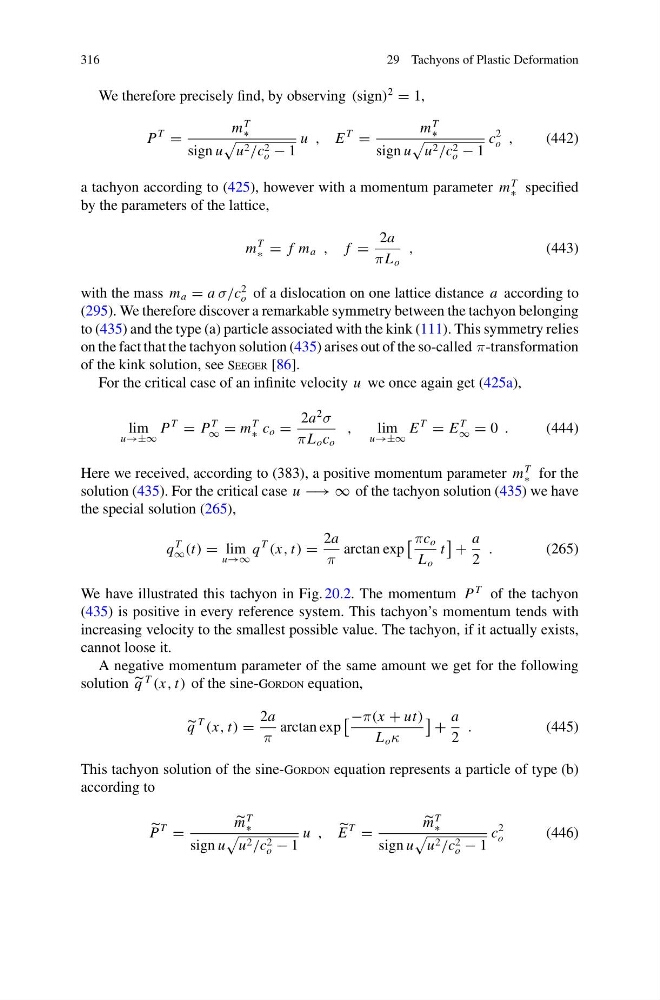
We therefore precisely find, by observing (sign)
2
= 1,
P
T
=
m
T
∗
sign u
u 2 /c 2
o − 1
u , E
T
=
m
T
∗
sign u
u 2 /c 2
o − 1
c
2
o ,
(442)
a tachyon according to (425), however with a momentum parameter m
T
∗ specified
by the parameters of the lattice,
m
T
∗ = f m a , f =
2a
πL o
,
(443)
with the mass m a = a σ/c
2
o of a dislocation on one lattice distance a according to
(295). We therefore discover a remarkable symmetry between the tachyon belonging
to (435) and the type (a) particle associated with the kink (111). This symmetry relies
on the fact that the tachyon solution (435) arises out of the so-called π-transformation
of the kink solution, see Seeger [86].
For the critical case of an infinite velocity u we once again get (425a),
lim
u→±∞
P
T
= P
T
∞ = m
T
∗ c o =
2a
2
σ
πL o c o
,
lim
u→±∞
E
T
= E
T
∞ = 0 .
(444)
Here we received, according to (383), a positive momentum parameter m
T
∗ for the
solution (435). For the critical case u −→ ∞ of the tachyon solution (435) we have
the special solution (265),
q
T
∞ (t) = lim
u→∞
q
T
(x, t) =
2a
π
arctan exp
πc o
L o
t
+
a
2
.
(265)
We have illustrated this tachyon in Fig. 20.2. The momentum P
T of the tachyon
(435) is positive in every reference system. This tachyon’s momentum tends with
increasing velocity to the smallest possible value. The tachyon, if it actually exists,
cannot loose it.
A negative momentum parameter of the same amount we get for the following
solution q
T
(x, t) of the sine-Gordon equation,
q
T
(x, t) =
2a
π
arctan exp
−π(x + ut)
L o κ
+
a
2
.
(445)
This tachyon solution of the sine-Gordon equation represents a particle of type (b)
according to
P
T
=
m
T
∗
sign u
u 2 /c 2
o − 1
u ,
E
T
=
m
T
∗
sign u
u 2 /c 2
o − 1
c
2
o
(446)
29 Tachyons of Plastic Deformation
We therefore precisely find, by observing (sign)
2
= 1,
P
T
=
m
T
∗
sign u
u 2 /c 2
o − 1
u , E
T
=
m
T
∗
sign u
u 2 /c 2
o − 1
c
2
o ,
(442)
a tachyon according to (425), however with a momentum parameter m
T
∗ specified
by the parameters of the lattice,
m
T
∗ = f m a , f =
2a
πL o
,
(443)
with the mass m a = a σ/c
2
o of a dislocation on one lattice distance a according to
(295). We therefore discover a remarkable symmetry between the tachyon belonging
to (435) and the type (a) particle associated with the kink (111). This symmetry relies
on the fact that the tachyon solution (435) arises out of the so-called π-transformation
of the kink solution, see Seeger [86].
For the critical case of an infinite velocity u we once again get (425a),
lim
u→±∞
P
T
= P
T
∞ = m
T
∗ c o =
2a
2
σ
πL o c o
,
lim
u→±∞
E
T
= E
T
∞ = 0 .
(444)
Here we received, according to (383), a positive momentum parameter m
T
∗ for the
solution (435). For the critical case u −→ ∞ of the tachyon solution (435) we have
the special solution (265),
q
T
∞ (t) = lim
u→∞
q
T
(x, t) =
2a
π
arctan exp
πc o
L o
t
+
a
2
.
(265)
We have illustrated this tachyon in Fig. 20.2. The momentum P
T of the tachyon
(435) is positive in every reference system. This tachyon’s momentum tends with
increasing velocity to the smallest possible value. The tachyon, if it actually exists,
cannot loose it.
A negative momentum parameter of the same amount we get for the following
solution q
T
(x, t) of the sine-Gordon equation,
q
T
(x, t) =
2a
π
arctan exp
−π(x + ut)
L o κ
+
a
2
.
(445)
This tachyon solution of the sine-Gordon equation represents a particle of type (b)
according to
P
T
=
m
T
∗
sign u
u 2 /c 2
o − 1
u ,
E
T
=
m
T
∗
sign u
u 2 /c 2
o − 1
c
2
o
(446)