

4 Where Does the Wave Equation Come From?
21
We assume, due to our experience, that inertial frames actually exist. The postulation of relativity for all physical processes already introduced in the Galileian
principle was expressed in the view of mechanics, because it was thought that principally all physical processes and phenomena were of mechanical origin. Einstein’s
analysis introduced the new idea that relativity—now independent from the field of
mechanics—could also be applied for electromagnetic phenomena. The fundamental
physical consequences were summarised in the previous chapter.
3
We are now interested in the general law for the motion of a mass m in an arbitrary
inertial system under the action of a force. This law was formulated in 1687 by
I. Newton and is called The Second Newtonian Axiom. Here, for the momentum
p = m · v of a mass m moving at the velocity v under the influence of a force F, the
following is valid,
d
dt
p = F.
(11)
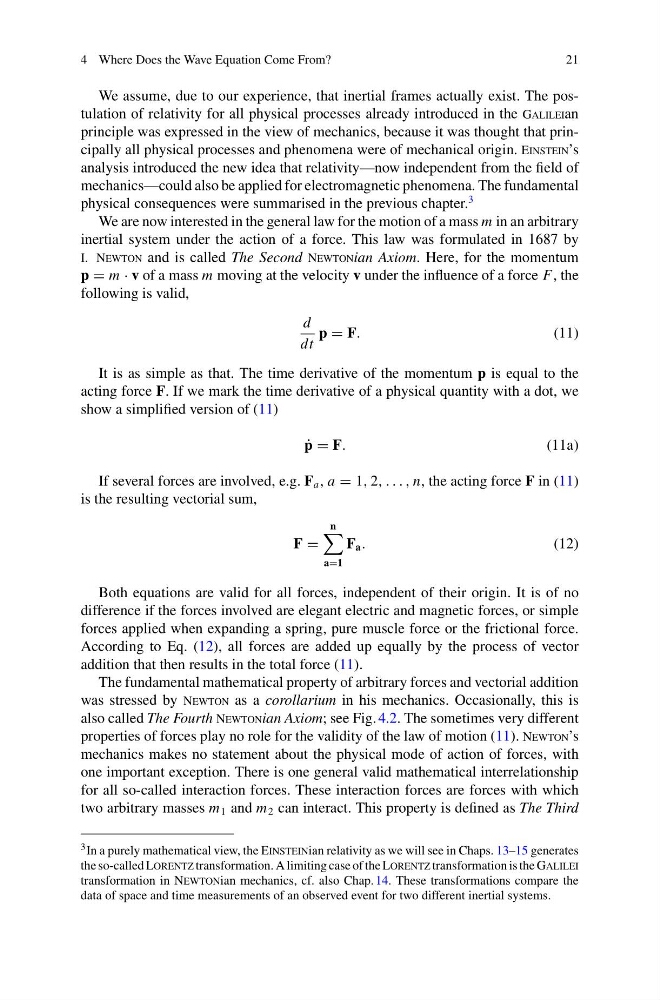
It is as simple as that. The time derivative of the momentum p is equal to the
acting force F. If we mark the time derivative of a physical quantity with a dot, we
show a simplified version of (11)
˙
p = F.
(11a)
If several forces are involved, e.g. F a , a = 1, 2, . . . , n, the acting force F in (11)
is the resulting vectorial sum,
F =
n
a=1
F a .
(12)
Both equations are valid for all forces, independent of their origin. It is of no
difference if the forces involved are elegant electric and magnetic forces, or simple
forces applied when expanding a spring, pure muscle force or the frictional force.
According to Eq. (12), all forces are added up equally by the process of vector
addition that then results in the total force (11).
The fundamental mathematical property of arbitrary forces and vectorial addition
was stressed by Newton as a corollarium in his mechanics. Occasionally, this is
also called The Fourth Newtonian Axiom; see Fig. 4.2. The sometimes very different
properties of forces play no role for the validity of the law of motion (11). Newton’s
mechanics makes no statement about the physical mode of action of forces, with
one important exception. There is one general valid mathematical interrelationship
for all so-called interaction forces. These interaction forces are forces with which
two arbitrary masses m 1 and m 2 can interact. This property is defined as The Third
3 In a purely mathematical view, the Einsteinian relativity as we will see in Chaps. 13–15 generates
the so-called Lorentz transformation. A limiting case of the Lorentz transformation is the Galilei
transformation in Newtonian mechanics, cf. also Chap. 14. These transformations compare the
data of space and time measurements of an observed event for two different inertial systems.
21
We assume, due to our experience, that inertial frames actually exist. The postulation of relativity for all physical processes already introduced in the Galileian
principle was expressed in the view of mechanics, because it was thought that principally all physical processes and phenomena were of mechanical origin. Einstein’s
analysis introduced the new idea that relativity—now independent from the field of
mechanics—could also be applied for electromagnetic phenomena. The fundamental
physical consequences were summarised in the previous chapter.
3
We are now interested in the general law for the motion of a mass m in an arbitrary
inertial system under the action of a force. This law was formulated in 1687 by
I. Newton and is called The Second Newtonian Axiom. Here, for the momentum
p = m · v of a mass m moving at the velocity v under the influence of a force F, the
following is valid,
d
dt
p = F.
(11)
It is as simple as that. The time derivative of the momentum p is equal to the
acting force F. If we mark the time derivative of a physical quantity with a dot, we
show a simplified version of (11)
˙
p = F.
(11a)
If several forces are involved, e.g. F a , a = 1, 2, . . . , n, the acting force F in (11)
is the resulting vectorial sum,
F =
n
a=1
F a .
(12)
Both equations are valid for all forces, independent of their origin. It is of no
difference if the forces involved are elegant electric and magnetic forces, or simple
forces applied when expanding a spring, pure muscle force or the frictional force.
According to Eq. (12), all forces are added up equally by the process of vector
addition that then results in the total force (11).
The fundamental mathematical property of arbitrary forces and vectorial addition
was stressed by Newton as a corollarium in his mechanics. Occasionally, this is
also called The Fourth Newtonian Axiom; see Fig. 4.2. The sometimes very different
properties of forces play no role for the validity of the law of motion (11). Newton’s
mechanics makes no statement about the physical mode of action of forces, with
one important exception. There is one general valid mathematical interrelationship
for all so-called interaction forces. These interaction forces are forces with which
two arbitrary masses m 1 and m 2 can interact. This property is defined as The Third
3 In a purely mathematical view, the Einsteinian relativity as we will see in Chaps. 13–15 generates
the so-called Lorentz transformation. A limiting case of the Lorentz transformation is the Galilei
transformation in Newtonian mechanics, cf. also Chap. 14. These transformations compare the
data of space and time measurements of an observed event for two different inertial systems.