

300
28 Particles and Tachyons
of a tachyon has, as we will see below, a rather abstract meaning and can only be
introduced using the momentum P
T of the tachyon. The relationships for ‘normal’
particles cannot just be carried over to tachyons.
We will, to start off with, examine the general Einsteinian composition of velocities
that we developed in Chap. 17, Eq. (194). A ‘flying’ object may have in the reference
system
(x
, t
) the arbitrary velocity u
= dx
/dt
. The reference system
,
which we should consider a ‘normal object’ such as a train for example, may have the
velocity V measured from out the reference system o . |V | < c o always applies to
the velocities |V | of a reference system. The velocity u = dx/dt that an observer in
the reference system o measures for the same flying object must then be, according
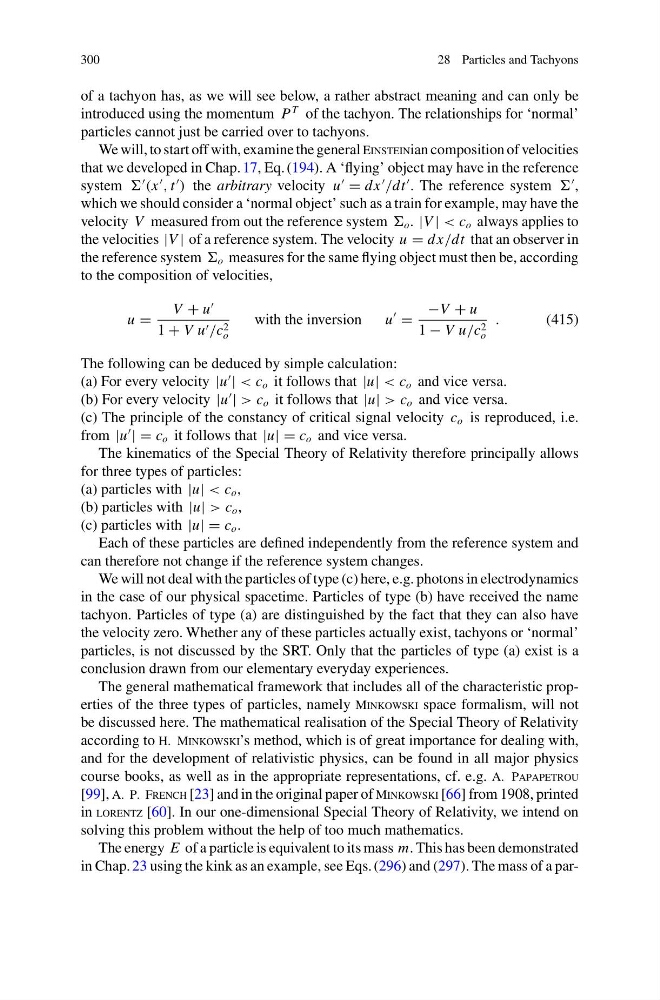
to the composition of velocities,
u =
V + u
1 + V u /c 2
o
with the inversion
u
=
−V + u
1 − V u/c 2
o
.
(415)
The following can be deduced by simple calculation:
(a) For every velocity |u
| < c o it follows that |u| < c o and vice versa.
(b) For every velocity |u
| > c o it follows that |u| > c o and vice versa.
(c) The principle of the constancy of critical signal velocity c o is reproduced, i.e.
from |u
| = c o it follows that |u| = c o and vice versa.
The kinematics of the Special Theory of Relativity therefore principally allows
for three types of particles:
(a) particles with |u| < c o ,
(b) particles with |u| > c o ,
(c) particles with |u| = c o .
Each of these particles are defined independently from the reference system and
can therefore not change if the reference system changes.
We will not deal with the particles of type (c) here, e.g. photons in electrodynamics
in the case of our physical spacetime. Particles of type (b) have received the name
tachyon. Particles of type (a) are distinguished by the fact that they can also have
the velocity zero. Whether any of these particles actually exist, tachyons or ‘normal’
particles, is not discussed by the SRT. Only that the particles of type (a) exist is a
conclusion drawn from our elementary everyday experiences.
The general mathematical framework that includes all of the characteristic properties of the three types of particles, namely Minkowski space formalism, will not
be discussed here. The mathematical realisation of the Special Theory of Relativity
according to H. Minkowski’s method, which is of great importance for dealing with,
and for the development of relativistic physics, can be found in all major physics
course books, as well as in the appropriate representations, cf. e.g. A. Papapetrou
[99], A. P. French [23] and in the original paper of Minkowski [66] from 1908, printed
in lorentz [60]. In our one-dimensional Special Theory of Relativity, we intend on
solving this problem without the help of too much mathematics.
The energy E of a particle is equivalent to its mass m. This has been demonstrated
in Chap. 23 using the kink as an example, see Eqs. (296) and (297). The mass of a par-
28 Particles and Tachyons
of a tachyon has, as we will see below, a rather abstract meaning and can only be
introduced using the momentum P
T of the tachyon. The relationships for ‘normal’
particles cannot just be carried over to tachyons.
We will, to start off with, examine the general Einsteinian composition of velocities
that we developed in Chap. 17, Eq. (194). A ‘flying’ object may have in the reference
system
(x
, t
) the arbitrary velocity u
= dx
/dt
. The reference system
,
which we should consider a ‘normal object’ such as a train for example, may have the
velocity V measured from out the reference system o . |V | < c o always applies to
the velocities |V | of a reference system. The velocity u = dx/dt that an observer in
the reference system o measures for the same flying object must then be, according
to the composition of velocities,
u =
V + u
1 + V u /c 2
o
with the inversion
u
=
−V + u
1 − V u/c 2
o
.
(415)
The following can be deduced by simple calculation:
(a) For every velocity |u
| < c o it follows that |u| < c o and vice versa.
(b) For every velocity |u
| > c o it follows that |u| > c o and vice versa.
(c) The principle of the constancy of critical signal velocity c o is reproduced, i.e.
from |u
| = c o it follows that |u| = c o and vice versa.
The kinematics of the Special Theory of Relativity therefore principally allows
for three types of particles:
(a) particles with |u| < c o ,
(b) particles with |u| > c o ,
(c) particles with |u| = c o .
Each of these particles are defined independently from the reference system and
can therefore not change if the reference system changes.
We will not deal with the particles of type (c) here, e.g. photons in electrodynamics
in the case of our physical spacetime. Particles of type (b) have received the name
tachyon. Particles of type (a) are distinguished by the fact that they can also have
the velocity zero. Whether any of these particles actually exist, tachyons or ‘normal’
particles, is not discussed by the SRT. Only that the particles of type (a) exist is a
conclusion drawn from our elementary everyday experiences.
The general mathematical framework that includes all of the characteristic properties of the three types of particles, namely Minkowski space formalism, will not
be discussed here. The mathematical realisation of the Special Theory of Relativity
according to H. Minkowski’s method, which is of great importance for dealing with,
and for the development of relativistic physics, can be found in all major physics
course books, as well as in the appropriate representations, cf. e.g. A. Papapetrou
[99], A. P. French [23] and in the original paper of Minkowski [66] from 1908, printed
in lorentz [60]. In our one-dimensional Special Theory of Relativity, we intend on
solving this problem without the help of too much mathematics.
The energy E of a particle is equivalent to its mass m. This has been demonstrated
in Chap. 23 using the kink as an example, see Eqs. (296) and (297). The mass of a par-