

274
25 Elastic Displacements and Waves
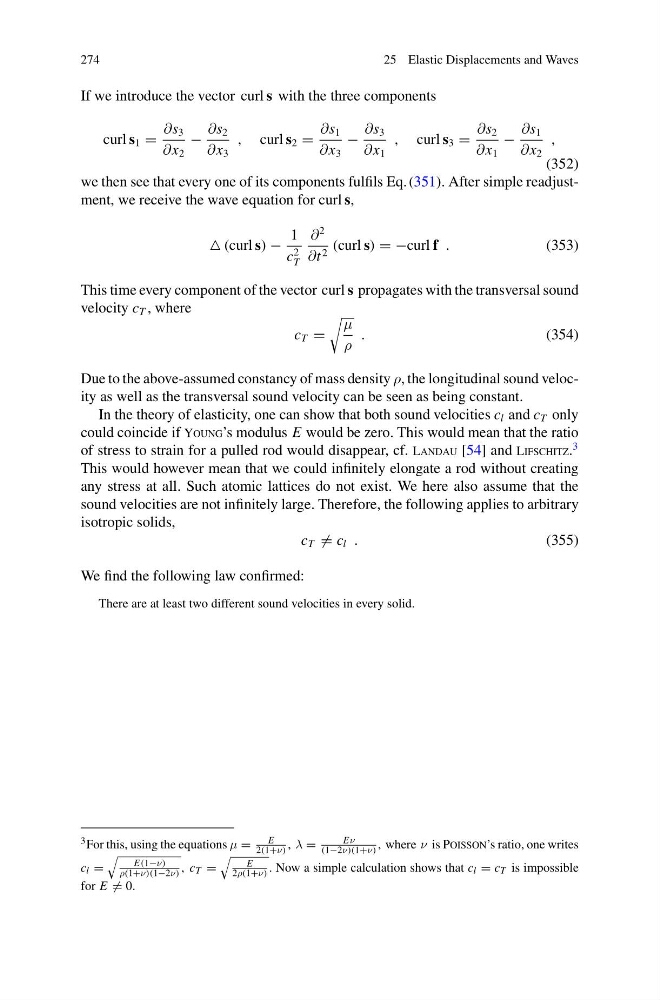
If we introduce the vector curl s with the three components
curl s 1 =
∂s 3
∂x 2
−
∂s 2
∂x 3
, curl s 2 =
∂s 1
∂x 3
−
∂s 3
∂x 1
, curl s 3 =
∂s 2
∂x 1
−
∂s 1
∂x 2
,
(352)
we then see that every one of its components fulfils Eq. (351). After simple readjustment, we receive the wave equation for curl s,
(curl s) −
1
c
2
T
∂
2
∂t 2 (curl s) = −curl f .
(353)
This time every component of the vector curl s propagates with the transversal sound
velocity c T , where
c T =
μ
ρ
.
(354)
Due to the above-assumed constancy of mass density ρ, the longitudinal sound velocity as well as the transversal sound velocity can be seen as being constant.
In the theory of elasticity, one can show that both sound velocities c l and c T only
could coincide if Young’s modulus E would be zero. This would mean that the ratio
of stress to strain for a pulled rod would disappear, cf. Landau [54] and Lifschitz.
3
This would however mean that we could infinitely elongate a rod without creating
any stress at all. Such atomic lattices do not exist. We here also assume that the
sound velocities are not infinitely large. Therefore, the following applies to arbitrary
isotropic solids,
c T = c l .
(355)
We find the following law confirmed:
There are at least two different sound velocities in every solid.
3 For this, using the equations μ =
E
2(1+ν) , λ =
Eν
(1−2ν)(1+ν) , where ν is Poisson’s ratio, one writes
c l =
E(1−ν)
ρ(1+ν)(1−2ν) , c T =
E
2ρ(1+ν) . Now a simple calculation shows that c l = c T is impossible
for E = 0.
25 Elastic Displacements and Waves
If we introduce the vector curl s with the three components
curl s 1 =
∂s 3
∂x 2
−
∂s 2
∂x 3
, curl s 2 =
∂s 1
∂x 3
−
∂s 3
∂x 1
, curl s 3 =
∂s 2
∂x 1
−
∂s 1
∂x 2
,
(352)
we then see that every one of its components fulfils Eq. (351). After simple readjustment, we receive the wave equation for curl s,
(curl s) −
1
c
2
T
∂
2
∂t 2 (curl s) = −curl f .
(353)
This time every component of the vector curl s propagates with the transversal sound
velocity c T , where
c T =
μ
ρ
.
(354)
Due to the above-assumed constancy of mass density ρ, the longitudinal sound velocity as well as the transversal sound velocity can be seen as being constant.
In the theory of elasticity, one can show that both sound velocities c l and c T only
could coincide if Young’s modulus E would be zero. This would mean that the ratio
of stress to strain for a pulled rod would disappear, cf. Landau [54] and Lifschitz.
3
This would however mean that we could infinitely elongate a rod without creating
any stress at all. Such atomic lattices do not exist. We here also assume that the
sound velocities are not infinitely large. Therefore, the following applies to arbitrary
isotropic solids,
c T = c l .
(355)
We find the following law confirmed:
There are at least two different sound velocities in every solid.
3 For this, using the equations μ =
E
2(1+ν) , λ =
Eν
(1−2ν)(1+ν) , where ν is Poisson’s ratio, one writes
c l =
E(1−ν)
ρ(1+ν)(1−2ν) , c T =
E
2ρ(1+ν) . Now a simple calculation shows that c l = c T is impossible
for E = 0.