

16
3 The Physical Elements of the Special Theory of Relativity
[70] paper.
4 We will return to this at the end of Chap. 18. Einstein spoke of this
experiment as the ‘experimentum crucis’ of the Special Theory of Relativity. In
comparison, the negative results of the many refined Michelson experiments carried
out with much effort played only a secondary role in Einstein’s conclusions. The
results of these experiments ‘only’ showed that there was no way of measuring an
ether wind. The supposed discovery of an ether wind in April of 1921 by D. C. Miller
in the mount Wilson observatory leads to one of Einstein’s most famous quotations,
‘Subtle is the Lord, but malicious He is not’. He later added the wonderful statement,
‘Nature hides her secret because of her essential loftiness, but not by means of ruse’.
Here, I once again refer to A. Pais [71]’ book which contains a detailed description
of the historic facts concerning the Special Theory of Relativity. The consequence
derived from Einstein’s Special Theory of Relativity that all our clocks really do
behave as strangely as stated by Special Relativity and that this can be measured
using our clocks and measuring-rods, which was proven correct by the experiments in
1938/39. The result of these experiments proved that the dilatation of time, Einstein’s
most astounding statement was correct. There was no room for another interpretation.
For the mathematically interested reader, we recommend Einstein’s [14, 15] original paper that even today has not lost any of its beauty and clearness.
Up to now, we have described the so-called kinematic effects of Special Relativity.
These effects are at the centre of our interest, and we will concern ourselves with
them in Chaps. 9–21. The Special Theory of Relativity makes another spectacular
statement. Only three months after his famous paper Einstein [14], in a further paper
Einstein [16] came to the conclusion of the inertia of energy, cf. also the translation
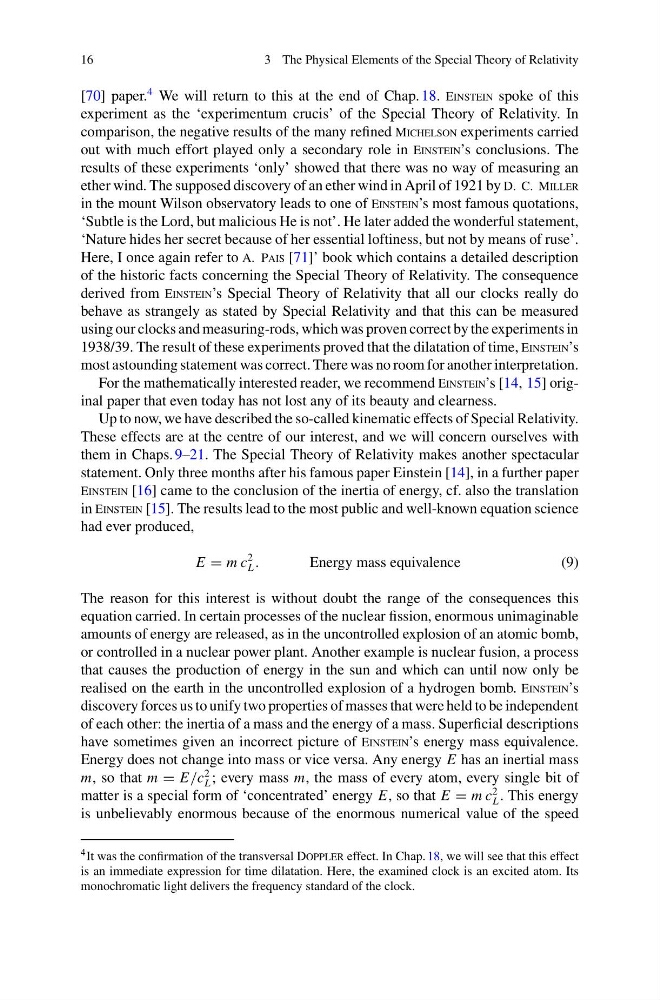
in Einstein [15]. The results lead to the most public and well-known equation science
had ever produced,
E = m c
2
L .
Energy mass equivalence
(9)
The reason for this interest is without doubt the range of the consequences this
equation carried. In certain processes of the nuclear fission, enormous unimaginable
amounts of energy are released, as in the uncontrolled explosion of an atomic bomb,
or controlled in a nuclear power plant. Another example is nuclear fusion, a process
that causes the production of energy in the sun and which can until now only be
realised on the earth in the uncontrolled explosion of a hydrogen bomb. Einstein’s
discovery forces us to unify two properties of masses that were held to be independent
of each other: the inertia of a mass and the energy of a mass. Superficial descriptions
have sometimes given an incorrect picture of Einstein’s energy mass equivalence.
Energy does not change into mass or vice versa. Any energy E has an inertial mass
m, so that m = E/c
2
L ; every mass m, the mass of every atom, every single bit of
matter is a special form of ‘concentrated’ energy E, so that E = m c
2
L . This energy
is unbelievably enormous because of the enormous numerical value of the speed
4 It was the confirmation of the transversal Doppler effect. In Chap. 18, we will see that this effect
is an immediate expression for time dilatation. Here, the examined clock is an excited atom. Its
monochromatic light delivers the frequency standard of the clock.
3 The Physical Elements of the Special Theory of Relativity
[70] paper.
4 We will return to this at the end of Chap. 18. Einstein spoke of this
experiment as the ‘experimentum crucis’ of the Special Theory of Relativity. In
comparison, the negative results of the many refined Michelson experiments carried
out with much effort played only a secondary role in Einstein’s conclusions. The
results of these experiments ‘only’ showed that there was no way of measuring an
ether wind. The supposed discovery of an ether wind in April of 1921 by D. C. Miller
in the mount Wilson observatory leads to one of Einstein’s most famous quotations,
‘Subtle is the Lord, but malicious He is not’. He later added the wonderful statement,
‘Nature hides her secret because of her essential loftiness, but not by means of ruse’.
Here, I once again refer to A. Pais [71]’ book which contains a detailed description
of the historic facts concerning the Special Theory of Relativity. The consequence
derived from Einstein’s Special Theory of Relativity that all our clocks really do
behave as strangely as stated by Special Relativity and that this can be measured
using our clocks and measuring-rods, which was proven correct by the experiments in
1938/39. The result of these experiments proved that the dilatation of time, Einstein’s
most astounding statement was correct. There was no room for another interpretation.
For the mathematically interested reader, we recommend Einstein’s [14, 15] original paper that even today has not lost any of its beauty and clearness.
Up to now, we have described the so-called kinematic effects of Special Relativity.
These effects are at the centre of our interest, and we will concern ourselves with
them in Chaps. 9–21. The Special Theory of Relativity makes another spectacular
statement. Only three months after his famous paper Einstein [14], in a further paper
Einstein [16] came to the conclusion of the inertia of energy, cf. also the translation
in Einstein [15]. The results lead to the most public and well-known equation science
had ever produced,
E = m c
2
L .
Energy mass equivalence
(9)
The reason for this interest is without doubt the range of the consequences this
equation carried. In certain processes of the nuclear fission, enormous unimaginable
amounts of energy are released, as in the uncontrolled explosion of an atomic bomb,
or controlled in a nuclear power plant. Another example is nuclear fusion, a process
that causes the production of energy in the sun and which can until now only be
realised on the earth in the uncontrolled explosion of a hydrogen bomb. Einstein’s
discovery forces us to unify two properties of masses that were held to be independent
of each other: the inertia of a mass and the energy of a mass. Superficial descriptions
have sometimes given an incorrect picture of Einstein’s energy mass equivalence.
Energy does not change into mass or vice versa. Any energy E has an inertial mass
m, so that m = E/c
2
L ; every mass m, the mass of every atom, every single bit of
matter is a special form of ‘concentrated’ energy E, so that E = m c
2
L . This energy
is unbelievably enormous because of the enormous numerical value of the speed
4 It was the confirmation of the transversal Doppler effect. In Chap. 18, we will see that this effect
is an immediate expression for time dilatation. Here, the examined clock is an excited atom. Its
monochromatic light delivers the frequency standard of the clock.