

244
22 Particles and Fields
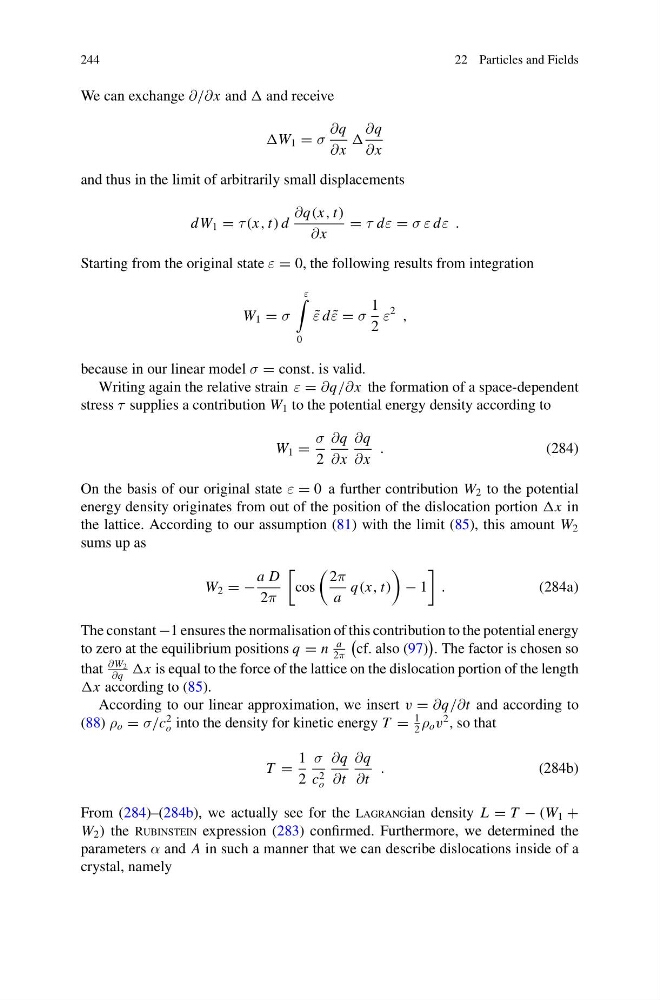
We can exchange ∂/∂x and and receive
W 1 = σ
∂q
∂x
∂q
∂x
and thus in the limit of arbitrarily small displacements
dW 1 = τ (x, t) d
∂q(x, t)
∂x
= τ dε = σ ε dε .
Starting from the original state ε = 0, the following results from integration
W 1 = σ
ε
0
˜
ε d ˜
ε = σ
1
2
ε
2
,
because in our linear model σ = const. is valid.
Writing again the relative strain ε = ∂q/∂x the formation of a space-dependent
stress τ supplies a contribution W 1 to the potential energy density according to
W 1 =
σ
2
∂q
∂x
∂q
∂x
.
(284)
On the basis of our original state ε = 0 a further contribution W 2 to the potential
energy density originates from out of the position of the dislocation portion x in
the lattice. According to our assumption (81) with the limit (85), this amount W 2
sums up as
W 2 = −
a D
2π
cos
2π
a
q(x, t)
− 1
.
(284a)
The constant −1 ensures the normalisation of this contribution to the potential energy
to zero at the equilibrium positions q = n
a
2π
cf. also (97)
. The factor is chosen so
that
∂W 2
∂q
x is equal to the force of the lattice on the dislocation portion of the length
x according to (85).
According to our linear approximation, we insert v = ∂q/∂t and according to
(88) ρ o = σ/c
2
o into the density for kinetic energy T =
1
2
ρ o v
2 , so that
T =
1
2
σ
c 2
o
∂q
∂t
∂q
∂t
.
(284b)
From (284)–(284b), we actually see for the Lagrangian density L = T − (W 1 +
W 2 ) the Rubinstein expression (283) confirmed. Furthermore, we determined the
parameters α and A in such a manner that we can describe dislocations inside of a
crystal, namely
22 Particles and Fields
We can exchange ∂/∂x and and receive
W 1 = σ
∂q
∂x
∂q
∂x
and thus in the limit of arbitrarily small displacements
dW 1 = τ (x, t) d
∂q(x, t)
∂x
= τ dε = σ ε dε .
Starting from the original state ε = 0, the following results from integration
W 1 = σ
ε
0
˜
ε d ˜
ε = σ
1
2
ε
2
,
because in our linear model σ = const. is valid.
Writing again the relative strain ε = ∂q/∂x the formation of a space-dependent
stress τ supplies a contribution W 1 to the potential energy density according to
W 1 =
σ
2
∂q
∂x
∂q
∂x
.
(284)
On the basis of our original state ε = 0 a further contribution W 2 to the potential
energy density originates from out of the position of the dislocation portion x in
the lattice. According to our assumption (81) with the limit (85), this amount W 2
sums up as
W 2 = −
a D
2π
cos
2π
a
q(x, t)
− 1
.
(284a)
The constant −1 ensures the normalisation of this contribution to the potential energy
to zero at the equilibrium positions q = n
a
2π
cf. also (97)
. The factor is chosen so
that
∂W 2
∂q
x is equal to the force of the lattice on the dislocation portion of the length
x according to (85).
According to our linear approximation, we insert v = ∂q/∂t and according to
(88) ρ o = σ/c
2
o into the density for kinetic energy T =
1
2
ρ o v
2 , so that
T =
1
2
σ
c 2
o
∂q
∂t
∂q
∂t
.
(284b)
From (284)–(284b), we actually see for the Lagrangian density L = T − (W 1 +
W 2 ) the Rubinstein expression (283) confirmed. Furthermore, we determined the
parameters α and A in such a manner that we can describe dislocations inside of a
crystal, namely