

14
3 The Physical Elements of the Special Theory of Relativity
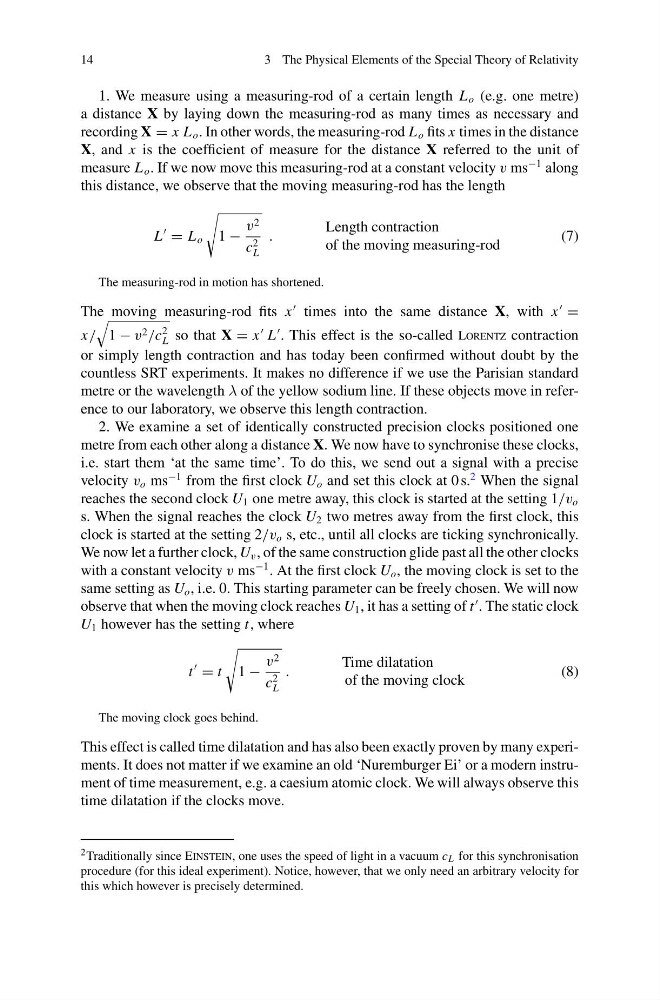
1. We measure using a measuring-rod of a certain length L o (e.g. one metre)
a distance X by laying down the measuring-rod as many times as necessary and
recording X = x L o . In other words, the measuring-rod L o fits x times in the distance
X, and x is the coefficient of measure for the distance X referred to the unit of
measure L o . If we now move this measuring-rod at a constant velocity v ms
−1 along
this distance, we observe that the moving measuring-rod has the length
L
= L o
1 −
v 2
c
2
L
.
Length contraction
of the moving measuring-rod
(7)
The measuring-rod in motion has shortened.
The moving measuring-rod fits x
times into the same distance X, with x
=
x/
1 − v 2 /c
2
L so that X = x
L
. This effect is the so-called Lorentz contraction
or simply length contraction and has today been confirmed without doubt by the
countless SRT experiments. It makes no difference if we use the Parisian standard
metre or the wavelength λ of the yellow sodium line. If these objects move in reference to our laboratory, we observe this length contraction.
2. We examine a set of identically constructed precision clocks positioned one
metre from each other along a distance X. We now have to synchronise these clocks,
i.e. start them ‘at the same time’. To do this, we send out a signal with a precise
velocity v o ms
−1 from the first clock U o and set this clock at 0 s.
2 When the signal
reaches the second clock U 1 one metre away, this clock is started at the setting 1/v o
s. When the signal reaches the clock U 2 two metres away from the first clock, this
clock is started at the setting 2/v o s, etc., until all clocks are ticking synchronically.
We now let a further clock, U v , of the same construction glide past all the other clocks
with a constant velocity v ms
−1 . At the first clock U o , the moving clock is set to the
same setting as U o , i.e. 0. This starting parameter can be freely chosen. We will now
observe that when the moving clock reaches U 1 , it has a setting of t
. The static clock
U 1 however has the setting t, where
t
= t
1 −
v 2
c
2
L
.
Time dilatation
of the moving clock
(8)
The moving clock goes behind.
This effect is called time dilatation and has also been exactly proven by many experiments. It does not matter if we examine an old ‘Nuremburger Ei’ or a modern instrument of time measurement, e.g. a caesium atomic clock. We will always observe this
time dilatation if the clocks move.
2 Traditionally since Einstein, one uses the speed of light in a vacuum c L for this synchronisation
procedure (for this ideal experiment). Notice, however, that we only need an arbitrary velocity for
this which however is precisely determined.
3 The Physical Elements of the Special Theory of Relativity
1. We measure using a measuring-rod of a certain length L o (e.g. one metre)
a distance X by laying down the measuring-rod as many times as necessary and
recording X = x L o . In other words, the measuring-rod L o fits x times in the distance
X, and x is the coefficient of measure for the distance X referred to the unit of
measure L o . If we now move this measuring-rod at a constant velocity v ms
−1 along
this distance, we observe that the moving measuring-rod has the length
L
= L o
1 −
v 2
c
2
L
.
Length contraction
of the moving measuring-rod
(7)
The measuring-rod in motion has shortened.
The moving measuring-rod fits x
times into the same distance X, with x
=
x/
1 − v 2 /c
2
L so that X = x
L
. This effect is the so-called Lorentz contraction
or simply length contraction and has today been confirmed without doubt by the
countless SRT experiments. It makes no difference if we use the Parisian standard
metre or the wavelength λ of the yellow sodium line. If these objects move in reference to our laboratory, we observe this length contraction.
2. We examine a set of identically constructed precision clocks positioned one
metre from each other along a distance X. We now have to synchronise these clocks,
i.e. start them ‘at the same time’. To do this, we send out a signal with a precise
velocity v o ms
−1 from the first clock U o and set this clock at 0 s.
2 When the signal
reaches the second clock U 1 one metre away, this clock is started at the setting 1/v o
s. When the signal reaches the clock U 2 two metres away from the first clock, this
clock is started at the setting 2/v o s, etc., until all clocks are ticking synchronically.
We now let a further clock, U v , of the same construction glide past all the other clocks
with a constant velocity v ms
−1 . At the first clock U o , the moving clock is set to the
same setting as U o , i.e. 0. This starting parameter can be freely chosen. We will now
observe that when the moving clock reaches U 1 , it has a setting of t
. The static clock
U 1 however has the setting t, where
t
= t
1 −
v 2
c
2
L
.
Time dilatation
of the moving clock
(8)
The moving clock goes behind.
This effect is called time dilatation and has also been exactly proven by many experiments. It does not matter if we examine an old ‘Nuremburger Ei’ or a modern instrument of time measurement, e.g. a caesium atomic clock. We will always observe this
time dilatation if the clocks move.
2 Traditionally since Einstein, one uses the speed of light in a vacuum c L for this synchronisation
procedure (for this ideal experiment). Notice, however, that we only need an arbitrary velocity for
this which however is precisely determined.