

21 Violation of Relativity—The Rediscovered Crystal
235
universal length contraction of moving measuring rods, nor would we get the time
dilatation of moving clocks.
Without length contraction and time dilatation, no principle of relativity for signal
propagation!
Special Relativity, the absolute equality of all internal observer’s reference systems moving with uniform velocity with respect to each other, is broken. The internal
observers are able to, thanks to their high energy physics, track the background of
their specific relativistic equations. They examine their space, their vacuum and are
finally in the position of discovering the crystalline origin of their vacuum, the crystal
lattice, and maybe even the Newtonian physics of this lattice, which, as we know, is
a primary theory for all mechanical processes inside of a crystal.
This does not mean that all of our prior examinations, the results of Chaps. 8–
20, are simply false; it means that these are just an approximation—as everything
in physics is. In the region of not too large energies, everything remains as it was.
The internal observers then exist in a continuous structured space, for which, in the
boundaries of their ‘everyday experiences’, the Special Theory of Relativity is valid:
All reference systems moving with a uniform velocity with respect to each other are
physically indistinguishable. It is only when the internal observers start to experiment
with extreme energies, which does not constitute ‘everyday experiences’, that they
are in the position of coming to the conclusion that the space in which they dwell is
actually of a lattice construction. One can make it clear for oneself that a reference
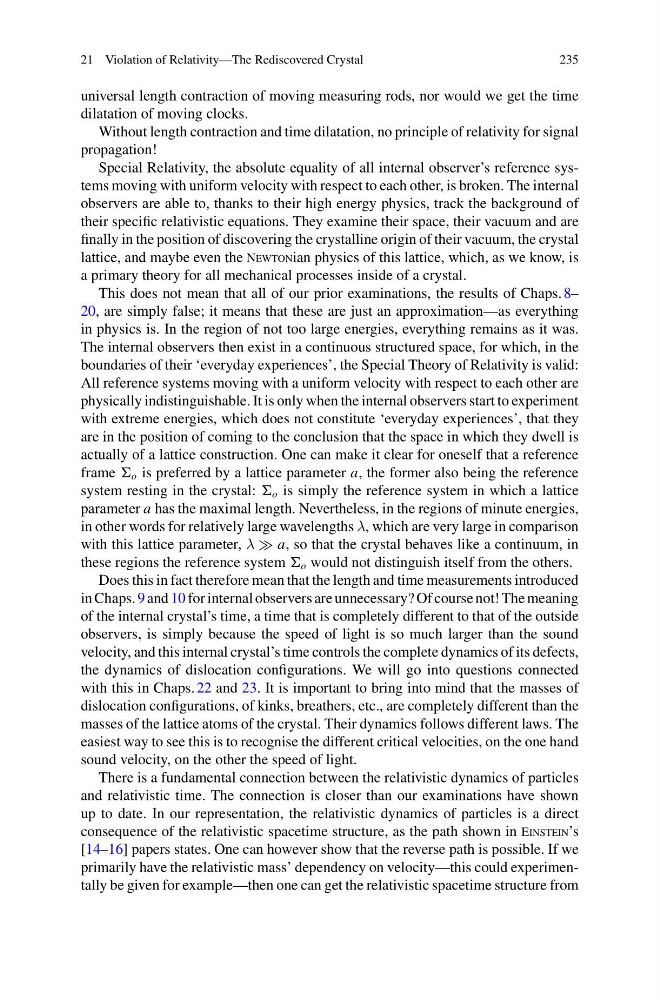
frame o is preferred by a lattice parameter a, the former also being the reference
system resting in the crystal: o is simply the reference system in which a lattice
parameter a has the maximal length. Nevertheless, in the regions of minute energies,
in other words for relatively large wavelengths λ, which are very large in comparison
with this lattice parameter, λ a, so that the crystal behaves like a continuum, in
these regions the reference system o would not distinguish itself from the others.
Does this in fact therefore mean that the length and time measurements introduced
in Chaps. 9 and 10 for internal observers are unnecessary? Of course not! The meaning
of the internal crystal’s time, a time that is completely different to that of the outside
observers, is simply because the speed of light is so much larger than the sound
velocity, and this internal crystal’s time controls the complete dynamics of its defects,
the dynamics of dislocation configurations. We will go into questions connected
with this in Chaps. 22 and 23. It is important to bring into mind that the masses of
dislocation configurations, of kinks, breathers, etc., are completely different than the
masses of the lattice atoms of the crystal. Their dynamics follows different laws. The
easiest way to see this is to recognise the different critical velocities, on the one hand
sound velocity, on the other the speed of light.
There is a fundamental connection between the relativistic dynamics of particles
and relativistic time. The connection is closer than our examinations have shown
up to date. In our representation, the relativistic dynamics of particles is a direct
consequence of the relativistic spacetime structure, as the path shown in Einstein’s
[14–16] papers states. One can however show that the reverse path is possible. If we
primarily have the relativistic mass’ dependency on velocity—this could experimentally be given for example—then one can get the relativistic spacetime structure from
235
universal length contraction of moving measuring rods, nor would we get the time
dilatation of moving clocks.
Without length contraction and time dilatation, no principle of relativity for signal
propagation!
Special Relativity, the absolute equality of all internal observer’s reference systems moving with uniform velocity with respect to each other, is broken. The internal
observers are able to, thanks to their high energy physics, track the background of
their specific relativistic equations. They examine their space, their vacuum and are
finally in the position of discovering the crystalline origin of their vacuum, the crystal
lattice, and maybe even the Newtonian physics of this lattice, which, as we know, is
a primary theory for all mechanical processes inside of a crystal.
This does not mean that all of our prior examinations, the results of Chaps. 8–
20, are simply false; it means that these are just an approximation—as everything
in physics is. In the region of not too large energies, everything remains as it was.
The internal observers then exist in a continuous structured space, for which, in the
boundaries of their ‘everyday experiences’, the Special Theory of Relativity is valid:
All reference systems moving with a uniform velocity with respect to each other are
physically indistinguishable. It is only when the internal observers start to experiment
with extreme energies, which does not constitute ‘everyday experiences’, that they
are in the position of coming to the conclusion that the space in which they dwell is
actually of a lattice construction. One can make it clear for oneself that a reference
frame o is preferred by a lattice parameter a, the former also being the reference
system resting in the crystal: o is simply the reference system in which a lattice
parameter a has the maximal length. Nevertheless, in the regions of minute energies,
in other words for relatively large wavelengths λ, which are very large in comparison
with this lattice parameter, λ a, so that the crystal behaves like a continuum, in
these regions the reference system o would not distinguish itself from the others.
Does this in fact therefore mean that the length and time measurements introduced
in Chaps. 9 and 10 for internal observers are unnecessary? Of course not! The meaning
of the internal crystal’s time, a time that is completely different to that of the outside
observers, is simply because the speed of light is so much larger than the sound
velocity, and this internal crystal’s time controls the complete dynamics of its defects,
the dynamics of dislocation configurations. We will go into questions connected
with this in Chaps. 22 and 23. It is important to bring into mind that the masses of
dislocation configurations, of kinks, breathers, etc., are completely different than the
masses of the lattice atoms of the crystal. Their dynamics follows different laws. The
easiest way to see this is to recognise the different critical velocities, on the one hand
sound velocity, on the other the speed of light.
There is a fundamental connection between the relativistic dynamics of particles
and relativistic time. The connection is closer than our examinations have shown
up to date. In our representation, the relativistic dynamics of particles is a direct
consequence of the relativistic spacetime structure, as the path shown in Einstein’s
[14–16] papers states. One can however show that the reverse path is possible. If we
primarily have the relativistic mass’ dependency on velocity—this could experimentally be given for example—then one can get the relativistic spacetime structure from