

230
20 Tachyons and Causality
: q
T
∞ (t
) =
2a
π
arctan exp
πc o
L o
t
+
a
2
,
(271)
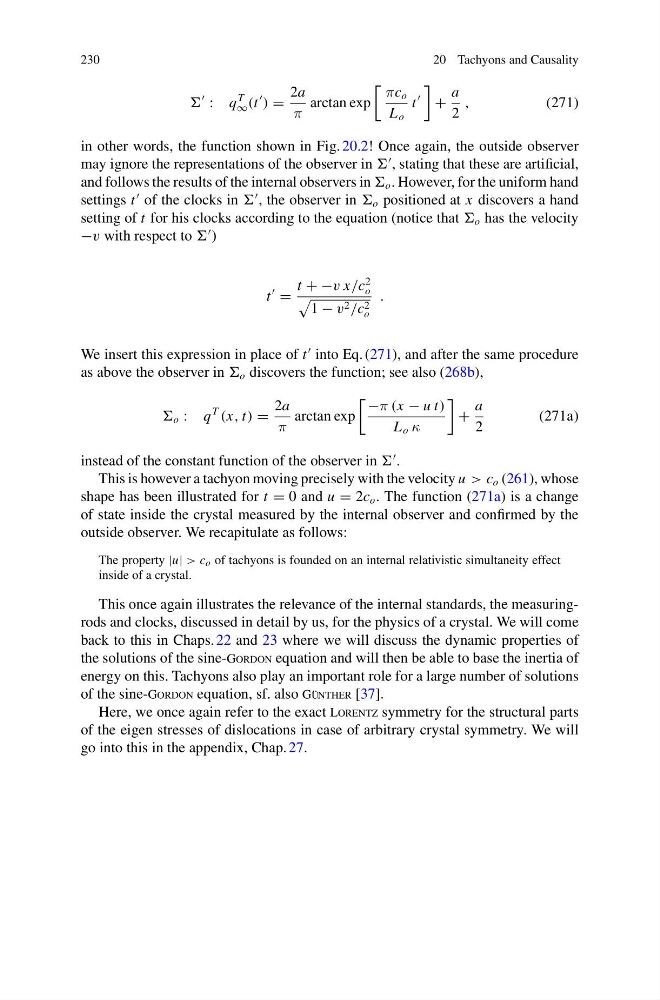
in other words, the function shown in Fig. 20.2! Once again, the outside observer
may ignore the representations of the observer in
, stating that these are artificial,
and follows the results of the internal observers in o . However, for the uniform hand
settings t
of the clocks in
, the observer in o positioned at x discovers a hand
setting of t for his clocks according to the equation (notice that o has the velocity
−v with respect to
)
t
=
t + −v x/c
2
o
1 − v 2 /c 2
o
.
We insert this expression in place of t
into Eq. (271), and after the same procedure
as above the observer in o discovers the function; see also (268b),
o : q
T
(x, t) =
2a
π
arctan exp
−π (x − u t)
L o κ
+
a
2
(271a)
instead of the constant function of the observer in
.
This is however a tachyon moving precisely with the velocity u > c o (261), whose
shape has been illustrated for t = 0 and u = 2c o . The function (271a) is a change
of state inside the crystal measured by the internal observer and confirmed by the
outside observer. We recapitulate as follows:
The property |u| > c o of tachyons is founded on an internal relativistic simultaneity effect
inside of a crystal.
This once again illustrates the relevance of the internal standards, the measuringrods and clocks, discussed in detail by us, for the physics of a crystal. We will come
back to this in Chaps. 22 and 23 where we will discuss the dynamic properties of
the solutions of the sine-Gordon equation and will then be able to base the inertia of
energy on this. Tachyons also play an important role for a large number of solutions
of the sine-Gordon equation, sf. also Günther [37].
Here, we once again refer to the exact Lorentz symmetry for the structural parts
of the eigen stresses of dislocations in case of arbitrary crystal symmetry. We will
go into this in the appendix, Chap. 27.
20 Tachyons and Causality
: q
T
∞ (t
) =
2a
π
arctan exp
πc o
L o
t
+
a
2
,
(271)
in other words, the function shown in Fig. 20.2! Once again, the outside observer
may ignore the representations of the observer in
, stating that these are artificial,
and follows the results of the internal observers in o . However, for the uniform hand
settings t
of the clocks in
, the observer in o positioned at x discovers a hand
setting of t for his clocks according to the equation (notice that o has the velocity
−v with respect to
)
t
=
t + −v x/c
2
o
1 − v 2 /c 2
o
.
We insert this expression in place of t
into Eq. (271), and after the same procedure
as above the observer in o discovers the function; see also (268b),
o : q
T
(x, t) =
2a
π
arctan exp
−π (x − u t)
L o κ
+
a
2
(271a)
instead of the constant function of the observer in
.
This is however a tachyon moving precisely with the velocity u > c o (261), whose
shape has been illustrated for t = 0 and u = 2c o . The function (271a) is a change
of state inside the crystal measured by the internal observer and confirmed by the
outside observer. We recapitulate as follows:
The property |u| > c o of tachyons is founded on an internal relativistic simultaneity effect
inside of a crystal.
This once again illustrates the relevance of the internal standards, the measuringrods and clocks, discussed in detail by us, for the physics of a crystal. We will come
back to this in Chaps. 22 and 23 where we will discuss the dynamic properties of
the solutions of the sine-Gordon equation and will then be able to base the inertia of
energy on this. Tachyons also play an important role for a large number of solutions
of the sine-Gordon equation, sf. also Günther [37].
Here, we once again refer to the exact Lorentz symmetry for the structural parts
of the eigen stresses of dislocations in case of arbitrary crystal symmetry. We will
go into this in the appendix, Chap. 27.