

20 Tachyons and Causality
227
for synchronising clocks. We therefore cannot talk of a contradiction to the Special
Theory of Relativity.
This ideal experiment should not lead us to the hasty conclusion that we have
finally, with the help of tachyons, found a signal that allows us to transmit information
with infinite velocity. We therefore, until we have discussed this in detail in Chaps. 28–
30, formulate the following provisional thesis:
The tachyons of the sine-Gordon equation are not signals.
Causality is the cause of the conflict if we accept the existence of tachyons.
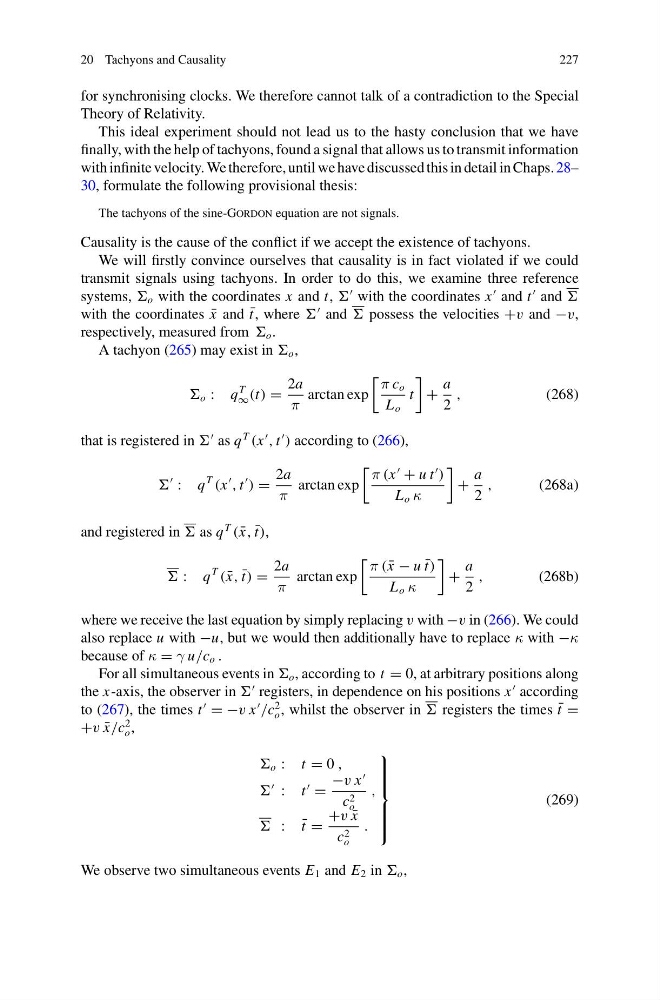
We will firstly convince ourselves that causality is in fact violated if we could
transmit signals using tachyons. In order to do this, we examine three reference
systems, o with the coordinates x and t,
with the coordinates x
and t
and
with the coordinates ¯
x and ¯
t, where
and possess the velocities +v and −v,
respectively, measured from o .
A tachyon (265) may exist in o ,
o : q
T
∞ (t) =
2a
π
arctan exp
π c o
L o
t
+
a
2
,
(268)
that is registered in
as q
T
(x
, t
) according to (266),
: q
T
(x
, t
) =
2a
π
arctan exp
π (x
+ u t
)
L o κ
+
a
2
,
(268a)
and registered in as q
T
( ¯
x, ¯
t),
: q
T
( ¯
x, ¯
t) =
2a
π
arctan exp
π ( ¯
x − u ¯
t)
L o κ
+
a
2
,
(268b)
where we receive the last equation by simply replacing v with −v in (266). We could
also replace u with −u, but we would then additionally have to replace κ with −κ
because of κ = γ u/c o .
For all simultaneous events in o , according to t = 0, at arbitrary positions along
the x-axis, the observer in
registers, in dependence on his positions x
according
to (267), the times t
= −v x
/c
2
o , whilst the observer in registers the times ¯
t =
+v ¯
x/c
2
o ,
o : t = 0 ,
: t
=
−v x
c 2
o
,
: ¯
t =
+v ¯
x
c 2
o
.
⎫
⎪ ⎪ ⎪ ⎪ ⎬
⎪ ⎪ ⎪ ⎪ ⎭
(269)
We observe two simultaneous events E 1 and E 2 in o ,
227
for synchronising clocks. We therefore cannot talk of a contradiction to the Special
Theory of Relativity.
This ideal experiment should not lead us to the hasty conclusion that we have
finally, with the help of tachyons, found a signal that allows us to transmit information
with infinite velocity. We therefore, until we have discussed this in detail in Chaps. 28–
30, formulate the following provisional thesis:
The tachyons of the sine-Gordon equation are not signals.
Causality is the cause of the conflict if we accept the existence of tachyons.
We will firstly convince ourselves that causality is in fact violated if we could
transmit signals using tachyons. In order to do this, we examine three reference
systems, o with the coordinates x and t,
with the coordinates x
and t
and
with the coordinates ¯
x and ¯
t, where
and possess the velocities +v and −v,
respectively, measured from o .
A tachyon (265) may exist in o ,
o : q
T
∞ (t) =
2a
π
arctan exp
π c o
L o
t
+
a
2
,
(268)
that is registered in
as q
T
(x
, t
) according to (266),
: q
T
(x
, t
) =
2a
π
arctan exp
π (x
+ u t
)
L o κ
+
a
2
,
(268a)
and registered in as q
T
( ¯
x, ¯
t),
: q
T
( ¯
x, ¯
t) =
2a
π
arctan exp
π ( ¯
x − u ¯
t)
L o κ
+
a
2
,
(268b)
where we receive the last equation by simply replacing v with −v in (266). We could
also replace u with −u, but we would then additionally have to replace κ with −κ
because of κ = γ u/c o .
For all simultaneous events in o , according to t = 0, at arbitrary positions along
the x-axis, the observer in
registers, in dependence on his positions x
according
to (267), the times t
= −v x
/c
2
o , whilst the observer in registers the times ¯
t =
+v ¯
x/c
2
o ,
o : t = 0 ,
: t
=
−v x
c 2
o
,
: ¯
t =
+v ¯
x
c 2
o
.
⎫
⎪ ⎪ ⎪ ⎪ ⎬
⎪ ⎪ ⎪ ⎪ ⎭
(269)
We observe two simultaneous events E 1 and E 2 in o ,