

218
19 Aberration
u 1,2 =
L
γ
(2γ sin α
− β cos α
)
±
(2γ sin α −β cos α ) 2 −4γ 2 sin
2
α +γ 2 cos α +sin
2
α +4βγ sin α cos α
.
(248)
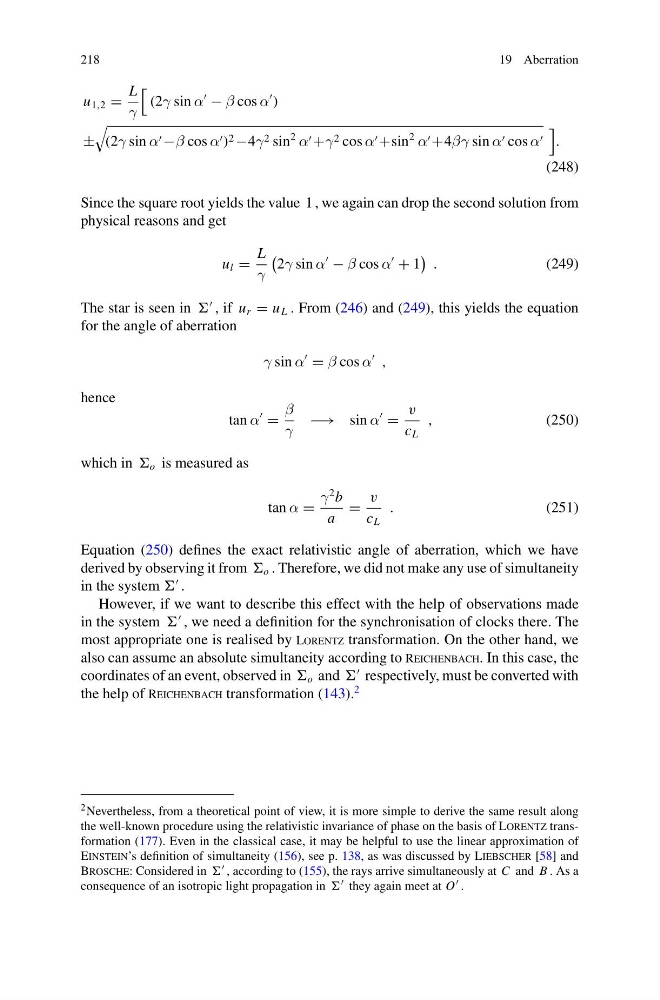
Since the square root yields the value 1 , we again can drop the second solution from
physical reasons and get
u l =
L
γ
2γ sin α
− β cos α
+ 1
.
(249)
The star is seen in
, if u r = u L . From (246) and (249), this yields the equation
for the angle of aberration
γ sin α
= β cos α
,
hence
tan α
=
β
γ
−→ sin α
=
v
c L
,
(250)
which in o is measured as
tan α =
γ
2 b
a
=
v
c L
.
(251)
Equation (250) defines the exact relativistic angle of aberration, which we have
derived by observing it from o . Therefore, we did not make any use of simultaneity
in the system
.
However, if we want to describe this effect with the help of observations made
in the system
, we need a definition for the synchronisation of clocks there. The
most appropriate one is realised by Lorentz transformation. On the other hand, we
also can assume an absolute simultaneity according to Reichenbach. In this case, the
coordinates of an event, observed in o and
respectively, must be converted with
the help of Reichenbach transformation (143).
2
2 Nevertheless, from a theoretical point of view, it is more simple to derive the same result along
the well-known procedure using the relativistic invariance of phase on the basis of Lorentz transformation (177). Even in the classical case, it may be helpful to use the linear approximation of
Einstein’s definition of simultaneity (156), see p. 138, as was discussed by Liebscher [58] and
Brosche: Considered in , according to (155), the rays arrive simultaneously at C and B . As a
consequence of an isotropic light propagation in they again meet at O .
19 Aberration
u 1,2 =
L
γ
(2γ sin α
− β cos α
)
±
(2γ sin α −β cos α ) 2 −4γ 2 sin
2
α +γ 2 cos α +sin
2
α +4βγ sin α cos α
.
(248)
Since the square root yields the value 1 , we again can drop the second solution from
physical reasons and get
u l =
L
γ
2γ sin α
− β cos α
+ 1
.
(249)
The star is seen in
, if u r = u L . From (246) and (249), this yields the equation
for the angle of aberration
γ sin α
= β cos α
,
hence
tan α
=
β
γ
−→ sin α
=
v
c L
,
(250)
which in o is measured as
tan α =
γ
2 b
a
=
v
c L
.
(251)
Equation (250) defines the exact relativistic angle of aberration, which we have
derived by observing it from o . Therefore, we did not make any use of simultaneity
in the system
.
However, if we want to describe this effect with the help of observations made
in the system
, we need a definition for the synchronisation of clocks there. The
most appropriate one is realised by Lorentz transformation. On the other hand, we
also can assume an absolute simultaneity according to Reichenbach. In this case, the
coordinates of an event, observed in o and
respectively, must be converted with
the help of Reichenbach transformation (143).
2
2 Nevertheless, from a theoretical point of view, it is more simple to derive the same result along
the well-known procedure using the relativistic invariance of phase on the basis of Lorentz transformation (177). Even in the classical case, it may be helpful to use the linear approximation of
Einstein’s definition of simultaneity (156), see p. 138, as was discussed by Liebscher [58] and
Brosche: Considered in , according to (155), the rays arrive simultaneously at C and B . As a
consequence of an isotropic light propagation in they again meet at O .