

216
19 Aberration
?
?
-
×
S
T
•
•
A(t 1 )
B(t 1 )
-
6
x
Σ o
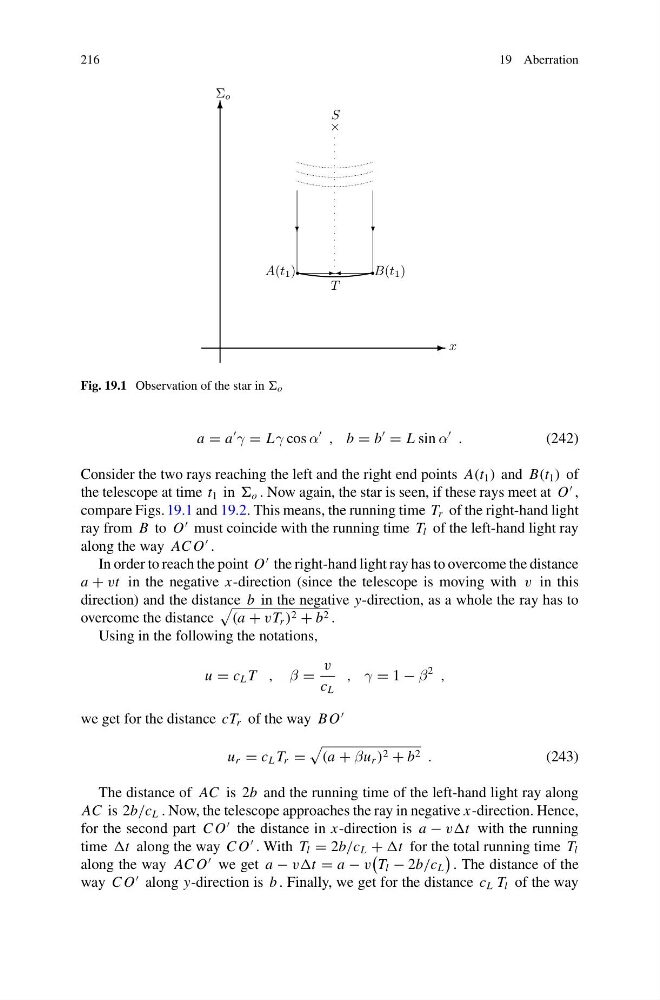
Fig. 19.1 Observation of the star in o
a = a
γ = Lγ cos α
, b = b
= L sin α
.
(242)
Consider the two rays reaching the left and the right end points A(t 1 ) and B(t 1 ) of
the telescope at time t 1 in o . Now again, the star is seen, if these rays meet at O
,
compare Figs. 19.1 and 19.2. This means, the running time T r of the right-hand light
ray from B to O
must coincide with the running time T l of the left-hand light ray
along the way AC O
.
In order to reach the point O
the right-hand light ray has to overcome the distance
a + vt in the negative x-direction (since the telescope is moving with v in this
direction) and the distance b in the negative y-direction, as a whole the ray has to
overcome the distance
(a + vT r ) 2 + b 2 .
Using in the following the notations,
u = c L T , β =
v
c L
, γ = 1 − β
2
,
we get for the distance cT r of the way B O
u r = c L T r =
(a + βu r ) 2 + b 2 .
(243)
The distance of AC is 2b and the running time of the left-hand light ray along
AC is 2b/c L . Now, the telescope approaches the ray in negative x-direction. Hence,
for the second part C O
the distance in x-direction is a − vvt with the running
time along the way C O
. With T l = 2b/c L + for the total running time T l
along the way AC O
we get a − vvt = a − v
T l − 2b/c L
. The distance of the
way C O
along y-direction is b . Finally, we get for the distance c L T l of the way
19 Aberration
?
?
-
×
S
T
•
•
A(t 1 )
B(t 1 )
-
6
x
Σ o
Fig. 19.1 Observation of the star in o
a = a
γ = Lγ cos α
, b = b
= L sin α
.
(242)
Consider the two rays reaching the left and the right end points A(t 1 ) and B(t 1 ) of
the telescope at time t 1 in o . Now again, the star is seen, if these rays meet at O
,
compare Figs. 19.1 and 19.2. This means, the running time T r of the right-hand light
ray from B to O
must coincide with the running time T l of the left-hand light ray
along the way AC O
.
In order to reach the point O
the right-hand light ray has to overcome the distance
a + vt in the negative x-direction (since the telescope is moving with v in this
direction) and the distance b in the negative y-direction, as a whole the ray has to
overcome the distance
(a + vT r ) 2 + b 2 .
Using in the following the notations,
u = c L T , β =
v
c L
, γ = 1 − β
2
,
we get for the distance cT r of the way B O
u r = c L T r =
(a + βu r ) 2 + b 2 .
(243)
The distance of AC is 2b and the running time of the left-hand light ray along
AC is 2b/c L . Now, the telescope approaches the ray in negative x-direction. Hence,
for the second part C O
the distance in x-direction is a − vvt with the running
time along the way C O
. With T l = 2b/c L + for the total running time T l
along the way AC O
we get a − vvt = a − v
T l − 2b/c L
. The distance of the
way C O
along y-direction is b . Finally, we get for the distance c L T l of the way