

2 The Ether and the Wave Equation
11
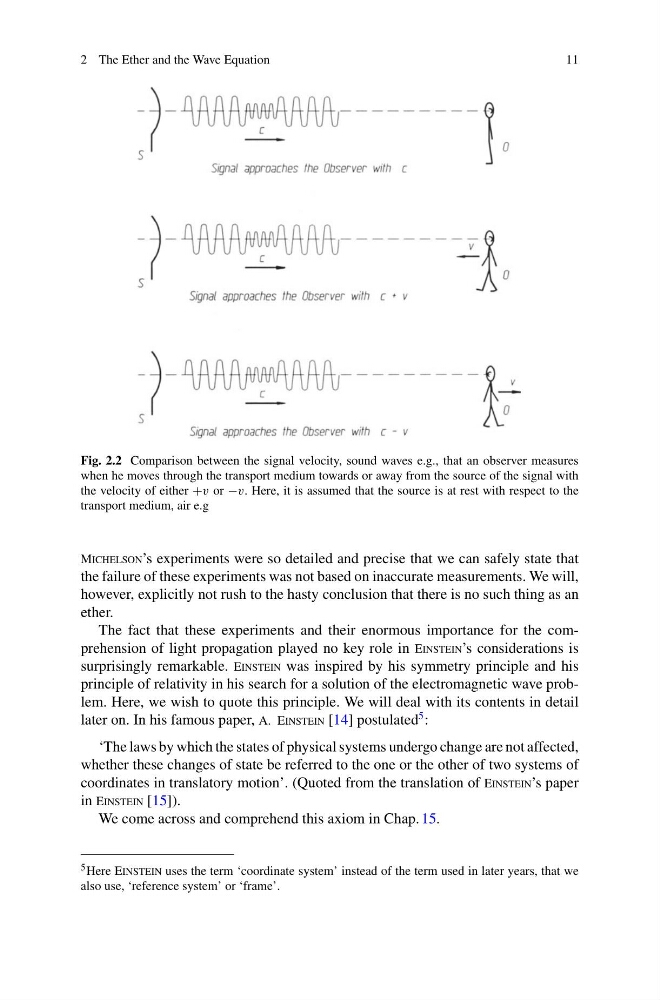
Fig. 2.2 Comparison between the signal velocity, sound waves e.g., that an observer measures
when he moves through the transport medium towards or away from the source of the signal with
the velocity of either +v or −v. Here, it is assumed that the source is at rest with respect to the
transport medium, air e.g
Michelson’s experiments were so detailed and precise that we can safely state that
the failure of these experiments was not based on inaccurate measurements. We will,
however, explicitly not rush to the hasty conclusion that there is no such thing as an
ether.
The fact that these experiments and their enormous importance for the comprehension of light propagation played no key role in Einstein’s considerations is
surprisingly remarkable. Einstein was inspired by his symmetry principle and his
principle of relativity in his search for a solution of the electromagnetic wave problem. Here, we wish to quote this principle. We will deal with its contents in detail
later on. In his famous paper, A. Einstein [14] postulated
5 :
‘The laws by which the states of physical systems undergo change are not affected,
whether these changes of state be referred to the one or the other of two systems of
coordinates in translatory motion’. (Quoted from the translation of Einstein’s paper
in Einstein [15]).
We come across and comprehend this axiom in Chap. 15.
5 Here Einstein uses the term ‘coordinate system’ instead of the term used in later years, that we
also use, ‘reference system’ or ‘frame’.
11
Fig. 2.2 Comparison between the signal velocity, sound waves e.g., that an observer measures
when he moves through the transport medium towards or away from the source of the signal with
the velocity of either +v or −v. Here, it is assumed that the source is at rest with respect to the
transport medium, air e.g
Michelson’s experiments were so detailed and precise that we can safely state that
the failure of these experiments was not based on inaccurate measurements. We will,
however, explicitly not rush to the hasty conclusion that there is no such thing as an
ether.
The fact that these experiments and their enormous importance for the comprehension of light propagation played no key role in Einstein’s considerations is
surprisingly remarkable. Einstein was inspired by his symmetry principle and his
principle of relativity in his search for a solution of the electromagnetic wave problem. Here, we wish to quote this principle. We will deal with its contents in detail
later on. In his famous paper, A. Einstein [14] postulated
5 :
‘The laws by which the states of physical systems undergo change are not affected,
whether these changes of state be referred to the one or the other of two systems of
coordinates in translatory motion’. (Quoted from the translation of Einstein’s paper
in Einstein [15]).
We come across and comprehend this axiom in Chap. 15.
5 Here Einstein uses the term ‘coordinate system’ instead of the term used in later years, that we
also use, ‘reference system’ or ‘frame’.