

204
18 The Doppler Effect
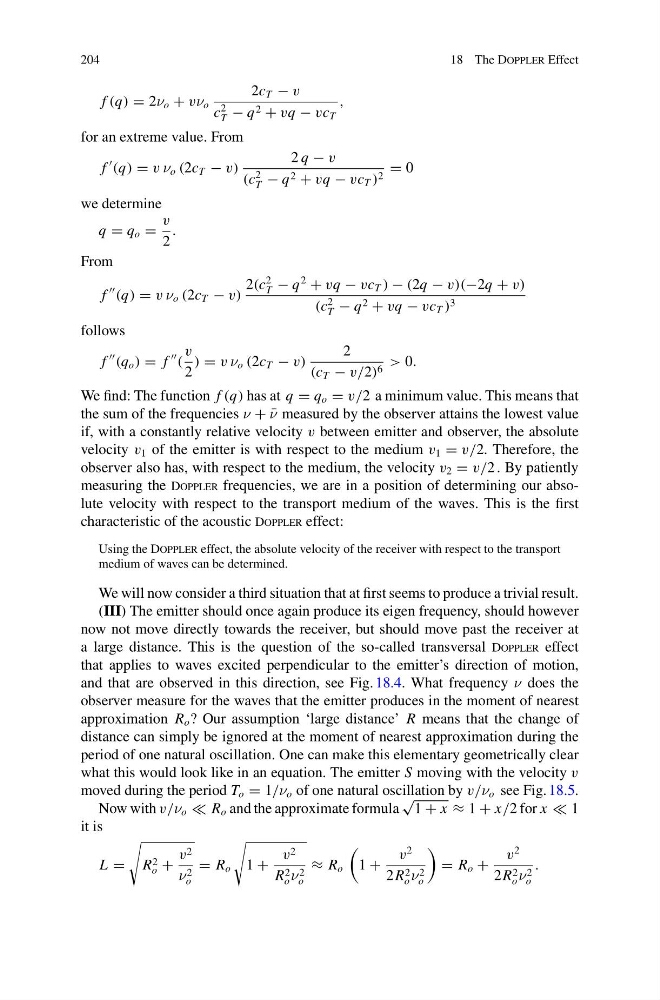
f (q) = 2ν o + vν o
2c T − v
c
2
T − q 2 + vq − vc T
,
for an extreme value. From
f
(q) = v ν o (2c T − v)
2 q − v
(c
2
T − q 2 + vq − vc T ) 2 = 0
we determine
q = q o =
v
2
.
From
f
(q) = v ν o (2c T − v)
2(c
2
T − q
2
+ vq − vc T ) − (2q − v)(−2q + v)
(c
2
T − q 2 + vq − vc T ) 3
follows
f
(q o ) = f
(
v
2
) = v ν o (2c T − v)
2
(c T − v/2) 6 > 0.
We find: The function f (q) has at q = q o = v/2 a minimum value. This means that
the sum of the frequencies ν + ¯
ν measured by the observer attains the lowest value
if, with a constantly relative velocity v between emitter and observer, the absolute
velocity v 1 of the emitter is with respect to the medium v 1 = v/2. Therefore, the
observer also has, with respect to the medium, the velocity v 2 = v/2 . By patiently
measuring the Doppler frequencies, we are in a position of determining our absolute velocity with respect to the transport medium of the waves. This is the first
characteristic of the acoustic Doppler effect:
Using the Doppler effect, the absolute velocity of the receiver with respect to the transport
medium of waves can be determined.
We will now consider a third situation that at first seems to produce a trivial result.
(III) The emitter should once again produce its eigen frequency, should however
now not move directly towards the receiver, but should move past the receiver at
a large distance. This is the question of the so-called transversal Doppler effect
that applies to waves excited perpendicular to the emitter’s direction of motion,
and that are observed in this direction, see Fig. 18.4. What frequency ν does the
observer measure for the waves that the emitter produces in the moment of nearest
approximation R o ? Our assumption ‘large distance’ R means that the change of
distance can simply be ignored at the moment of nearest approximation during the
period of one natural oscillation. One can make this elementary geometrically clear
what this would look like in an equation. The emitter S moving with the velocity v
moved during the period T o = 1/ν o of one natural oscillation by v/ν o see Fig. 18.5.
Now with v/ν o R o and the approximate formula
√
1 + x ≈ 1 + x/2 for x 1
it is
L =
R 2
o +
v 2
ν 2
o
= R o
1 +
v 2
R 2
o ν 2
o
≈ R o
1 +
v
2
2R 2
o ν 2
o
= R o +
v
2
2R 2
o ν 2
o
.
18 The Doppler Effect
f (q) = 2ν o + vν o
2c T − v
c
2
T − q 2 + vq − vc T
,
for an extreme value. From
f
(q) = v ν o (2c T − v)
2 q − v
(c
2
T − q 2 + vq − vc T ) 2 = 0
we determine
q = q o =
v
2
.
From
f
(q) = v ν o (2c T − v)
2(c
2
T − q
2
+ vq − vc T ) − (2q − v)(−2q + v)
(c
2
T − q 2 + vq − vc T ) 3
follows
f
(q o ) = f
(
v
2
) = v ν o (2c T − v)
2
(c T − v/2) 6 > 0.
We find: The function f (q) has at q = q o = v/2 a minimum value. This means that
the sum of the frequencies ν + ¯
ν measured by the observer attains the lowest value
if, with a constantly relative velocity v between emitter and observer, the absolute
velocity v 1 of the emitter is with respect to the medium v 1 = v/2. Therefore, the
observer also has, with respect to the medium, the velocity v 2 = v/2 . By patiently
measuring the Doppler frequencies, we are in a position of determining our absolute velocity with respect to the transport medium of the waves. This is the first
characteristic of the acoustic Doppler effect:
Using the Doppler effect, the absolute velocity of the receiver with respect to the transport
medium of waves can be determined.
We will now consider a third situation that at first seems to produce a trivial result.
(III) The emitter should once again produce its eigen frequency, should however
now not move directly towards the receiver, but should move past the receiver at
a large distance. This is the question of the so-called transversal Doppler effect
that applies to waves excited perpendicular to the emitter’s direction of motion,
and that are observed in this direction, see Fig. 18.4. What frequency ν does the
observer measure for the waves that the emitter produces in the moment of nearest
approximation R o ? Our assumption ‘large distance’ R means that the change of
distance can simply be ignored at the moment of nearest approximation during the
period of one natural oscillation. One can make this elementary geometrically clear
what this would look like in an equation. The emitter S moving with the velocity v
moved during the period T o = 1/ν o of one natural oscillation by v/ν o see Fig. 18.5.
Now with v/ν o R o and the approximate formula
√
1 + x ≈ 1 + x/2 for x 1
it is
L =
R 2
o +
v 2
ν 2
o
= R o
1 +
v 2
R 2
o ν 2
o
≈ R o
1 +
v
2
2R 2
o ν 2
o
= R o +
v
2
2R 2
o ν 2
o
.