

202
18 The Doppler Effect
towards O with the velocity c T whilst O moves towards the wave crest with the
velocity v. Thus, the distance λ o is bridged by a total combined velocity of c T + v
and the time needed for this is
T =
λ o
c T + v
=
c T
ν o
1
c T + v
=
1
ν o
1
1 + v/c T
.
The moving observer registers a frequency of ν = 1/T according to
ν = ν o
1 +
v
c T
.
Doppler effect
Moving observer
(230)
We count v > 0 for an approach between emitter and observer.
The Doppler effect for a moving observer (230) only coincides with the approximation formula (229a) of the Doppler effect for a moving emitter. In such a case
that velocities v are far smaller than sound velocity c T , and only in such cases, is it
of no difference if either the emitter or the observer move. However, the principle
difference between Eqs. (229) and (230) for the Doppler effect of a moving emitter
or observer respectively has a profound consequence that we now wish to discuss.
Up to now, we have taken it as granted that we could determine the velocity v of the
emitter or the observer with respect to the prescribed motionless state of the medium
in which the wave propagation took place. We therefore had to know previously
which is the state of rest for the medium. We will now drop this assumption.
We will now only assume that the emitter (per construction) produces its eigen
frequency and that the emitter moves towards the observer with the velocity v. The
velocity v is therefore the relative velocity between emitter and observer that we note
as v = v 1 + v 2 . Here v 1 = q is the unknown, absolute emitter velocity with respect
to the medium, and v 2 once again the calculated, with opposite sign, absolute velocity
of the observer with respect to the medium, whereby the observer is positioned to
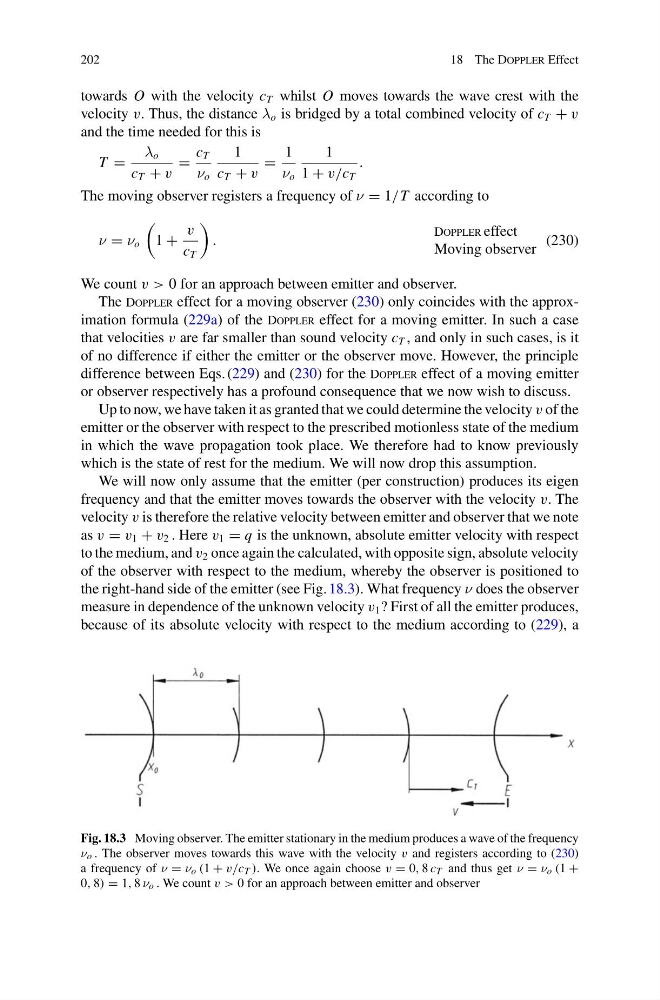
the right-hand side of the emitter (see Fig. 18.3). What frequency ν does the observer
measure in dependence of the unknown velocity v 1 ? First of all the emitter produces,
because of its absolute velocity with respect to the medium according to (229), a
Fig. 18.3 Moving observer. The emitter stationary in the medium produces a wave of the frequency
ν o . The observer moves towards this wave with the velocity v and registers according to (230)
a frequency of ν = ν o (1 + v/c T ). We once again choose v = 0, 8 c T and thus get ν = ν o (1 +
0, 8) = 1, 8 ν o . We count v > 0 for an approach between emitter and observer
18 The Doppler Effect
towards O with the velocity c T whilst O moves towards the wave crest with the
velocity v. Thus, the distance λ o is bridged by a total combined velocity of c T + v
and the time needed for this is
T =
λ o
c T + v
=
c T
ν o
1
c T + v
=
1
ν o
1
1 + v/c T
.
The moving observer registers a frequency of ν = 1/T according to
ν = ν o
1 +
v
c T
.
Doppler effect
Moving observer
(230)
We count v > 0 for an approach between emitter and observer.
The Doppler effect for a moving observer (230) only coincides with the approximation formula (229a) of the Doppler effect for a moving emitter. In such a case
that velocities v are far smaller than sound velocity c T , and only in such cases, is it
of no difference if either the emitter or the observer move. However, the principle
difference between Eqs. (229) and (230) for the Doppler effect of a moving emitter
or observer respectively has a profound consequence that we now wish to discuss.
Up to now, we have taken it as granted that we could determine the velocity v of the
emitter or the observer with respect to the prescribed motionless state of the medium
in which the wave propagation took place. We therefore had to know previously
which is the state of rest for the medium. We will now drop this assumption.
We will now only assume that the emitter (per construction) produces its eigen
frequency and that the emitter moves towards the observer with the velocity v. The
velocity v is therefore the relative velocity between emitter and observer that we note
as v = v 1 + v 2 . Here v 1 = q is the unknown, absolute emitter velocity with respect
to the medium, and v 2 once again the calculated, with opposite sign, absolute velocity
of the observer with respect to the medium, whereby the observer is positioned to
the right-hand side of the emitter (see Fig. 18.3). What frequency ν does the observer
measure in dependence of the unknown velocity v 1 ? First of all the emitter produces,
because of its absolute velocity with respect to the medium according to (229), a
Fig. 18.3 Moving observer. The emitter stationary in the medium produces a wave of the frequency
ν o . The observer moves towards this wave with the velocity v and registers according to (230)
a frequency of ν = ν o (1 + v/c T ). We once again choose v = 0, 8 c T and thus get ν = ν o (1 +
0, 8) = 1, 8 ν o . We count v > 0 for an approach between emitter and observer