

200
18 The Doppler Effect
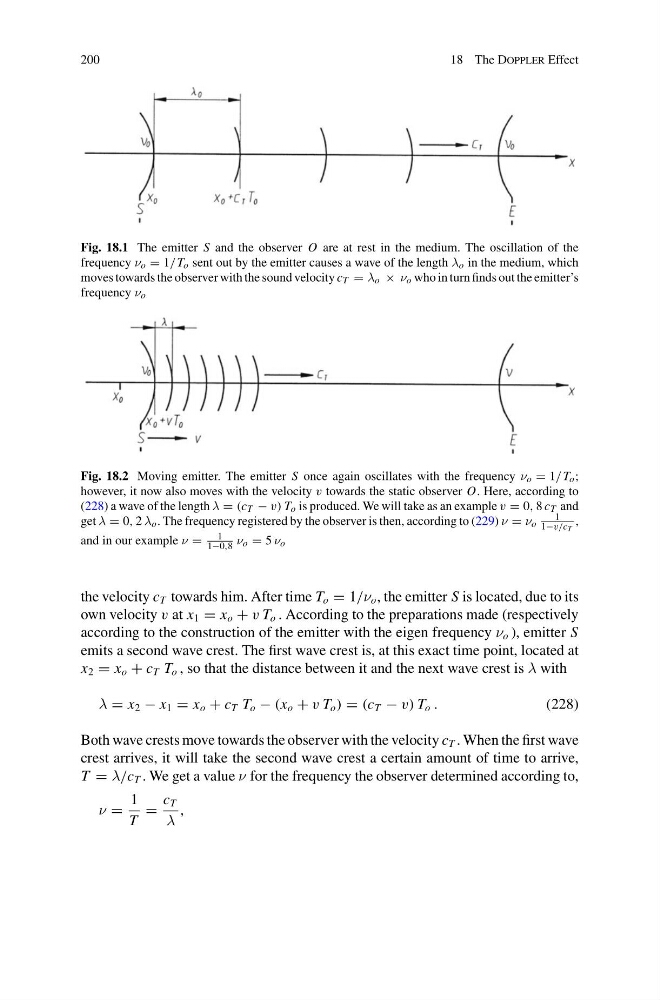
Fig. 18.1 The emitter S and the observer O are at rest in the medium. The oscillation of the
frequency ν o = 1/T o sent out by the emitter causes a wave of the length λ o in the medium, which
moves towards the observer with the sound velocity c T = λ o × ν o who in turn finds out the emitter’s
frequency ν o
Fig. 18.2 Moving emitter. The emitter S once again oscillates with the frequency ν o = 1/T o ;
however, it now also moves with the velocity v towards the static observer O. Here, according to
(228) a wave of the length λ = (c T − v) T o is produced. We will take as an example v = 0, 8 c T and
get λ = 0, 2 λ o . The frequency registered by the observer is then, according to (229) ν = ν o
1
1−v/c T
,
and in our example ν =
1
1−0,8 ν o = 5 ν o
the velocity c T towards him. After time T o = 1/ν o , the emitter S is located, due to its
own velocity v at x 1 = x o + v T o . According to the preparations made (respectively
according to the construction of the emitter with the eigen frequency ν o ), emitter S
emits a second wave crest. The first wave crest is, at this exact time point, located at
x 2 = x o + c T T o , so that the distance between it and the next wave crest is λ with
λ = x 2 − x 1 = x o + c T T o − (x o + v T o ) = (c T − v) T o .
(228)
Both wave crests move towards the observer with the velocity c T . When the first wave
crest arrives, it will take the second wave crest a certain amount of time to arrive,
T = λ/c T . We get a value ν for the frequency the observer determined according to,
ν =
1
T
=
c T
λ
,
18 The Doppler Effect
Fig. 18.1 The emitter S and the observer O are at rest in the medium. The oscillation of the
frequency ν o = 1/T o sent out by the emitter causes a wave of the length λ o in the medium, which
moves towards the observer with the sound velocity c T = λ o × ν o who in turn finds out the emitter’s
frequency ν o
Fig. 18.2 Moving emitter. The emitter S once again oscillates with the frequency ν o = 1/T o ;
however, it now also moves with the velocity v towards the static observer O. Here, according to
(228) a wave of the length λ = (c T − v) T o is produced. We will take as an example v = 0, 8 c T and
get λ = 0, 2 λ o . The frequency registered by the observer is then, according to (229) ν = ν o
1
1−v/c T
,
and in our example ν =
1
1−0,8 ν o = 5 ν o
the velocity c T towards him. After time T o = 1/ν o , the emitter S is located, due to its
own velocity v at x 1 = x o + v T o . According to the preparations made (respectively
according to the construction of the emitter with the eigen frequency ν o ), emitter S
emits a second wave crest. The first wave crest is, at this exact time point, located at
x 2 = x o + c T T o , so that the distance between it and the next wave crest is λ with
λ = x 2 − x 1 = x o + c T T o − (x o + v T o ) = (c T − v) T o .
(228)
Both wave crests move towards the observer with the velocity c T . When the first wave
crest arrives, it will take the second wave crest a certain amount of time to arrive,
T = λ/c T . We get a value ν for the frequency the observer determined according to,
ν =
1
T
=
c T
λ
,