

174
17 The Twin Paradox
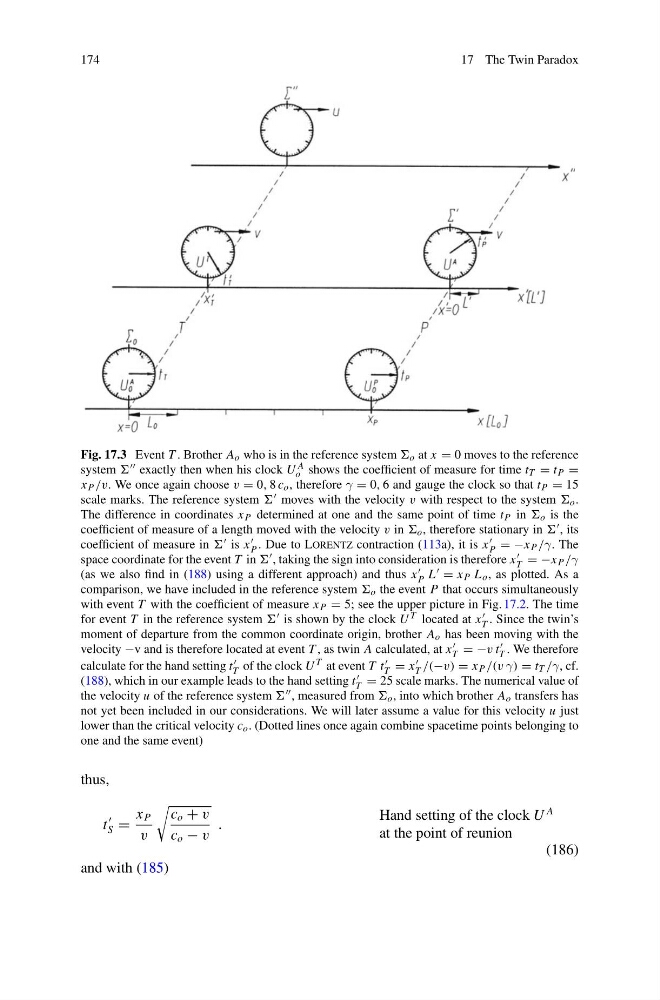
Fig. 17.3 Event T . Brother A o who is in the reference system o at x = 0 moves to the reference
system exactly then when his clock U A
o shows the coefficient of measure for time t T = t P =
x P /v. We once again choose v = 0, 8 c o , therefore γ = 0, 6 and gauge the clock so that t P = 15
scale marks. The reference system moves with the velocity v with respect to the system o .
The difference in coordinates x P determined at one and the same point of time t P in o is the
coefficient of measure of a length moved with the velocity v in o , therefore stationary in , its
coefficient of measure in is x
P . Due to Lorentz contraction (113a), it is x
P = −x P /γ. The
space coordinate for the event T in , taking the sign into consideration is therefore x
T = −x P /γ
(as we also find in (188) using a different approach) and thus x
P L = x P L o , as plotted. As a
comparison, we have included in the reference system o the event P that occurs simultaneously
with event T with the coefficient of measure x P = 5; see the upper picture in Fig. 17.2. The time
for event T in the reference system is shown by the clock U T located at x
T . Since the twin’s
moment of departure from the common coordinate origin, brother A o has been moving with the
velocity −v and is therefore located at event T , as twin A calculated, at x
T = −v t
T . We therefore
calculate for the hand setting t
T of the clock U T at event T t
T = x
T /(−v) = x P /(v γ) = t T /γ, cf.
(188), which in our example leads to the hand setting t
T = 25 scale marks. The numerical value of
the velocity u of the reference system , measured from o , into which brother A o transfers has
not yet been included in our considerations. We will later assume a value for this velocity u just
lower than the critical velocity c o . (Dotted lines once again combine spacetime points belonging to
one and the same event)
thus,
t
S =
x P
v
c o + v
c o − v
.
Hand setting of the clock U
A
at the point of reunion
(186)
and with (185)
17 The Twin Paradox
Fig. 17.3 Event T . Brother A o who is in the reference system o at x = 0 moves to the reference
system exactly then when his clock U A
o shows the coefficient of measure for time t T = t P =
x P /v. We once again choose v = 0, 8 c o , therefore γ = 0, 6 and gauge the clock so that t P = 15
scale marks. The reference system moves with the velocity v with respect to the system o .
The difference in coordinates x P determined at one and the same point of time t P in o is the
coefficient of measure of a length moved with the velocity v in o , therefore stationary in , its
coefficient of measure in is x
P . Due to Lorentz contraction (113a), it is x
P = −x P /γ. The
space coordinate for the event T in , taking the sign into consideration is therefore x
T = −x P /γ
(as we also find in (188) using a different approach) and thus x
P L = x P L o , as plotted. As a
comparison, we have included in the reference system o the event P that occurs simultaneously
with event T with the coefficient of measure x P = 5; see the upper picture in Fig. 17.2. The time
for event T in the reference system is shown by the clock U T located at x
T . Since the twin’s
moment of departure from the common coordinate origin, brother A o has been moving with the
velocity −v and is therefore located at event T , as twin A calculated, at x
T = −v t
T . We therefore
calculate for the hand setting t
T of the clock U T at event T t
T = x
T /(−v) = x P /(v γ) = t T /γ, cf.
(188), which in our example leads to the hand setting t
T = 25 scale marks. The numerical value of
the velocity u of the reference system , measured from o , into which brother A o transfers has
not yet been included in our considerations. We will later assume a value for this velocity u just
lower than the critical velocity c o . (Dotted lines once again combine spacetime points belonging to
one and the same event)
thus,
t
S =
x P
v
c o + v
c o − v
.
Hand setting of the clock U
A
at the point of reunion
(186)
and with (185)